Sadiya goes to school
Displaced and living with physical disability, a little girl takes her first steps into the future, with support from UNICEF and Education Cannot Wait.

In the eastern wing of Bakassi IDP camp, Maiduguri, north-east Nigeria, the soft sound of Sadiya Ali’s crutches is a familiar rhythm.
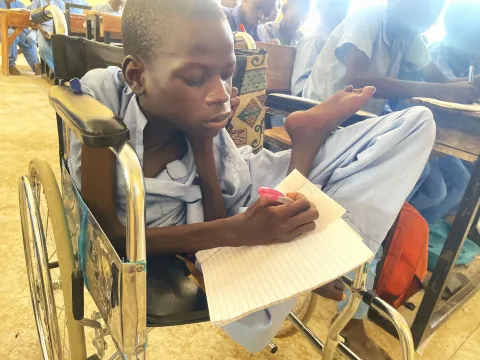
Two months earlier, the six-year-old girl had no crutches and had to crawl on the floor to reach her destination, including a community classroom for out-of-school children established by UNICEF in the camp.
Sadiya’s family had fled conflict in Gwoza, soon settling into a new routine at the Mairi Kuwait community in Maiduguri, where Sadiya was born in 2014. But a near-fatal road accident involving a sand truck in 2016 shattered Sadiya’s left leg, which had to be amputated. Sadiya was only two years old at the time.
“She has remained quiet since then. She chooses her friends carefully and does not talk much. She has come to rely only on Adamu, her stepbrother, who is now her best friend,’’ said Mariam Ali, Sadiya’s stepmother. Sadiya’s mother is separated from her father.
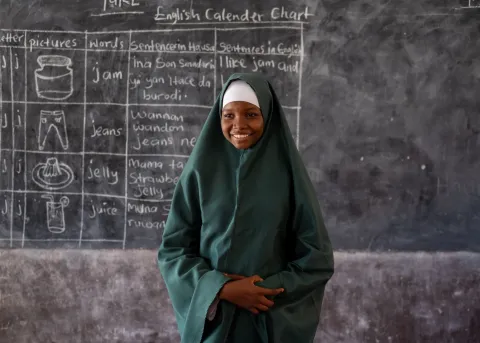
When UNICEF and the Restoration of Hope Initiative established 14 community classrooms at the camp in July 2020, Sadiya and Ali were among the first to enroll. The intervention, funded by the Education Cannot Wait (ECW), ensures children can continue to learn despite school closings due to COVID-19, and provides education supplies and school bags for the children. Ali Mohammad, a volunteer teacher paid by ECW, teaches Sadiya and 199 other children in four shifts.
Sadiya, who had never been enrolled in any formal learning before, attended either limping or riding on Adamu’s back.

But the little girl maintained her quiet disposition, talking only when spoken to.
“I discovered Sadiya when I went to monitor how the project was going,’’ said Phillip Gana Malgwi, a community mobiliser. “One day, I saw her limping to class. When she got tired, she sat on the bare road to rest before proceeding. I decided to get her a set of crutches, to encourage her. Schools in Borno will reopen next week, and I know that without help, Sadiya might not attend because it is a little further than the community classroom near her house,’’ said Malgwi.

Malgwi approached Benjamin John, programme manager at Restoration of Hope Initiative, who contacted a carpenter to design simple wooden crutches for Sadiya.
“Sadiya has improved. She is willing to learn. Now she is talking to other children in the class and responds to questions,” said teacher Ali Mohammad.
Since July 2020, UNICEF and the Restoration of Hope Initiative have established 97 temporary classrooms across 10 IDP camps in Maiduguri. All the learning points across the city operate in four shifts to mitigate the risk of COVID-19 infection and accommodate more children. A total of 16,224 children (9,254 of them girls), including Sadiya, access education in these learning points, facilitated by 150 volunteer teachers. Before the programme began, UNICEF organized intensive capacity building for the teachers on lesson delivery, COVID-19 mitigation, prevention of sexual exploitation and abuse and where to refer children experiencing challenges. The teachers receive a small monthly stipend, thanks to ECW.
Sadiya’s stepmother Mariam said that when schools reopen in Borno, her daughter will be enrolled formally. “Sadiya is like my child because she lives with me. Her mother does not live with us. She would like to be a medical doctor and I pray that it happens so that she can help others.’’