Hassan Goes to School, Finally
With funding support from Education Cannot Wait (ECW), a boy living with disability in Gwoza, northeast Nigeria enrolls in school and kick starts his ambition to become a lawyer in the future.

Call him a lawyer-to-be and Hassan Mohammed cracks up immediately. A thin smile spreads rapidly across his face all the way to his eyes and settles there. The warm glow stays. But, if you want more soul, ask the 17-year-old who lives in Gwoza, a conflict-affected community in northeast Nigeria why he desires to be a lawyer.
“I just want to help people in my community,’’ says the teenager who lives with disability in a heartbeat. “I want to help everyone around me,’’ he responds immediately.
At the Guduf Primary School in Gwoza. Hassan is quietly finding his way to that future where a court wig and gown await him.
But the road to this new beginning was rough. Hassan had always wanted to enroll in school, but his father was not enthusiastic about it.
“I was enrolled in school some years back but I dropped out because my father thought it was a waste of time because of my condition. I am the first child and all my siblings were enrolled in school. I was the only one who had to drop out. I didn’t like it all but there was nothing I could do about,’’ he says.
Hassan’s dreams to be a lawyer were abruptly aborted for three years until a new education intervention called Accelerated Basic Education Programme (ABEP) revived them. Funded by the Education Cannot Wait (ECW), the ABEP is a component of the Multi-year Resilience Programme implemented across northeast Nigeria. Now in its second phase, it targets vulnerable out-of-school children by providing afternoon catch up literacy and numeracy classes. Children like Hassan attend the classes for nine months after which they are enrolled in formal classes.
In Gwoza, UNICEF, Norwegian Refugee Council (NRC) and partner, Grow Strong Foundation (GSF), in collaboration with the Borno State Government, have enrolled 832 children in the ABEP programme. Through this intervention, conflict-affected children are being empowered with skills to transform their lives, resist exploitation and lead healthy lives.

For children like Hassan, access to education is a lifeline. Children with disability living in northeast Nigeria, a region impacted by protracted conflict, deal with multiple barriers, including exclusion from education opportunities.
For Hassan, returning to the classroom proved to be an uphill task that he eventually overcame. “I had to tell my grandmother and mother to help me beg my father before he allowed me to enroll in the ABEP classes. After that, I started formal school and I am happy that there has been no interruption,’’ he adds.
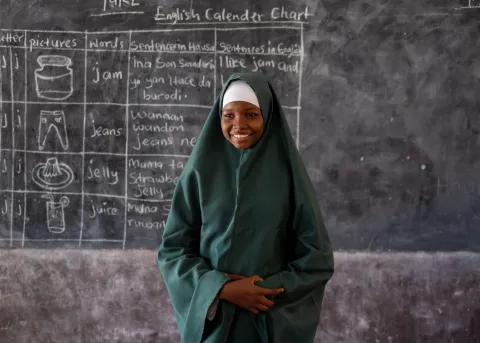
Hassan is a quiet child. But English Language classes bring him alive. Together with his best friends – Abdullahi and Adamu, school is all that they dream of.
“What I love most about coming to school is the people. I used to be home alone while everyone either goes to farm, market or school. I had no company. But it is different in school. I love the noise and I have new friends here,’’ he says.
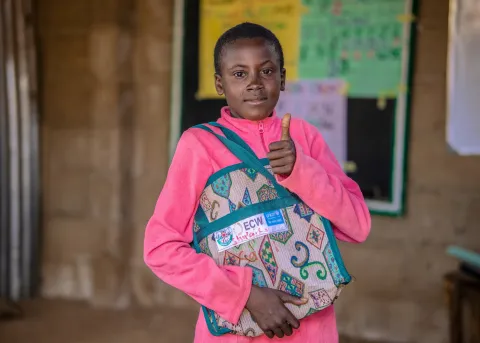
To improve access to education and school enrollment, UNICEF and GSF are providing free learning materials and uniforms to Hassan and other vulnerable children. Teachers in the ABEP schools are also being trained to boost education quality and learning outcome.