How One Teacher Opens the Classroom to Children with Hearing Loss
A teacher trained on the use of an innovative learning method in northeast Nigeria finds a way to expand its benefits to more children

When children at the Yerwa Special Primary School in Maiduguri, northeast Nigeria resume for the new academic term, the biggest smiles on their faces will be easily traced to Adamu Muhammad, their volunteer teacher.
For these learners who live with different disabilities, the 27-year-old teacher is a hero who single-handedly transformed the learning experience of children at the school.
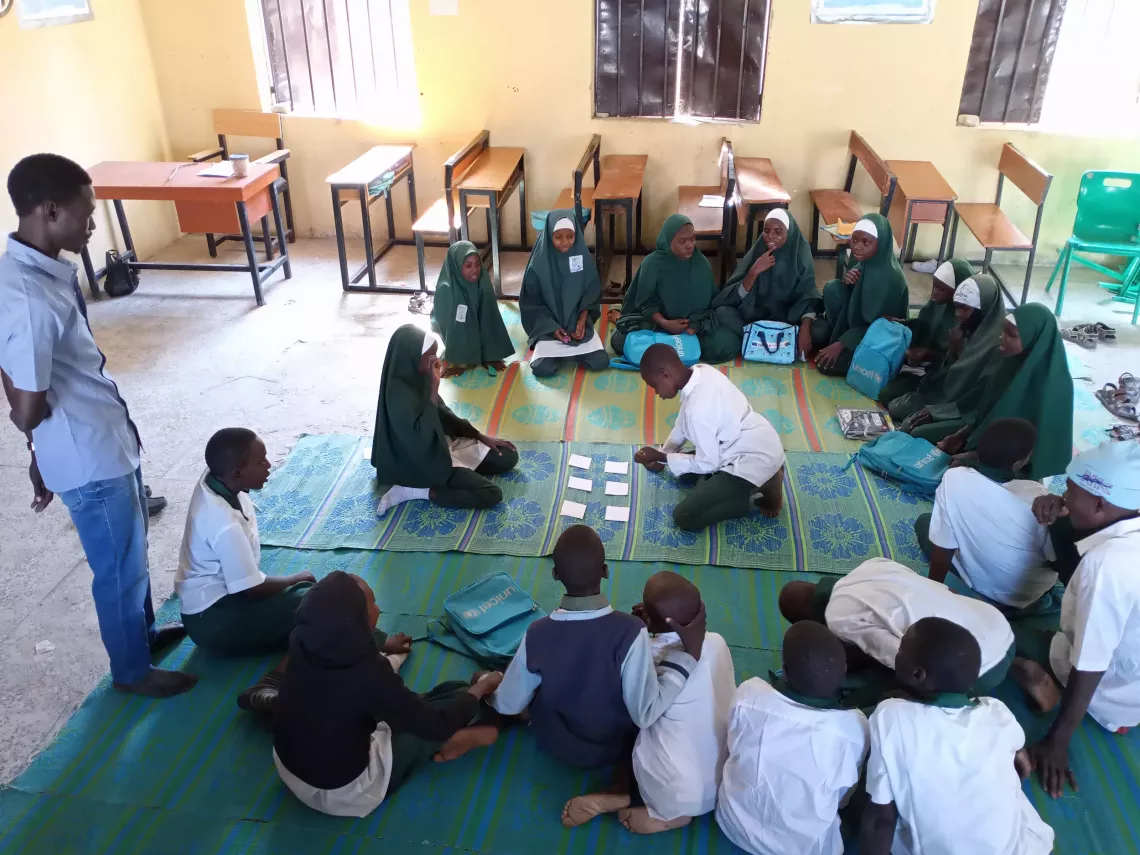
“I am one of the teachers trained by UNICEF on the use of the Teaching at the Right Level methodology for the benefits of learners. It is the best teaching method I have ever seen as a teacher. For teachers, it helps us to assess the learning needs of our students and support them based on their levels.
“The methodology is good for children. Many of them can now read and write at different degrees. This is something that they could not do before. Majority of the children have improved and are now proud of themselves,’’ he said.
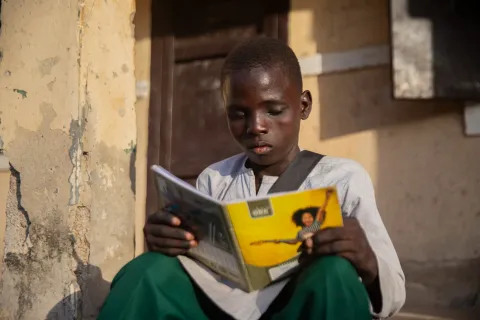
But, being a special school, a crop of children appeared left behind in the transformative learning process. Over time, Adamu noticed that children with hearing impairment could not benefit from the new methodology. During classes, the high pitch sounds of phonetics and alphabets literally fell on deaf ears.
That was the turning point for Adamu, who decided to address this problem.
"It is very challenging for children with hearing loss to learn with the new methodology. There were specific challenges such as the identification of letter sound, difficulty in social interaction, and self-esteem.
I took it upon myself to learn sign language so that I can support them. I paid for a short course and managed to learn sign language in two months. After four months, I noticed that there has been a rapid improvement in their literacy and numeracy skills. The children can make and read sentences in both Hausa and English languages. They can also solve two-by-two addition and subtraction’’

Funded through the Partnership for Learning for All in Nigeria (PLANE) of the Foreign, Commonwealth and Development Office (FCDO), the TaRL methodology is helping to address learning poverty, and improving education outcomes for thousands of children affected by conflict across the northeast region.
For children living with disabilities, the challenges are even more daunting in the realization of their human rights. According to a 2022 UNICEF Fact Sheet on Children with Disabilities, nearly 240 million children – 1 in 10 children live with disabilities globally. In addition to child protection violations, children living with disabilities are more likely to be excluded from opportunities and participation.
“Children with disabilities are 25 per cent less likely to attend early childhood education, 49 per cent more likely to have never attended school, 47 per cent more likely to be out of primary school, 33 per cent more likely to be out of lower secondary school and 27 per cent more likely to be out of upper secondary school,’’ said the report.
In northeast Nigeria, protracted conflict has contributed significantly to the collapse of essential services and support system to protect the most vulnerable. As government, communities and households rebuild their lives, children with disabilities still find themselves having the short end of the stick.
However, Adamu’s solution for children living with hearing impairment highlights the power of individual initiative and that change can be effective at the individual level. Leveraging his professionalism, the teacher is pushing the frontier of support for children affected by conflict and disability.
“I am satisfied that all the children in the school can benefit from TaRL. I devoted my personal resources to learn basic sign language but the reactions on the faces of the children nearly always bring me to tears. I would gladly do it again,’’ he said.