Learning in the Shadow of Flood Waters
Half a school term after a devastating flood swooped on Maiduguri, northeast Nigeria, UNICEF is ensuring learning continuity for displaced children

Until eight weeks ago, Fatima Mustapha did not know any of the 29 girls in her class at the Gubio IDP Camp in Maiduguri, northeast Nigeria.
Born into various families with varying socio-economic circumstances, the girls were strangers displaced by rampaging floodwaters that sacked their homes, farmlands, and schools.
Before the flood, Fatima attended the Iman Secondary School in the Kayeri area of the city, where she was in her final year of junior secondary school. The 15-year-old loved basic science and aspired to be a nurse.
But the flood of September 9 not only decimated her home, it collapsed the school structure and disrupted learning activities.
My school was located directly behind the University of Maiduguri Teaching Hospital." Occasionally, we would hear the sirens of ambulances filtering in from the hospital. When that happens, our teachers usually stop teaching for a few minutes before continuing the classes. It was like a breather whenever it happened, recalled Fatima.
I lost my books and uniforms in the flood. There was nothing left of our belongings. My father moved us here because there was nowhere else to go. I really missed school. Fatima continued, "People are helping us here, but I would love it if we could get support to return to our house.
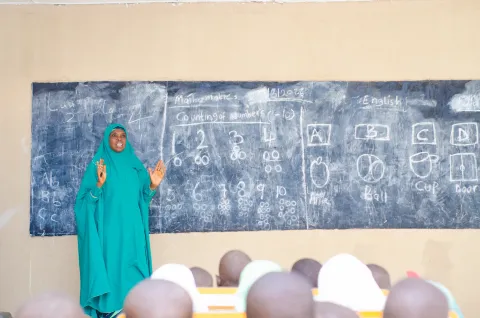
Now living at the Gubio IDP Camp in Maiduguri, northeast Nigeria, Fatima is navigating displacement with new friendships and radio learning classes. In collaboration with the Borno State Government and the Unique Care and Support Foundation (CASFOD), UNICEF is providing radio learning services for children like Fatima in flood-affected communities like Dikwa, as well as Gubio and Bakassi IDP camps in Maiduguri.

With funding from Education Cannot Wait (ECW) and the Self-Inclusive Learning and Skills (SILSA) project of the Norwegian Government, UNICEF is ensuring education continuity for over 10,000 children across three locations affected by flooding in Borno State.
To improve the quality of learning and outcomes for the children unexpectedly forced out of their schools, UNICEF is also providing dignity kits, writing materials, and other learning supplies. In addition, UNICEF recruited 110 volunteer teachers to support these children across the centres.
Fatima was at first intrigued by the radio learning classes.
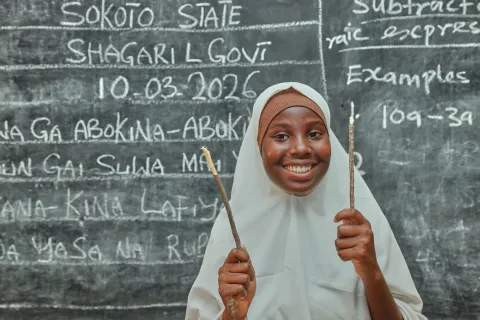
On my first day in the class, I was pleasantly surprised. I had never taken a radio learning class before, as my teachers used chalkboards to teach. We learned about the skeletal system yesterday, and I found it interesting. I want to be a nurse because I want to help women, she added.
With Mighty Zacchaeus, the volunteer teacher, the classroom is always fun, as learning sessions are always followed by counselling on confidential issues.
Mustapha has found a fast friend in Zara, another girl displaced by flood from Magumeri, another section of the city.
The girls are excited to come to class. None of them was out of school prior to the flood. So, it is easy for them to be responsive in class. I see them as my little sisters because they share other matters with me, said Zacchaeus.