Where Faith Meets the Future: Reimagining Learning for Out of School Children in Northern Nigeria
How innovative education is reshaping the out of school narrative in northern Nigeria

At first glance, the scene feels timeless.
A modest Qur’anic learning space. Children seated on woven mats. Wooden slates held in small hands. Voices rising and falling together in rhythmic recitation of verses from the Holy Qur’an.
Girls and boys sit side by side, separated only by tradition, not opportunity. Their faces reflect focus, joy, and a deep sense of belonging.
But look closer, and something quietly transformative comes into view.
Alongside Qur’anic inscriptions, wooden slates carry English alphabets. The walls display numbers, letters, and simple words. Then the rhythm shifts.
The echoes change.
Arabic verses give way to English sounds.
A, B, C, D, E.
Same room. Same children. Same energy.
A broader future taking shape.
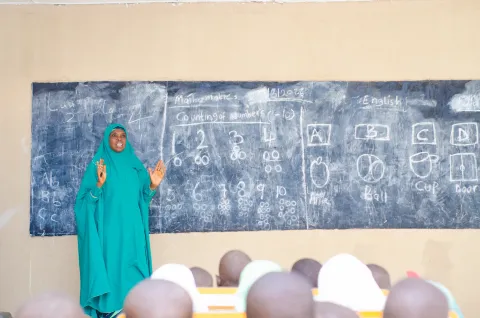
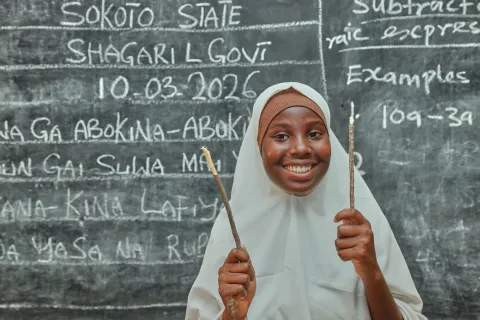
At the front of the class stands Asiya Aminu, 15, confidently guiding her peers through the English alphabet. Using a simple stick as a pointer, she leads the lesson with ease.
When asked whether she attends a western school, she smiles.
“This is my western school. Here, we learn both Islamic and western education.”
She speaks with excitement about learning English.
“It amazes me how I learn the alphabets and still have fun.”
Asiya dreams of becoming a doctor, to help people in need. From a family of 17 children, four of her siblings are enrolled in the same integrated school, a sign of growing trust in this blended approach to learning.
In another school across the northern state of Sokoto, 13-year-old Jafar Zayyanu is also thriving. “I learned how to read and write in this school,” he says proudly.
Beyond academics, Jafar values the care he receives. “Even when I’m sick, Malam Muhammad checks on me.”
He hopes to become an engineer one day.

For families, acceptance of integrated Qur’anic education is steadily growing. Balarabe Salihu, 80, Jafar’s grandfather, enrolled all his grandchildren by choice. “I support the merging of Islamic and western education because it gives them more opportunities,” he says.
Reflecting on his own childhood, he adds, “I cannot deny my grandchildren what I was denied as a young boy. Some advised me to withdraw them, but they do not share the vision I have for their future.”
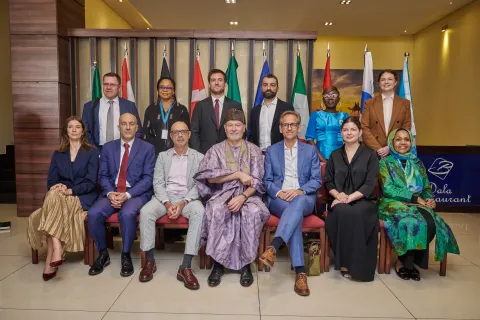
Through support from the European Union, under the Education and Youth Empowerment (EYE) Project, 100 Integrated Qur’anic Schools have been established across 10 local government areas in northern Nigeria, enrolling more than 10,000 children, with an average of 100 learners per centre.
The initiative promotes enrolment, retention, and transition into formal education, directly contributing to efforts to reduce the number of out-of-school children in the region.
In classrooms where Qur’anic verses and English alphabets now coexist, learning is no longer divided. It is integrated, inclusive, and hopeful, offering children like Asiya and Jafar not just knowledge, but dignity, choice, and a future full of possibility.