The Girl with the Sticks
How a handful of sticks in a classroom in northern Nigeria helped a young girl discover the power of learning

The lesson began with a handful of sticks.
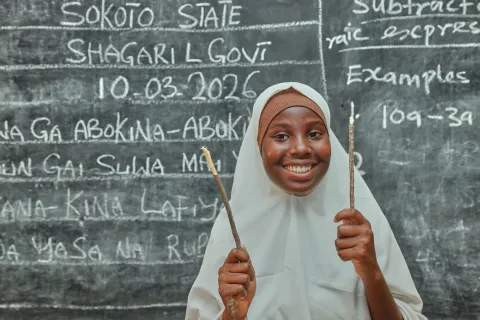
Inside a small classroom in Shagari town in Sokoto State, children sat closely together, leaning forward with curiosity as their teacher placed a few thin wooden sticks in their hands.
One stick.
Then another.
Two became three. Three became five.
For ten-year-old Rahima Muhammad, those sticks were not just part of a classroom exercise. They were the first tools that helped her understand numbers. Something clicked that day. What began as a simple activity slowly turned into something deeper, a quiet excitement about learning.
Four years later, Rahima still remembers those lessons vividly.
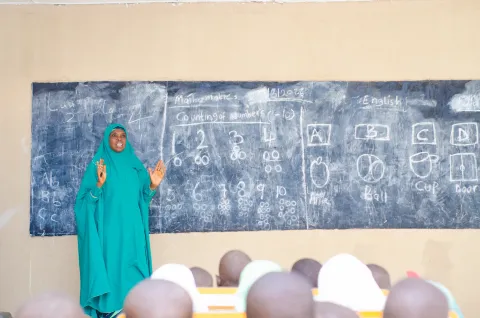
Back then she was a pupil at Magaji Bello Model Primary School. Her teacher, Malama Maimuna Abubakar, believed that learning should never feel like a burden. Her classroom was full of energy. Children sang while they studied. They played games to understand numbers. They told stories as they learned to read.
Sometimes, they learned with sticks.
“We used to study while singing and playing,” Rahima says, smiling at the memory.“School was always exciting. Our teacher made everything easy to understand.” But Malama Maimuna taught them far more than reading and arithmetic. “She also taught us how to take care of ourselves,” Rahima recalls. “She spoke about personal hygiene, about respect, about looking after one another. She treated us like her own children.”

Today Rahima is fourteen and studying in Junior Secondary School Two at Government Girls Secondary School in Shagari. School is more serious now. The lessons are harder. The expectations are higher.
Yet one thing has not changed.
She still loves learning.
For Rahima, the memory of Malama Maimuna remains deeply personal. The teacher who once guided her through those early lessons is no longer alive. But the impact she left behind continues to shape the lives of the children she taught.
Malama Maimuna began as a volunteer teacher, working for years without pay because she believed the children in her community deserved an education. She spent four years helping young learners master basic literacy and numeracy.
Her dedication did not go unnoticed. After receiving training through the Educate A Child programme, she was eventually recruited by the state education system, a recognition of her commitment and the difference she was making in the classroom.
Her husband, Nasiru Aliyu, remembers a time when he asked her to stop volunteering. “She was working so hard without any salary,” he says. Then members of the community came to speak with him. “They told me she was helping build a generation that could read and learn,” he recalls. “When I heard that, I understood how important her work was. From that moment, I supported her.”
Today, the children she taught carry her legacy forward.
Across Shagari, teachers say the training they received through the Educate A Child initiative changed the way they approached their classrooms. Malam Faruk, one of the teachers who benefited from the programme, says it helped educators break complex ideas into lessons that children could truly understand.
Since 2019, he estimates that he has taught more than two thousand students. Some of those children are now studying medicine. Others are pursuing engineering and other professional careers.
“For me, the greatest joy is seeing children excited about learning,” he says.
“But seeing them succeed later in life, that is what truly makes a teacher proud.”
His dedication eventually led to his promotion through the Teachers Service Board, allowing him to continue teaching at the secondary level.

At Magaji Bello Model Primary School, the effects have been visible far beyond individual classrooms. The school’s principal, Malam Muhammad Abubakar, says parents began to notice a change. “They started telling us that their children were understanding their lessons better,” he explains. Word spread through the community. Slowly, enrolment began to rise as more families saw the value of sending their children to school.
“Children are learning better now,” he says. “And that has encouraged more parents to enrol their children.”
For Rahima, education has opened something even bigger than good grades.
It has given her a dream.
She wants to finish secondary school, go to university, and become a lawyer.
“I want to help people,” she says with quiet determination.
Her story is part of a much larger effort. The Educate A Child programme, an initiative of the Education Above All Foundation, works across several countries to help children who would otherwise be left out of school.
Across twelve countries, the programme has helped more than four million children gain access to education and remain in school.
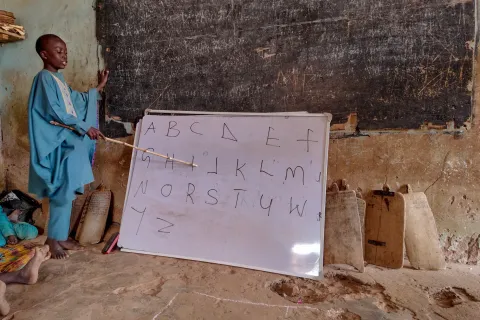
In Nigeria, thousands of teachers, head teachers, and facilitators have received training in literacy and numeracy instruction. Schools have received learning materials and support to strengthen classrooms and make learning more engaging for children. More than two thousand public and integrated Qur’anic schools have also been supported to improve the learning environment for students.
But for Rahima, the journey began with something very simple.
A few sticks in a classroom.
Small pieces of wood that helped her understand numbers.
Sticks that turned learning into laughter.
Sticks that sparked curiosity.
And from that small beginning grew something much bigger, a determination to keep learning, to build a future, and one day to stand up for others.
Sometimes, that is all it takes.
A committed teacher.
A simple tool.
And a child who begins to believe in her own possibilities.