An Impassioned Dislike for Polio
A lens through distinct experiences of two advocates fighting to end polio in their community.

Talatu Garba has witnessed the cruel face of polio. To her, it is not just a disease – it is a thief that steals laughter, movement, and sometimes, life itself from innocent children. “I’ve seen children diagnosed with polio, and by the following day, I hear they were dead,” she says, her voice heavy with memories. She has seen tiny legs that should be running, and dancing go still, paralyzed forever.
Talatu is a volunteer community health mobilizer (VCM) in Misau, a local government area (LGA) in Bauchi state, northern Nigeria. Earlier in her life, she worked as a traditional birth attendant. When the opportunity to become a UNICEF-supported VCM came about eight years ago, she embraced it. “I became VCM because I wanted to see more pregnant women visit health facilities,” she says.
VCMs are community-based volunteer health workers who encourage positive health-seeking behaviours and act as vital links between communities and health facilities.
Talatu has been heartbroken by what she has seen polio do to children. “As a mother, I feel the pain of a child affected by polio. They struggle to do the basic things children do. The sight of a child suffering from polio is a heartbreaking one,” she says.
This trained VCM knows polio is preventable. The vaccine is safe, free, and effective. But in Misau, many parents still hesitate. Fear and misinformation linger. Misau is one of 13 LGAs in Bauchi, where there are zero-dose children.

But Talatu refuses to give up. She knocks on doors, speaks to mothers, and fights on. She knows that every child vaccinated is protected from the cruelty she has seen too many times. “Having seen the damage polio does to children, I am determined to ensure that every mother understands the importance of vaccinating their children,” asserts a determined Talatu.
“I am the evidence”

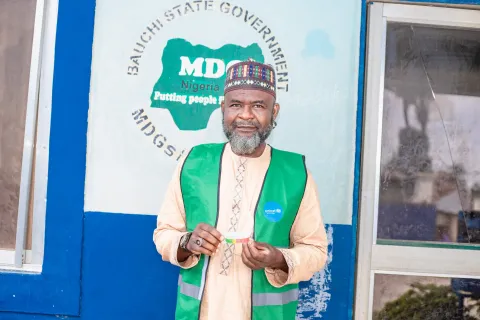
At 47, Balarabe Musa stands tall—in courage, resilience, and purpose. A polio survivor and a fellow resident of Misau, Balarabe knows firsthand how the disease robs children of their mobility and independence.
“As a boy, I watched other children run and walk to school while my elder brother had to carry me,” he recalls. The first painful awareness of his condition came around age 16. He had hoped to attend boarding school, but his father gently told him it was not possible because of his condition.
Nonetheless, Balarabe pushed through. He got an education, started a happy and healthy family, and built a meaningful life.

Now, he uses his own life as a cautionary tale – an example for other parents. "I am like this because I did not get vaccinated," he says.
When UNICEF introduced the "Fathers for Good Health (FFGH)" initiative in Bauchi state, Balarabe enthusiastically joined. The initiative enlists volunteer fathers to use informal networks to convince hesitant fathers about the importance of immunization for children.
Balarabe speaks with authority – from both faith and lived experience. "I use every opportunity to tell other fathers that religion does not forbid vaccines," he explains. "Vaccines protect our children. They give them a chance I never had." As both a father and a respected religious leader, when Balarabe speaks, people listen. "No one in my community says no when I talk to them about vaccines."
Voices for a dose of good news
Talatu and Balarabe have experienced the scourge of polio in different ways. Their respective personal stories fuel their passion. Talatu fights with the passion of a mother who has seen many children suffer. Balarabe, shaped by his own journey, fights with the quiet strength of a man who survived what no child should ever face. But they share a common goal in their commitment to spreading vaccine acceptance, protecting children in Misau from vaccine-preventable diseases, and ending polio once and for all.

As the world marks the 2025 World Immunization Week, UNICEF and its partners highlight a troubling resurgence of vaccine-preventable diseases – driven in part by misinformation. In this context, the work of dedicated grassroots advocates like Talatu and Balarabe has never been more vital.
In preparation for Nigeria’s national immunization campaign in April 2025, UNICEF and the government of Bauchi state—where more than 100,000 children are zero–dose—are intensifying awareness creation to improve compliance in the state. Together, they are supporting a network of 423 VCMs like Talatu and 1,130 members of the FFGH like Balarabe. The goal is simple: to reach every caregiver, every child, and every home with the dose of good news: Vaccines Save Lives.