Back and thriving: How Bakura found his voice again
Kidnapped outside his home in a community in northeast Nigeria, UNICEF is supporting a teenager to thrive again

It was a setting so surreal that it is etched in his mind to this day.
Bakura Bukar (not real name) and his friends were sitting by a makeshift bonfire to fight the early morning cold in 2023 when he was abducted. His father, Baba, had gone to the farm, while his mother and siblings were inside the house cooking.
For a while, he could hear their conversation floating through the cold air from the back of the house. Outside, Bakura and his friends greeted passersby, their hands tucked into their laps to keep warm.
Then the abductors came and stopped.
“My friends and I thought that they were just passing by,” says Bakura. “In fact, when they stopped by our bonfire, we thought they just wanted to keep warm before going their way.”
But the men asked Bakura and his friends to get up and follow them. The boys did not resist.
It was not until hours later that Bakura’s family realized that the 12-year-old had been abducted.
Bakura would remain in captivity for one year before he was rescued by security forces.
“We never attempted to escape because they were armed. We were just attending religious classes and helping them to farm. They did not beat or maltreat us. My friends and I became friends with the groups of children we met there,” he says.
For over twelve months, life in captivity continued for Bakura and his friends. The boys worked on farms and ran errands. During this period, they were denied their freedom of movement and access to formal education, immunization and other health services.
Nearly 20 years after armed conflict broke out in northeast Nigeria, children and adolescents in the region continue to suffer grave violations of their rights. These include killing and maiming, recruitment and use of children by armed forces and armed groups, sexual violence against children, abduction, attacks on schools and hospitals, and denial of humanitarian access.
Bama and surrounding communities are close to areas where armed groups operate. Children like Bakura remain vulnerable to abduction, recruitment and use by armed groups.
According to the 2025 Annual Report of the UN Secretary-General on Children and Armed Conflict, nearly 25,000 children were affected by grave violations of human rights during the year, the highest number registered in 30 years by the UN. With 40 per cent of global cases across fourteen conflict contexts, Africa has the highest overall number of violations against children in 2025.
For children who have experienced such violations, leaving captivity is only part of the journey. They also need support to deal with what they have experienced, rebuild relationships and regain a sense of normal life.
Through the European Union-supported Support for Disengagement, Review, Reintegration and Reconciliation (SD3R) project, UNICEF and its partner, Grow Strong Foundation (GSF), are providing psychosocial support to children and adolescents affected by conflict.
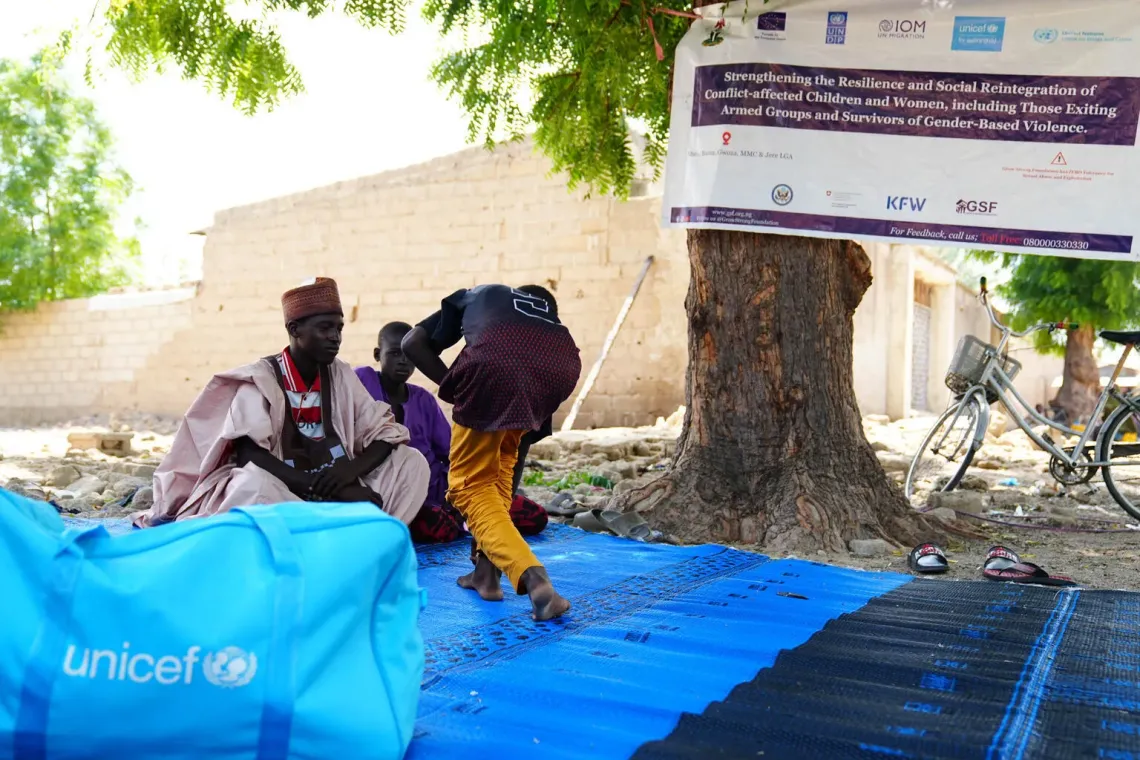
Through life skills sessions, drama and role play, children learn interpersonal skills and ways of solving problems without resorting to violence. They also learn positive coping mechanisms for dealing with peer pressure and personal challenges.
For Bakura, the sessions have become an important part of rebuilding his life.
Since his rescue and enrolment in one of the UNICEF-supported life skills centres in Bama, he has found a new community among other children recovering from difficult experiences. He particularly enjoys taking part in drama presentations and critical-thinking sessions.
“I have made new friends. I am happier and I am learning new things,” he says.
The changes extend beyond the centre. Bakura says he practices at home what he learns during the sessions. He plays football and now has time for leisure. In the evenings, he stitches caps to earn some money.
His next wish is simple: to return to school.
“Eventually, I hope to enrol in school in Bama,” he says. “When I am rich enough, I want to build a house and buy a car.”
For Bakura, these hopes are signs of a childhood slowly being reclaimed and a future he can once again imagine.