UNICEF and Partners Find High Economic Returns from Investing in Adolescent Girls in Northern Nigeria
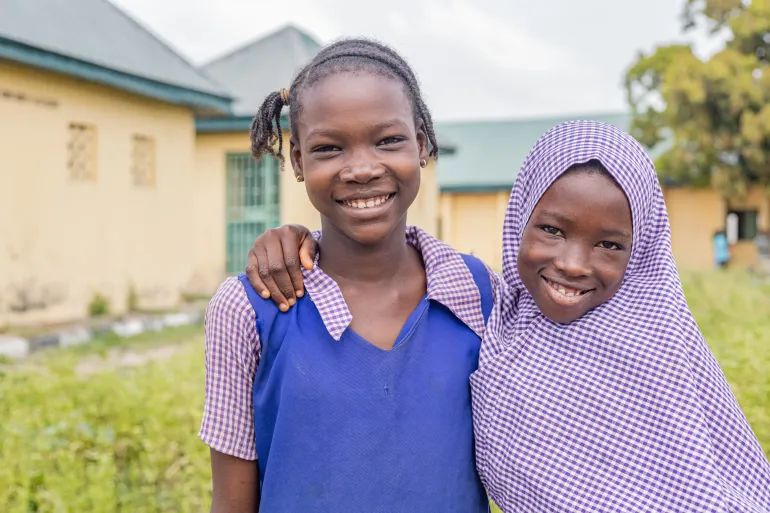
Abuja, Nigeria. December 11, 2025 - Investing in adolescent girls could significantly accelerate Northern Nigeria’s economic and social progress, according to new evidence presented earlier today in Abuja. The analysis found that if every girl in Northern Nigeria completes secondary school, child marriage could drop by up to two-thirds, adolescent pregnancy would decline sharply, and economic productivity would rise, breaking intergenerational cycles of poverty and deprivation.
Child marriage is a violation of human rights that denies girls their childhood, education, and opportunities for a better future. In Nigeria, where over 3.7 million women aged 20–24 were married before turning 18, the practice remains widespread, particularly in the northern regions. Despite progress shown in the latest Demographic and Health Survey (DHS 2024), nationally, one in three (33.4%) young women still marry before age 18, with rates close to 50 percent in the Northeast and Northwest. Child marriage undermines girls’ health, wellbeing, education, and future employability - perpetuating poverty and limiting Nigeria’s potential for inclusive growth.
Education is central to change. The median age at first marriage is 16.6 years among girls with no education but rises to 21.7 years for those who complete secondary school. Yet an estimated 7.6 million Nigerian girls remain out of school, half of them in the North.
At a high-level workshop today, government officials, development partners, and civil society organizations reviewed new evidence confirming that investing in adolescent girls is one of the most cost-effective investments Nigeria can make.
Supported by the Gates Foundation, the Accelerate Research Hub - a collaboration between the Universities of Oxford, Cape Town, and Witwatersrand - conducted a rigorous analysis of proven, cost-effective interventions to reduce child marriage, adolescent pregnancy, school dropout, and gender-based violence. Working closely with UNICEF, the Federal Ministry of Women Affairs, Girls Not Brides Nigeria, the Kaduna-based Centre for Girls Education, and other key partners, the study modeled the costs, impacts, and economic returns of a package of “accelerator” interventions tailored to high-prevalence northern states.
The study found that investments of US$114 million in support to all out-of-school girls aged 10-18 in two northern states could yield returns of $2.5 billion (₦3.6 trillion) in societal benefits – a 21:1 return on investment.
“This evidence underscores what we have always known - investing in girls is not only the right thing to do, it is the smart thing to do,” said Hajia Iman Sulaiman-Ibrahim, Minister of Women’s Affairs. “When girls learn, delay marriage, and realize their full potential, their families and communities flourish, with returns that extend for generations.”
The new analysis indicates that context-specific, bundled interventions targeted to adolescent girls, including safe spaces, accelerated education, support for school enrolment, and community engagement, could generate substantial returns for Nigeria in both economic productivity and improved health and wellbeing outcomes.
Participants from the federal government, state governments of Kano, Kaduna, Jigawa, Bauchi, and Katsina, as well as multilateral, donor, and civil society partners pledged to:
- Utilize the study’s findings to inform policies and programmes;
- Mobilise and reprogram resources to support evidence-grounded, context-specific, high-impact interventions informed by girls and their communities;
- Challenge harmful norms that perpetuate child marriage and restrict girls’ education; and
- Collaborate across all levels to support girls’ schooling and work to end child marriage in Nigeria.
These commitments advance progress towards the commitments made by the government of Nigeria at the 2024 Ministerial Conference to End Violence against Children, particularly those focused on the rollout of the strategies and costed action plans to end child marriage nationwide.
UNICEF Representative in Nigeria, Wafaa Saeed Abdelatef, said the data must translate into stronger action. “Every girl who stays in school and decides her own future adds to Nigeria’s strength,” she said. “Behind every statistic is a life filled with dreams and determination. This evidence reminds us that when Nigeria invests in its girls, it invests in a healthier, fairer, and more prosperous nation. We must turn this evidence into sustained action in every northern state.”
The event concluded with a shared call to scale up investments that enable every girl to learn, lead, and thrive, reaffirming that Northern Nigeria’s future progress depends on the success of its girls.
Click here to read the full report.
About the Accelerate Research Hub
The Accelerate Research Hub is an interdisciplinary partnership between the Universities of Oxford, Cape Town, and Witwatersrand that works with governments and development partners across Africa to identify and model cost-effective, adolescent-centred interventions that improve education, health, and protection outcomes.
Media contacts
About UNICEF
UNICEF works in over 190 countries and territories to save children’s lives, defend their rights, and help them reach their full potential, from early childhood through adolescence.
For more information about UNICEF and its work for children in Nigeria, visit www.unicef.org/nigeria