21 Years a Polio Warrior
A community vaccinator recounts her two-decade experience protecting children from polio and other childhood diseases in northeast Nigeria.

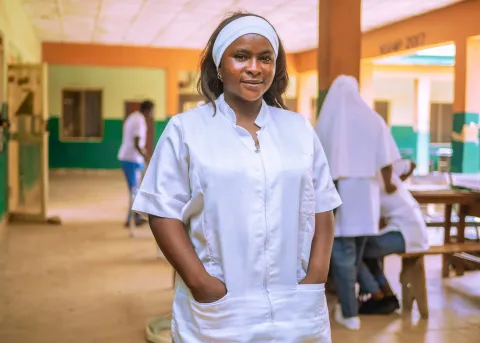
Hasiua Mohammed, a mobiliser in northeast Nigeria remembers the first community where she first vaccinated a child. The vaccine was for protection against polio, a deadly viral disease that mostly paralyses children. The community was Pawari, in the London Ciki area of Damaturu, Yobe State.
Pawari was the same community where she had got married a few years earlier and started raising two precocious toddlers. “I became a vaccinator, and my children were among the first set of children I vaccinated against different childhood diseases,’’ she says.
“Becoming a mobilizer was not difficult,’’ she adds. “I started from my neighbourhood and then other parts of my community. I had no reservation because immunization helps children to ward off diseases. Even the appearance of a child that is vaccinated is different from the one that is not,’’ she says.
That was 21 years ago. Many of the children vaccinated about two decades ago have left but Pawari has hardly changed. Its topography and landmarks remain nearly the same as they were 20 years back. This year, Hasiua herself turned 43.

“Many of the children I vaccinated have become mothers and left the community. I have continued the work because I enjoy the work and my community values me. Meeting women gives me joy, and I love helping people. I love counselling women and creating awareness. I am one of those who campaigned against home birth in my community. I am usually consulted on immunization schedules whenever there is a new birth. All my four grandchildren are fully immunized against childhood diseases’’.
According to 2023 Nigeria Demographic and Health Survey (NDHS), the number of vaccinated children in northeast Nigeria stands at 40.3 per cent, one of the lowest in the country.
To reach more children in northeast Nigeria with life-saving vaccines, UNICEF works with Government and donors like GAVI, Gates Foundation and the Government of Germany through KfW, to mobilize vaccination teams for routine immunization schedules and special campaigns.
Through mobilisers like Hasiua, UNICEF and Government in northeast Nigeria have been able to reduce the number of zero-dose children through hundreds of teams who work in fixed locations across IDP camps and communities.
Hasiua is part of a team of three mobilisers – a vaccinator, a recorder and an entertainer for the Directly Observed Oral Polio Vaccination (DoPV). Team members are usually part of the communities they serve. Like Hasiua, they have an existing bond with their neighbourhood and are well-positioned to address vaccine misinformation.

Compared to when she started, Hasiua says her job is easier these days. According to her, “women are now more receptive to vaccination teams. The resistance is not as much as it used to be. Misinformation used to be a huge problem. There was a phase that vaccination was believed to cause rashes in children. There was also a time when the myth that vaccination reduces population. As a team, we go around naming and wedding ceremonies to dispel these myths,’’ she adds.
The veteran vaccinator has advice for young vaccinators.
“My advice is that they should be patient with caregivers. Though people are more receptive now, vaccinators still experience resistance. So, patience is the name of the game. It is also important to be knowledgeable and attend training. I have personally witnessed a case that rashes did appear on a child after vaccination. Based on my knowledge, the rashes could have been waiting to happen and not a direct result of the vaccination. In a particular case, it disappeared a few days later and there was no other illness. The woman brought her other children for vaccination’'.