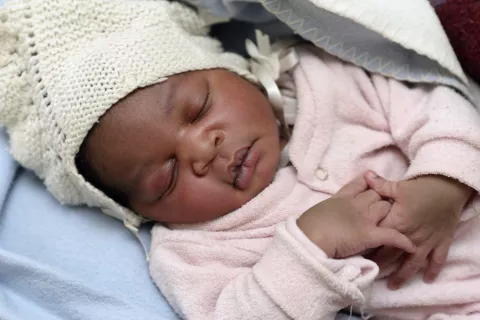
Reaching mothers with vital health information and support
Community health workers improving survival rates of mothers and newborns

October 2017 - Oshakati - At the Oshakati referral hospital, which services the region of Oshana in Namibia, more than 7 000 babies are delivered annually. Most of these babies are then discharged to communities such as Okaukamasheshe Village, located more than 60km away from the nearest health facility, making it difficult for mothers to seek immediate medical help when it is required.
Since 2015 when Hileni Ananias (28 years) was deployed as a Community Health Worker, she has played a significant role in closing the gap to health care which the long distances create. On each day of the week, she saddles her backpack of supplies onto her back and steps out to provide care and support to the villagers of Okaukamasheshe Village, especially the mothers before, during and after their pregnancies.
“As a Community Health Worker, we received a six months training before being deployed into the communities. Since that training, I have continued to be mentored by nurses from the hospital to ensure that am I always update with ways to give good care”, says Hileni, as she acknowledges the ongoing support and knowledge sharing that she receives from trained nurses from the main hospital.
Community Health Workers such as Hileni, have become an integral part of the health care system in Namibia, providing immediate care and support, especially to mothers and newborns.
The six months intensive training has a detailed module on community based maternal and new-born health. Community Health Workers are given skills and knowledge to overcome the barriers to effective new-born and maternal health care and contribute to the reduction of overall neonatal mortality rate from the current level of 20 per 1000 live birth.
Long distances from health care facilities, harmful socio cultural and traditional practices and lack of information are some of these barriers which are being handled by Hileni on a regular basis and which pose a threat to the survival rates of both the mother and the newborn.
Since April 2017, with support from Teck Resources and UNICEF health professionals, from the Oshana region are being capacitated with fresh knowledge and skills on how to provide focused antenatal care, lifesaving skills and new born care including Kangaroo Mother Care and new-born resuscitation.

Under an auspicious Every New-born Action Plan (ENAP), designed through an assessment of the main bottlenecks to maternal and neo natal survival, community of care of mothers and newborns has been identified as critical to improve survival rates of mothers and newborns - this is where Hileni and her 98 peers from the region come in.
Through their regular interface with their field mentors and hospital nurses, knowledge acquired through the manual to pose questions which help the mothers to properly identify early danger signs ENAP trainings is being cascaded to the CHW through regular field support visits.
Community Health Workers have therefore become a valuable vehicle to give community based support and providing new mothers with appropriate health education information, promoting optimum infant feeding practices, as well as early identification of problems.
As Hileni speaks passionately about the joy and relieve she has brought to many families in Okaukamasheshe Village, she also reveals how her training as a Community Health Worker has benefited even those close to her.
A few months ago, her younger sister’s procedure to repair a perineal tear after delivery was not properly done at the health facility. Weeks after the delivery and stitching up, her sister could barely find relief nor healing. She was in constant pain and discomfort and was even unable to attend to her new born because of the severe pain.
Hileni immediately contacted her hospital based mentors, who were able to give attention to her sister – not only was her live saved, but also that of the baby, who had been weaned off breastfeeding because of the mother’s condition.
“Many clients are sometimes shy to reveal information on what is wrong with them when they go to the clinic, especially if this is related to the genital area,” says Hileni, as she explains how she uses the field based pictorial manual to pose questions which help the clients to properly identify early danger signs. She then shares these finding with the hospital for support and treatment.
“Community Health Workers in Namibia contribute tremendously to the reduction of maternal and child morbidity and mortality in Namibia,” says UNICEF Representative, Micaela Marques de Sousa. “Where these cadres are deployed, the Ministry of Health and Social Services is assured of an indispensable community based structure to help in the prevention and response of health problems.”
Hileni’s passion about being a CHW is unquestionable and the personal bond she creates with the community pays off. Through her tireless efforts, more people are being drawn to Primary Health Centres to receive continuous treatment, care and support especially related to maternal and child health.