UNICEF programmes in Montenegro – setting good examples for ECA region
UNICEF’s Deputy Regional Director for Europe and Central Asia Phillippe Cori met with Montenegrin highest officials, ambassadors, children, parents and teachers during his visit to Montenegro

- Crnogorski
- English
UNICEF’s Deputy Regional Director for Europe and Central Asia Phillippe Cori met with Montenegrin highest officials, ambassadors, children, parents and teachers during his visit to Montenegro
PODGORICA, 26 OCTOBER 2019 – During his five-day visit to Montenegro, UNICEF’s Deputy Regional Director for Europe and Central Asia, Philippe Cori, together with the Prime Minister, Duško Marković, opened the National Conference on Early Childhood Development. Afterwards, he met with many parents, teachers, children and young people, as well as with the Deputy Prime Minister, Milutin Simović, Minister of Labour and Social Welfare, Kemal Purišić, and the Head of the EU Delegation to Montenegro, Aivo Orav.
I think that you have a development model that can be of help for others not only in the Western Balkans, but also in the European Union. I think that there are many things you can teach the European Union countries.
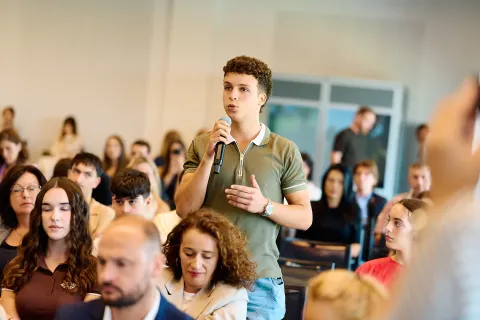
Talking to young people gathered around UNICEF youth programmes, Cori heard numerous ideas he believed to be useful for youth around Europe and the world.

The programmes you are pursuing here – the UPSHIFT, the U-Report and the programme for the development of socioemotional skills – do give an opportunity to young people to offer solutions for their local communities, to show what they can do themselves, and to learn in the process. I sincerely believe that this is a successful approach that could be replicated in many other countries
During his stay, the Deputy Regional Director visited preschool “Sunce” in Nikšić, where he talked to Roma children and parents on the importance of preschool education and support to children and families from the Roma community.
It all starts in preschool – if you manage to have inclusion in preschool context, it will result in greater level of engagement, inclusion and social cohesion later on – in primary school, secondary school and adulthood.
Talking with Cori, Alej Selim, a father of four children (including two attendingpreschool), said he was happy that his two younger children are learning and socialising with children from different backgrounds.
I am happiest when they themselves ask to be taken to preschool,” said Selim. “I think they will be well prepared when the time comes to start primary school.
Five-year-old Medina Itaj gave Cori a picture she had drawn with her preschool mates.

I like going to preschool a lot. I spend time with friends and play here.
Preschool education and early childhood development were discussed at the meeting Cori had with Milutun Simović, the Deputy Prime Minister for Economic Policy and Financial System. “Investing in early childhood development is crucial for any country’s economic prosperity,”
Cori said during the meeting.
During his visit to primary school “Mileva Lajović Lalatović” in Niksic, Cori said it was the task of the whole community to make inclusion work, and primarily of parents, teachers and children themselves.
You have to create a space for children to express themselves, to benefit from child-centred education programmes, not the ones imposed on them. Such curricula must include children facing adversities and children with disabilities, so that they are not left behind. I see a lot good investments, efforts and capacities for further development of inclusive education here.
He also met with the parents attending UNICEF supported Parenting for Lifelong Health programme, conducted in several Montenegrin municipalities since 2017 through collaboration of preschools, health clinics, Parents’ Association and the Pedagogical Centre.
This is a highly interesting and simple, but very impactful approach, which refers to positive attitude towards children. This is something done really simply over 12 sessions only, and with such a great impact resulting in very motivated parents, calm families and happy children.
At the end of his five-day visit, Cori said he had learned a lot in Montenegro. He added that programmes for children, youth and parents successfully conducted here with the support of UNICEF would provide a good model for the countries in the Europe and Central Asia Region.