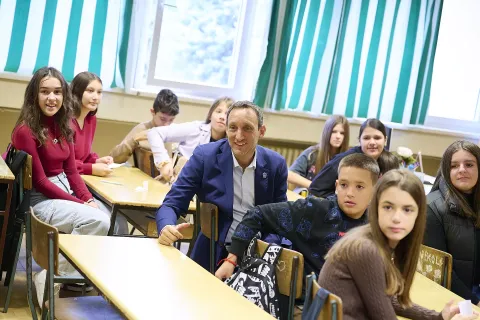
The “Prilike” programme – a chance for young people to apply their knowledge in practice
David is one of 450 secondary school students who has gained first-hand experience of a large business system

- Crnogorski
- English
- Shqip
PODGORICA, 8 March 2024 – “My family and friends won’t have to visit bank premises anymore, as I can explain loan terms to them and help them with the necessary documentation. My employer has thoroughly explained this whole process to me,” David Nikcevic, a 17-year-old student at Mirko Vesovic Economics Secondary School in Podgorica, proudly says.
David had the opportunity to peek into a large business system, gain practical knowledge and skills, and communicate with clients, thanks to UNICEF’s programme “Prilike”, implemented by the NGO ADP Zid, with financial support from the TUI Care Foundation.
By the end of July, approximately 450 secondary school students from three Montenegrin cities – Podgorica, Cetinje and Herceg Novi – will enjoy this opportunity and join the workforce of over 90 employers.
I didn’t quite expect the stark difference between theory and practice. During training, I had the opportunity to apply what I had learned in school and to make the first actual contact with clients.
He emphasizes that his colleagues made an effort to thoroughly explain everything to him.
“I highly appreciate how willing they were to repeat things multiple times to make it clearer for me,” David adds.
For him, the “Prilike” programme was a turning point – working for an employer solidified his decision to pursue his education after secondary school, particularly in the fields of banking and finance.
“Thanks to ‘Prilike’, I am now even more confident in my decision,” David concludes.
An analysis conducted by UNICEF and the European Training Foundation (ETF) in 2021 showed that, similar to their peers in the region, young people in Montenegro feel that their education does not prepare them for the job market. According to European Commission data, 27 per cent of young people in Montenegro aged 15 to 29 are not in employment, education or training.
Milena Scepanovic, Programme Assistant at ADP Zid, says that adolescents, especially those who do not attend secondary vocational schools, lack opportunities for practical training during formal education.

This is a great opportunity for them to familiarize themselves with their future profession and to understand whether what they have chosen is truly the career they want.
Throughout this programme, she explains, students gain “soft” skills such as teamwork and communication skills, and learn to manage their time properly.
“Once they find themselves in large companies and offices where 20 people are spending their working day, they learn about the importance of collaboration and communication with colleagues and clients,” Scepanovic emphasizes.
She adds that the project focuses on three cities and four secondary schools: the Gymnasium and the Economics Secondary School in Podgorica, the Mixed Secondary School in Herceg Novi, and the Gymnasium in Cetinje. She emphasized that the programme is being implemented in collaboration with schools this year.
Scepanovic expects the programme to gain future recognition so that adolescents can further train and acquire new knowledge necessary for the labour market.
The “Prilike” programme is beneficial for employers as well.
“This is an excellent opportunity for our company to engage with young people in time, to introduce them to micro-loans, and we hope to help them choose their future profession,” says Maja Boljevic, a representative of the company where David gained his first practical knowledge.
Secondary school students become familiar with operational tasks and how we communicate with clients and colleagues during the three-day internship. We are glad they will experience the business atmosphere and gain their first practical knowledge.

Jelena Raspopovic, David’s teacher, is very satisfied with the early results of the “Prilike” project.
She says that students have the opportunity to simulate work in a company through a subject course at their school, which they can later demonstrate in their work with employers.
“The ‘Prilike’ programme is very important for children because the knowledge they acquire can be applied through practical work with employers, allowing them to apply their knowledge in the labour market,” Raspopovic emphasizes, adding that students are sharing their experiences gained through this practice with their peers and motivating them to apply for the programme themselves.