A life free from infectious diseases – every child’s right, not a privilege
For Dr. Senad Begić, epidemiologist and parent, vaccines are a life-saving achievement of our time

- Crnogorski
- English
- Shqip
PODGORICA, 1 JULY 2025 – When Dr. Senad Begic speaks about vaccination, he does so both as a medical expert – an epidemiologist – and as a parent. For him, there is no doubt: vaccines are a milestone of civilization that save lives. That’s why his children are fully vaccinated.
“As a doctor, I have access to all relevant data, scientific analyses, and years of experience working in infectious disease prevention. As a parent, I have both the desire and the responsibility to do what is best for my children’s health. Timely vaccination is not a matter of personal feeling, nor is it solely based on professional knowledge and experience – it is about responsibility for their health and lives,” says Dr. Begic, UNICEF Montenegro’s Social and Behavioural Change Officer.
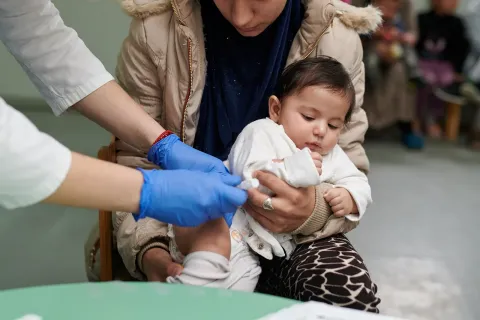
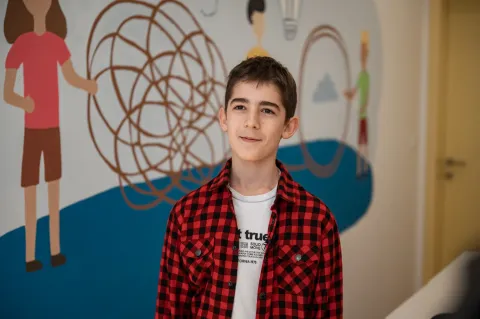
His son Fedja recently received his second dose of the MMR vaccine and is now ready for an important new chapter – starting school. After being vaccinated, he reassured his friends: “The vaccine wasn’t scary at all – it didn’t even hurt!”
Fedja’s simple sentence carries an important message, especially at a time when vaccination is increasingly met with skepticism, and misinformation spreads faster than viruses.
“Parents are often exposed online to various distorted facts and misinformation. One of these is the claim that healthcare professionals don’t vaccinate their own children. The truth is the opposite – I don’t know a single healthcare worker or colleague who hasn’t properly vaccinated their child,” Dr. Begic emphasizes.
Montenegro is among the countries in the region that has felt the most serious consequences of the COVID-19 pandemic. Immunization was one of the most impacted areas, although vaccination rates had already begun to decline before the pandemic. The COVID-19 crisis and increased exposure to misinformation further worsened the situation: coverage with the first dose of the MMR vaccine fell from 90% in 2010 to just 23% for children born in 2019. Thanks to a national campaign, nearly 2,000 more children were vaccinated in 2023 compared to the previous year, but coverage among preschool-aged children still remains at only 56%.
Data shows that the younger the child, the lower the vaccination rate. As of 1 July this year, only about 25% of children born in 2023 had received the first dose of the MMR vaccine, according to the Institute of Public Health of Montenegro – one of the lowest rates in Europe.
“As long as coverage remains low, there is a real risk of widespread outbreaks – and this is no longer just a theoretical threat. In 2024 alone, more than 127,000 cases of measles have been reported across the European region, including 38 associated deaths,” warns Dr. Begic.
The biggest challenge in Montenegro today is not open resistance to vaccination, but delayed vaccination. Although about 90% of parents do vaccinate their children, they often do so late, prolonging the period during which their children remain unprotected and vulnerable to illness, complications, and adverse outcomes.
“This delay creates a window in which a child can contract a disease before developing an immune response. And these are precisely the years when infections can cause the most serious complications,” explains Dr. Begic.
He reminds us that many children cannot receive vaccines – temporarily or permanently – due to congenital conditions, weakened immunity, or ongoing treatment. These children are protected only by herd immunity.
“By vaccinating our own children, we also protect those for whom vaccination is the only line of defense. Children cannot make these choices themselves – their health depends on our decisions. I believe every parent wants to make the best, most informed choices for their children and to ensure they have a healthy start in life. That’s why timely vaccination is essential,” Dr. Begic stresses.
Health is not a privilege – it is the right of every child. Dr. Begic emphasizes that it is the responsibility of parents to uphold that right: “Vaccinate your children on time and protect them, because vaccines are the only true, best, and most effective protection against potentially dangerous infectious diseases.”
UNICEF Montenegro, with support from the Government of the Republic of Korea and in partnership with the Ministry of Health and the Institute of Public Health, has been implementing a comprehensive immunization system strengthening programme for the past two years. Health center equipment has been upgraded, new procedures for vaccine storage and distribution have been introduced, and healthcare and education professionals have acquired new skills – with a special focus on communication with parents. Support has also been provided to NGOs working with communities and advocating for vaccination as a core primary healthcare service. At the same time, activities to counter misinformation are being carried out, including social media campaigns and research.
UNICEF, the European Union, and the World Health Organization have further supported efforts to increase vaccination coverage through public campaigns and healthcare worker training. Thanks to a collaboration between UNICEF and the Institute of Public Health of Montenegro, parents now also have access to Bebbo – a practical digital tool that provides up-to-date information about the national immunization schedule.