Digital literacy for every child
The Ministry of Education, supported by UNICEF and Telenor, is piloting the introduction of digital technologies into primary education

- Crnogorski
- English
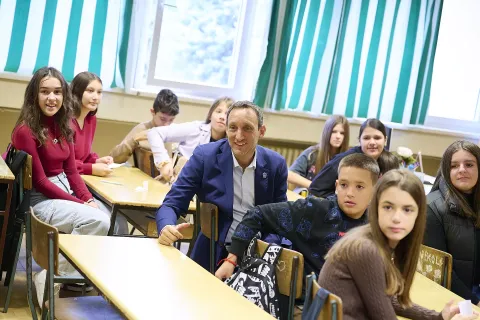
PODGORICA, 31 October 2018 – A pioneering project of introducing digital teaching into Montenegrin schools has been launched with the opening of a digital classroom in Stampar Makarije Primary School in Podgorica, which means that the children will study selected lessons through video productions and other interactive methods that involve the use of digital media in the classroom.

It was the fact that digital literacy is not a luxury or an option any more, but rather a necessity, for both adults and children, that prompted the Ministry of Education, Telenor and UNICEF to launch and implement this pilot initiative together.
The pupils of Stampar Makarije Primary School are looking forward to the computer and media laboratory that they will use from today to study compulsory lessons in an easier manner.
“For example, if we are studying biology and plants, the teachers and pupils will be able to record the plant on video and show the other pupils how it is developing,” the representative of the pupils’ parliament, Itana Vučinić, explained.
Ilija Ivanov, Itana’s friend from school and colleague on the pupils’ parliament, is particularly looking forward to the opportunity to gain a better understanding of some subjects through the digital laboratory.
The digital laboratory will help us with subjects where theory has to be memorized. For example, physics – there are many laws that pupils, unfortunately, have to memorize and do not have real examples where they can apply them, and now we can record a video to show to pupils as a simulation of a law.
Representatives of the Ministry of Education pointed out that the purpose of introducing digital teaching was to improve the quality of education in the 21st century.
There is a gap today between children’s knowledge and teachers’ and parents’ knowledge. The aim of this IT lab is precisely to contribute to the reduction of that gap.

If our teachers are more digitally literate, they will be increasingly using those skills within the classroom, which on the other hand will strengthen the sense of belonging to the digital age among our pupils.
Natasa Vlahovic, the principal of Stampar Makarije Primary School, said that she is proud that her school has been selected for this pilot project.
“Digital teaching is a step forward for us in adopting new models, forms and techniques and in the application of skills and knowledge, which is also our interest and demonstrates our need to preserve the current system and improve it in line with new technologies.”

The representatives of Telenor are proud of this project and they pointed out that it is necessary for all children in Montenegro to have the opportunity to attain digital literacy in a secure internet environment.
“The internet and the digital laboratory can help you attain skills and knowledge in your present environment, which is the primary school, in a different, more creative manner,” said Sandra Steiner, the General Manager of Telenor Montenegro.
This pilot initiative is a response to the findings of a survey that UNICEF conducted in 2016, which showed that one in five parents and one in 10 children in Montenegro do not use the internet. Moreover, a half of all parents want to have information from their child’s school on how they can help their child become digitally literate and media-literate.