Ana steps up to protect children from violence
With the support of UNICEF and the EU, healthcare workers are receiving training for better protection of children from and prevention of violence

- Crnogorski
- English
- Shqip
PODGORICA, 11 APRIL 2024 – Violence against children is usually discussed only when it escalates, while the topics of prevention and institutional efforts to prevent it are not commonly raised.
“There needs to be greater emphasis on this issue. Certain cultural norms here make it commonplace to shout at or even physically discipline children. This mindset needs to shift,” says Ana Bijedic, the head nurse of the organizational unit “Chosen Doctor for Children” and of the Centre for Children with Special Needs at the Primary Healthcare Centre of the Capital City.
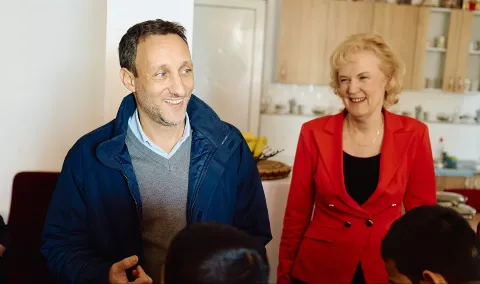
Ana Bijedić, nurse at the Primary Healthcare Centre and one of the participants in a training session focused on assisting children who are victims of violence and exploitation, organized with the support of UNICEF and the EU
Last September, Ana participated alongside a paediatrician in a training session focused on intersectoral collaboration in assisting children who are victims of violence and exploitation, organized with the support of UNICEF and the EU.
“This is the first time in my 20 years of work that I have had the opportunity to participate in such training. Direct communication and a dynamic approach to addressing the issue make a significant difference, especially when following the structured training steps,” Bijedic shares from her experience at the training session.
She shows us the Standard Operating Procedure manual, which she says has been shared with eight health facilities in the Capital City, including in the districts of Zeta and Tuzi, where healthcare is provided to children. She explains that her colleagues now enjoy the opportunity to independently examine, explore and utilize the most effective methods to address violence if they detect it.
She emphasizes that, after this training, another session followed, with two of her colleagues – a doctor and a nurse – joining in and sharing similar experiences.

We had positive experiences, benefiting from useful and practical work in groups, with participants representing their professions, whether it was me as a healthcare worker, a representative from the Ministry of Internal Affairs as an inspector, or social services professionals. It was a great training session.
Ana highlights that greater collaboration between institutions has been lacking thus far and conveys that all educational efforts are moving towards connecting and uniting institutions to be accessible, primarily for the benefit of children in need.
“It’s imperative for all of us to engage and cooperate, because any hindrance within the chain poses a problem. While coordinated institutional collaboration is still lacking, we are taking steps to make a change in that regard,” Bijedic says.
Bijedic emphasizes that chosen doctors advise parents from the birth of the child, aiming to educate and to prevent violence and neglect, while also being obliged to address it if they notice it.
She recounts a recent situation where one child’s parents refused to follow the doctor’s advice regarding the child’s nutrition.
“The doctor persisted, insisting even on an examination by a subspecialist to ensure they had indeed started incorporating everything necessary into the child’s nutrition. Faced with the parents’ categorical refusal to heed the advice, she cautioned them that if they were unwilling to resolve the issue jointly, she would be forced to take alternative action. This incident occurred after our training, which empowered us. While her persistence was evident before, her confidence in addressing such matters drastically increased after receiving the training,” Bijedic shares, citing one of her examples from practice.
Her colleague, nurse Maja Vujacic, recalls that, in her 26 years of work experience, there had been cases of violence against children that ended up in court. She notes that traces of violence were sometimes detected during routine school examinations and promptly reported.
It is necessary for all institutions to get involved. One can only do so much as an individual. A paediatrician may notice something in the clinic, but with the cooperation of all institutions, they can take action and be sure it will turn out well. The essence is to benefit from multidisciplinary action or collaboration between institutions.

“I think the problem is still that when we see something like that, we are reluctant to interfere, but that will change over time because we need to react to violence,” says Vujacic, hoping there will be more training opportunities. “We are constantly learning, and the changes are noticeable. We shouldn’t work as individuals but rather as a system. While progress is evident, there’s still room for significant improvement,” she remarks.
Experts like Ana who are involved in child protection have undergone training as part of the Partnership for Strengthening the Child Protection System for Protection of Children from and Prevention of All Forms of Violence and Exploitation initiative, implemented by the Ministry of Labour and Social Welfare with the support of UNICEF and the EU.