Nicoli Stresna - a 17-year-old STEAM mentor for hundreds of young women and men from Moldova
On International Day of the Girl, let’s empower girls to become whoever they want to be

In a world dominated by screens and algorithms, 17-year-old Nicoli Streșnă is familiar with technology and is shaping her future and future generations by creating STEAM (Science, Technology, Engineering, Arts, and Math) projects. Since her first volunteer experiences at thirteen, Nicoli has forged a path that defies gender stereotypes and the limitations of conventional education, passionately embracing engineering, technology, and mentorship. Although just beginning to scratch her way in life, Nicoli is already an important figure in promoting STEAM among young women.
A student at the "Dante Alighieri" High School in Chisinau, Nicoli started developing her interest in technology and engineering two years ago, through an apparently simple coincidence: attending the summer camp dedicated to IT girls, "Girls Go IT."
"When I saw the poster, my first thought was to apply. My sister was already in IT and encouraged me to try it. That's how I discovered Arduino and engineering," says Nicoli with a modest but proud smile.
Arduino is an electronic prototyping platform based on easy-to-use hardware and software. It is used by engineers, designers, educators, and electronics enthusiasts to develop various interactive and automated projects. Arduino allows the control of sensors, motors, LEDs, and other electronic components and is popular in education, robotics, and DIY (Do It Yourself) projects.


"It was one of the first camps I attended. First of all, I developed my soft skills, my public speaking skills, because we had to present projects, communicate. But I also improved my hardware side, I mean programming, critical thinking, analyzing code, developing my attention - if I dropped a wire or a semicolon, I had to start from the beginning. Not only was it an unforgettable experience, but I learned a lot of new things about microelectronics and the Arduino program," says Nicoli.
What started as simply attending a summer camp quickly turned into a vibrant, almost magnetic passion for microelectronics and hardware.
"After camp, I told my mom I wanted to buy Arduino development boards and sensors. I bought all the necessary components and started from scratch to make STEAM projects at home," Nicoli enthuses.
"I really like science, math, fixed domains, but engineering I think has a special place in my heart. I really enjoy creating and seeing what I program really become alive," says Nicoli about her first experiments with Arduino circuits and microcontrollers.

After attending the Girls Go IT camp, and doing many nights of research at home, Nicoli decided to pass on her knowledge to other young people who share the same passions and aspirations. The experience changed the direction of her life and has turned her into an inspiration to dozens of young women who dream of scratching their way into a field that men often dominate. In just a few years, Nicoli has grown from a young girl eager to learn to a trusted mentor in the local IT community. Driven by a relentless thirst for knowledge and a genuine desire to share what she has learned, Nicoli has become one of the key figures in the Girls Go IT and STEAM on Wheels program.
Before she teaches technology, she teaches confidence
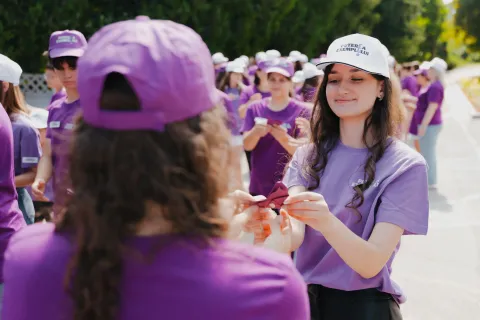
In mentoring sessions, Nicoli values creating an atmosphere of collaboration and learning. Each session begins with team-building activities so participants feel comfortable and become more open to exploring the world of technology. She believes that a relaxed environment can make the difference between success and failure, especially in such a technical field.
"We never start directly with programming. First we create an atmosphere where everyone feels welcome. I try to make the girls see that engineering is not a male domain. I've seen a lot of interest from them. Sometimes, girls are even more curious than boys to discover the technical details behind circuits and programming," says Nicoli, talking about how she is changing stereotypes and encouraging gender equality in STEAM.

Besides mentoring at "Girls Go IT", Nicoli also visits other regions of the country to spread her STEAM enthusiasm and knowledge to young people. The mentoring, competitions, and projects she participates in take up most of her time. But even so, she is the student with the highest average in her class.
"There are times when I have to leave my lessons. There have even been months when I've only been at school for two days, but the teachers and classmates are understanding. Studying the real profile is a bit more complicated because fixed subjects don't catch up so easily and need more time. But I do my homework all the time; I study extra at the weekend, for example, so that I can get high grades," explains Nicoli, adding that her mother is a primary school teacher and admits that her excellence in learning could be inherited from her.
Nicoli also mentors students in her school, both within the curriculum classes they take and in other extracurricular activities.
"In physics, for example, I try to bring different sensors, do lab work on the sensors, and digitize the process a bit. Likewise, I encourage colleagues to sign up for BootCamp or STEAM on Wheels, so they can get closer to the field."
One of the school's teams mentored by Nicoli won first place in a Republican competition with a STEAM project about an eco-friendly digital home.

Behind every success, however, there are hours of quiet work, nights when Nicoli turns ideas into reality with his eyes on codes and circuits, turns ideas into reality.
Learning from failure
Like any tech enthusiast, Nicoli has had moments that have overwhelmed her. One wrong wire or comma can change everything in a world dominated by precision and perfection; one wrong wire or comma can change everything. Her first Arduino project, which promised to impress with lights, sounds, and sensors, failed spectacularly in front of the public.
"At my first Summer Camp, I had a very complex project. It did everything - it sang, it measured the temperature in the room, it had LEDs and every sensor possible. When I got to present it, pushed the button and... nothing happened. But I made up a funny story for the audience. Our project was "tired" after all that work. It was disappointing but also an important lesson," she recalls.
Such situations taught her patience, as well as how to improvise, communicate, and interact with the audience.
Professions have no gender
For Nicoli, STEAM is not just a field of study, but also a platform through which she and other young women's dreams can be realized. It's a path to empowerment, a way to challenge gender stereotypes and demonstrate that engineering, like any other field, is about passion and perseverance, not gender.
Although she still has a long way to go, Nicoli already knows what she wants to do in the future: pursue a career in engineering. With all the opportunities she might find abroad, she wants to stay in Moldova and contribute to her country's development.
"I believe that if we develop young people's interest in STEAM, we can make big changes in Moldova," she says optimistically.
Nicoli is a great example for young women in her community. She shows that a passion for technology and a desire to learn can open even locked doors. At just 17 years old, she has not only discovered a rewarding field but has also inspired and motivated dozens of young women to follow in her footsteps.
This material has been produced with the financial support of the United States Bureau of Population, Refugees and Migration (BPRM) and the Gender Innovation Fund.