Maha Damaj at UNICEF's 30th anniversary in Moldova
"UNICEF will remain present — for as long as needed — not until perfection, but until fairness becomes the norm."

Three decades ago, UNICEF opened its doors here with a single mission: to make sure that every child, no matter where they are born, no matter what their circumstances, has an equal chance.
Over the years, together we have traveled a journey of reform, resilience, and renewal. And this evening is not just about UNICEF. It is dedicated to Moldova. It is dedicated to what can be achieved when partners, governments, families, and young people believe in something better and work to build it.
I am particularly touched that with us tonight is one of the first UNICEF staff members in Moldova, Octavian Bivol, who helped lay the groundwork for this journey. Octavian, thank you for being part of this story, then and now.
And, of course, I would like to extend our gratitude to our government partners, civil society allies, donors, and all our colleagues who have stood by us. But above all, thank you to the children and young people who have entrusted us with their stories. Tonight, we honor them.
I look forward to sharing this evening with you all, not just to look back, but to look forward because every child's story doesn't end with the first chapter.

Your Excellencies, dear colleagues, partners, and friends,
Today, UNICEF marks 30 years in the Republic of Moldova.
Thirty years since we first set foot in this country — not with headlines, but with a promise:
That no child should grow up alone, unseen, or forgotten.
That childhood should not be defined by survival, but by potential.
To understand what this promise meant — and still means — we must remember what Moldova looked like three decades ago.
In the early 1990s, Moldova had inherited a child protection system designed for a very different world — one where children were placed in state institutions not because they had no parents, but because those parents were poor, or single, or had a child with a disability.

By the early 2000s, over 10,000 children were growing up in residential care. These were not homes. They were cold, rigid places that echoed the logic of a system built on control, not care — a legacy of the past, where institutionalization was seen as a solution, not a failure.
We helped reimagine the system from one that removed children from families — to one that supports families to stay together.
Cristina Lupașco was one of those 10,000. Between the ages of 7 and 12, she lived in an institution in Stăuceni — just a short drive from the capital, but a world away from love.
Everything changed in 2013, when Cristina was placed with a foster family supported by UNICEF. Later, she was adopted by a family of teachers who offered her not just a roof, but a sense of belonging and a reason to believe in tomorrow.
Today, Cristina teaches biology and chemistry in the village of Lucășeuca. She’s not just explaining chemical bonds — she is a living example of human bonds that are not only defined by blood, but by care, trust, and commitment. And today, she stands here with both her foster and adoptive families — a living bridge between systems, generations, and the future.

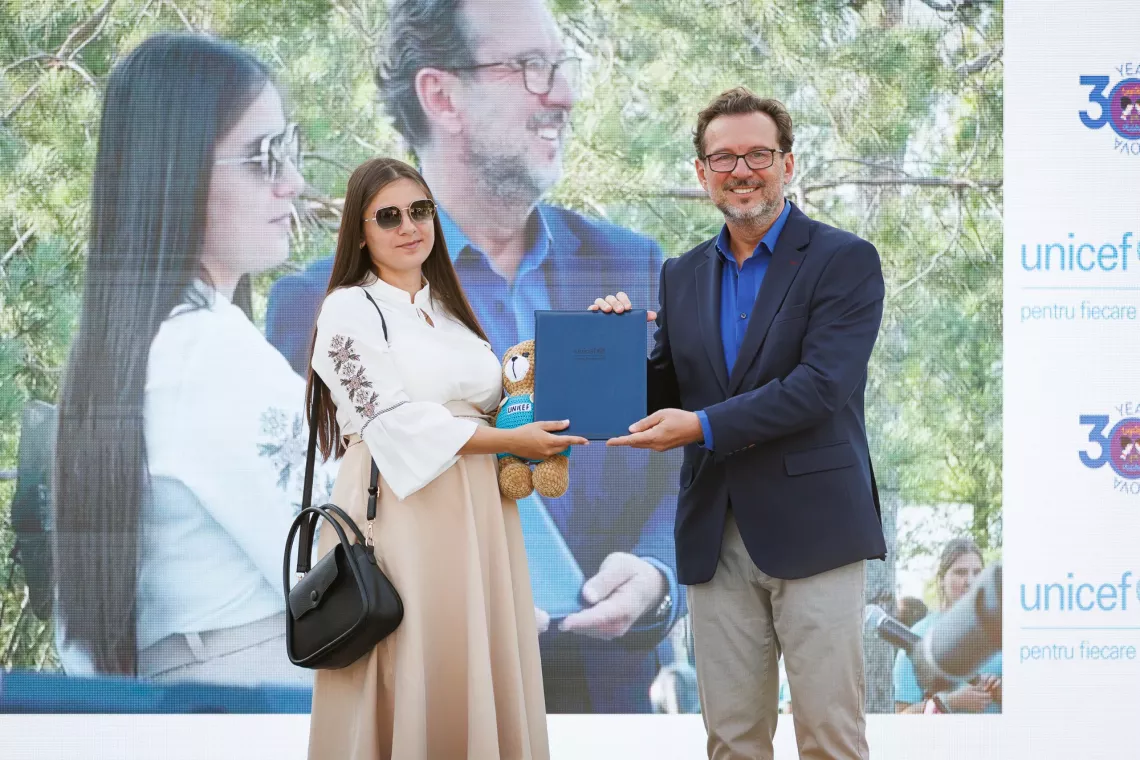
Olesea Melnic's story goes even deeper. Born with a disability, she was placed in an institution at just 9 years old. The discrimination she faced — at school, in the community, even in care — was not incidental. It was systemic. The system did not accommodate children with disabilities— it erased them.
The absence was so complete, so normalized, that many people genuinely believed there were no children with disabilities in their towns or cities at all. What Olesea and thousands like her had to overcome was not only personal hardship, but decades of systemic invisibility.
After her father died and her mother lost parental rights, Olesea could have been lost in the system. But she wasn’t. She was de-institutionalized through a partnership between UNICEF and LUMOS, and placed in a foster family that gave her the safety and stability to grow.
Today, she’s a mother, a university graduate, and a social worker. More than that, she founded an NGO to support youth leaving residential care — offering them the tools she once longed for: understanding, advocacy, and a voice.
Her story is not a miracle.
When systems shift from control to care, transformation becomes not the exception, but the expectation.


Daniela Crudu was never placed in care — but she was given something just as important: a platform.
At 14, Daniela became the host of Let’s PLAY — a television programme on children’s rights supported by UNICEF. In a media tradition where children were often included but rarely heard on their own terms, this was something different. She wasn’t just delivering lines — she was helping shape the message. It marked a quiet but important shift: from symbolic presence to real participation.
The show didn’t just reach children. It made history — winning an International Emmy Award.
For Daniela, it was a quiet shift in perspective — a sense that honest, clear voices, even young ones, could open up space for dialogue. She continues to work in public broadcasting today, carrying with her the experience of what it meant to speak not about childhood, but from within it.


Rasha Badawi ran from wars twice before turning 20. She was born to a Moldovan mother and a Syrian father in Aleppo, Syria. As a child, she fled the devastation of the Syrian war with her family, seeking refuge in Ukraine. But just as she began to find her place, another war erupted. The missiles over Kyiv brought back memories of Aleppo, and once again, she had to run. This time, to Moldova — a place connected to her by blood, but still unfamiliar. When she arrived in Moldova, she wasn’t looking for sympathy — she was navigating displacement for the second time in her life. Moldova wasn’t a destination; it was the next available refuge. What she needed was structure, calm, a sense of continuity — so she could speak a language she already knew fluently, and start making plans again instead of fleeing.
Through UNICEF’s work in refugee inclusion, Rasha found a community at the Chișinău Youth Centre.
Today, she studies medicine in Kyiv. She’s not just rebuilding her own life — she’s preparing to save others.


Gheorghina Negru’s story begins even earlier — on the edge of life.
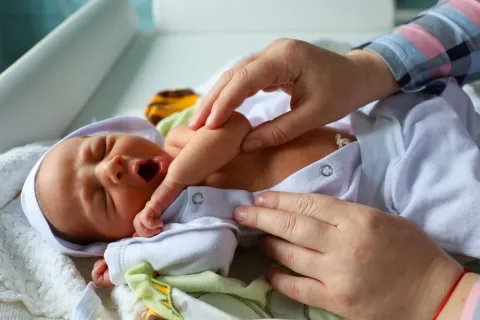
Born in 2009, she weighed just 910 grams. In many parts of the world, that would be a near-certain death sentence. And had she been born just a year or two earlier, before Moldova began updating its neonatal care standards in 2008, she may not have been recorded as a live birth at all. Until then, the medical system followed outdated criteria — babies born under 1,000 grams were not registered as live births and received limited or no intensive care. Lives like hers were often written off before they had a chance to begin.
But Gheorghina was placed in a neonatal incubator — one of many donated to Moldova’s maternal hospitals by UNICEF. Her mother visited every two hours to feed and comfort her. Every gram gained was a victory.
Today, Gheorghina is a healthy, bright, lively 16-year-old teenager. Her life is a testament to how investment in neonatal care saves futures, not just lives.


And finally, we come to Petru Bulat. Born with a condition that affected his mobility, his first cradle was a hyperbaric chamber. The odds were not in his favor.
But his family — supported by the Voinicel Centre and UNICEF — started early intervention at just 3 months old. He received regular therapy sessions tailored to his needs. He was introduced to swimming, which strengthened his body and built his confidence in the water. He was exposed to music — both as a form of expression and as a skill — learning to play instruments and sing. Movement exercises helped him gradually build coordination and independence. And above all, he was surrounded by love — the consistent, patient care of a family that never stopped believing in him.
Petru didn’t walk until four and a half. But when he did, the world opened up.
Today, he sings, plays the piano and violin, and not only does he move, he moves people.
His story is a lesson we must remember: when intervention is early and families are supported, even the hardest beginnings can lead to extraordinary lives.


These children — now young adults — show us what 30 years of UNICEF in Moldova truly means. It is not about what we did for children. It’s about what we did with Moldova, for Moldova, and through Moldova’s children.
To our partners in government, civil society, media, and communities — thank you. Your courage to change, your trust in us, made these stories possible.
UNICEF will remain present — for as long as needed — not until perfection, but until fairness becomes the norm. Until every child can grow not in fear or invisibility —
but in dignity, stability, and voice.
Thank you!

Media contacts
About UNICEF
UNICEF promotes the rights and wellbeing of every child, in everything we do. Together with our partners, we work in 190 countries and territories to translate that commitment into practical action, focusing special effort on reaching the most vulnerable and excluded children, to the benefit of all children, everywhere.
For more information about UNICEF and its work for children, visit www.unicef.org
Follow UNICEF on Twitter and Facebook