

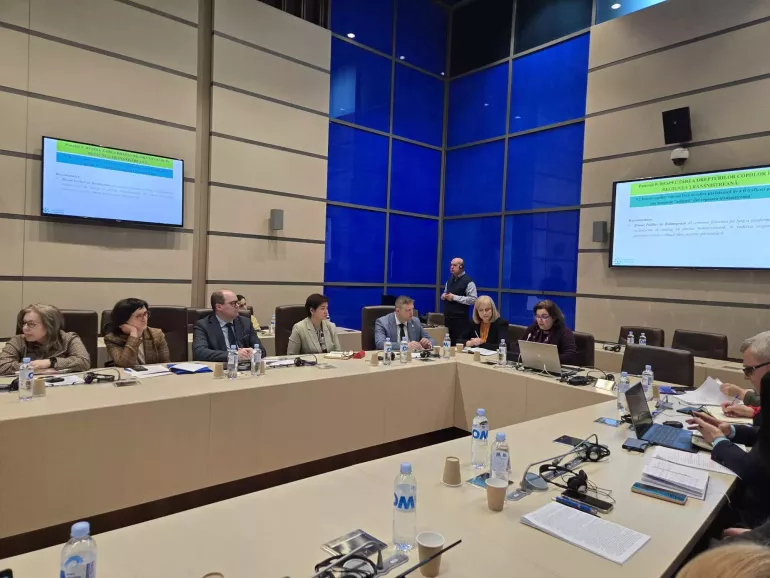
It is both an honor and a responsibility to speak today about Moldova’s commitment to upholding one of the most fundamental rights of every child — the right to grow up healthy, educated, protected, and heard.
Over the last two decades, Moldova has made important progress. Through the National Health Strategy 2030 and other policy frameworks, the country has set a clear course toward ensuring universal access to healthcare. There is much to recognize — from improved infrastructure to expanded services. Infant and under-five mortality rates, for example, have halved over the past 30 years. These are meaningful improvements.
Yet these numbers also tell us something sobering: Moldova’s child mortality rates remain three times higher than the European average. And many of these deaths — 20 to 25 percent — were from causes that could have been prevented: congenital malformations, perinatal complications, pneumonia, and injuries. These are not just medical issues — they are systemic signals.
The hard truth is that progress has not reached everyone equally. While the benefits package for insured individuals is relatively broad, far too many families fall outside its protective scope. In 2019, out-of-pocket health spending made up 36% of total health expenditure — nearly double the European average. That means Moldova’s most vulnerable families often face the highest costs, paying for services they can barely afford or forgoing care altogether.
Nowhere is this inequity more visible than in rural areas and among the poorest households. In 2022, only 14.8% of the poor population consulted a doctor, compared to 24.8% of the general population. Healthcare, like education and clean water, becomes a distant privilege when there is no money for transport, when parents work long hours without contracts, or when basic entitlements are not clearly communicated.
Children with disabilities face another layer of exclusion. Early intervention services are estimated to meet only one-tenth of the actual need. Many young children with developmental delays are missed altogether, as less than one-third of first-time disability determinations are made before school age. This is not only a lost opportunity — it’s a structural gap that delays support when it is most effective.
The Roma community, too, remains among those most underserved. Many Roma adults are not formally employed and lack insurance coverage. Misinformation about children’s rights to free healthcare and lingering informal payments further deter families from seeking medical help — even when it is urgent or preventive, like vaccination.
And this has real consequences. Moldova’s vaccination rates have declined in recent years. In 2024 alone, 216 children were infected with measles, and another 14 cases have already been recorded in 2025. Across the European region, more than 30 children have died due to measles over the past year. Each of these deaths is a reminder that when trust in public health weakens, children pay the highest price.
This is why UNICEF remains deeply engaged in Moldova — not only to support service delivery, but to address the barriers that prevent children from being reached in the first place. We are expanding mobile clinics to serve adolescents in rural areas, supporting the development of four new early intervention centers, and strengthening home-visiting programmes to detect health and developmental concerns early — especially where resources are scarce.
Health, however, is just one piece of the foundation a child needs. The right to quality education — inclusive, accessible, and supportive — is equally essential. Moldova has taken strong steps toward realizing this right for all children, especially those with special educational needs. Today, more than 11,000 children with disabilities are enrolled in mainstream schools — a figure that reflects a shift toward greater inclusion.
But numbers alone do not tell the whole story.
Just over 500 children with special needs remain in segregated or residential institutions. While this number may seem small in comparison, it represents 500 children still excluded from the full benefits of inclusive education. Many of them face profound barriers — children with hearing or visual impairments, those with severe intellectual disabilities or complex needs — for whom mainstream inclusion requires tailored support and resources that are not yet widely available.
And inclusion is not just about policy — it is about people. A recent study by UNICEF found that 60% of teachers say they are open to working with children with disabilities in their classrooms. But this also means that 40% either feel unequipped or unwilling. That is a challenge we cannot overlook. Because every teacher matters — to every child.
Parents, too, face a difficult choice. Today, only 40% of parents or caregivers choose to enroll their children with disabilities in mainstream schools. This signals both a lack of information and a lack of trust — trust that their child will be safe, understood, and supported.
That is why UNICEF is investing in inclusive teacher training and supporting the National Institute for Education and Leadership. By building mentoring systems and practical tools for educators, we aim to bridge the gap between intention and implementation — between laws and learning.
Technology also plays a vital role. We are providing assistive technologies to help children with hearing and visual impairments, and those with cognitive challenges, to access learning and express themselves — not only as students but as full members of their communities.
And we cannot forget another group too often left behind — children from Roma communities. Around 50% of Roma children are estimated to be out of school, and those who do attend face higher dropout rates. Part of the problem is invisibility: poor data collection, frequent migration, and parental mistrust make it hard to identify and support these children.
To address this, UNICEF has helped pilot the role of educational mediators in Roma-majority areas — building bridges between families, schools, and local authorities, so that every child is not only enrolled but encouraged to thrive.
Education also plays a powerful role in protection. But far too many children in Moldova experience violence, neglect, or exclusion — both in their homes and in the institutions meant to protect them.
Each year, over 1,000 children are registered as victims of crime — that’s more than two children every day. Alarmingly, about one-third are victims of sexual crimes. Equally concerning is that a similar number of children are in conflict with the law — many of them under the minimum age of criminal responsibility.
Children are not small adults. Their experiences, understanding, and development require a justice system that protects rather than punishes, that educates rather than excludes. UNICEF continues to support Moldova’s transition toward a child-friendly justice system — one rooted in prevention, early identification, and rehabilitation.
Diversion measures, non-custodial responses, and community-based care must become the norm — not the exception. And when children must enter the justice system, every effort must be made to ensure their dignity, safety, and rights are upheld.
Yet no system — no school, no clinic, no court — can compensate for the crushing impact of poverty on a child’s life.
The most recent data confirms that nearly one in two children in rural Moldova lives in poverty. Every second child. And while Moldova has made real progress in expanding child-sensitive social protection programs, we must be clear: the risks are growing. Economic pressures and reductions in public spending threaten to roll back the gains of recent years.
That is why Moldova’s RESTART reform is so important — because it seeks to expand both the coverage and adequacy of social protection, especially for children in vulnerable families. Cash benefits, childcare services, family counseling — these are not luxuries. They are lifelines.
We also welcome Moldova’s commitment to the European Child Guarantee, a framework that emphasizes universal access to health, education, and social support — not as isolated interventions, but as integrated rights.
Children’s rights, however, must not only be promised — they must be enforced. Yet enforcement mechanisms remain fragile.
Take child support enforcement, for example. While Moldova’s laws allow for forced execution, the effectiveness of this mechanism has plummeted from over 50% in 2012 to under 20% today. That means thousands of children are not receiving the financial support they are legally entitled to — often due to bureaucratic delays or structural loopholes.
UNICEF supports reforms that treat children as direct creditors in maintenance cases, that establish a minimum threshold aligned with subsistence levels, and that shift enforcement costs from families to the state — because justice must not be conditional on income.
We also call for stronger, more accessible mechanisms for children to report rights violations. Complaint systems must be child-friendly, confidential, and inclusive — especially for children with disabilities or those in institutions. And professionals across all sectors must be trained to recognize signs of abuse or neglect before harm escalates.
Participation is not a luxury either. It is a right. Moldova’s legislative framework for student councils and youth participation is encouraging, but it needs to be matched with resources, transparency, and real influence.
That is why UNICEF established the Roma Youth Advisory Council — a platform that goes beyond consultation to genuine impact. We want every child to know that their voice matters — not just in poetry contests or school concerts, but in policies, decisions, and institutions that shape their lives.
Let me close by reaffirming this: Moldova has shown the will to move forward. But the path to full realization of children’s rights requires sustained investment, public trust, and systemic change.
This is not just about catching up with European averages. It is about honoring a deeper promise — that every child, no matter where they are born or what challenges they face, has a right to health, to learning, to protection, to participation, and to hope.