

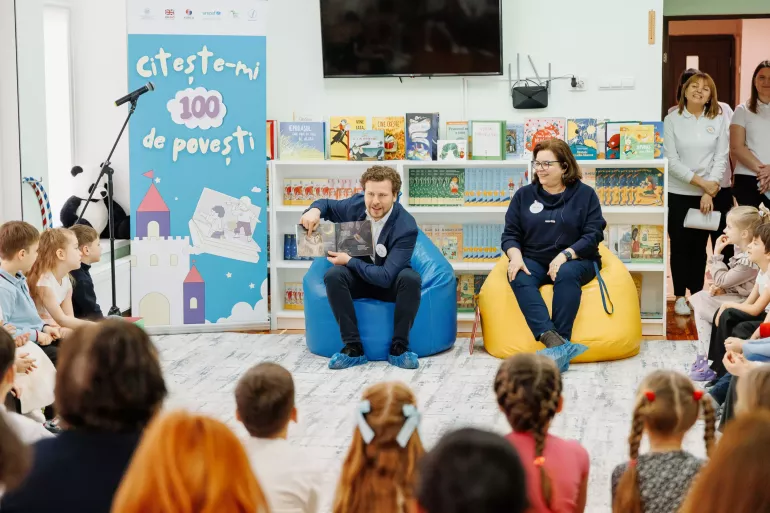
Dear partners, educators, parents and children!
Good morning. Just a week ago, we spoke about the importance of feeding young children’s bodies — making sure they get the right nutrition to grow, thrive, and stay healthy. We even talked about food substitutes — how some things may fill a child’s stomach but leave their body undernourished, without the nutrients they truly need. Today, we’re speaking about another kind of nourishment — just as vital, but often overlooked: the nourishment of the mind. And just like with food, there are no substitutes for books — entertaining content that may capture a child’s attention, but doesn’t always offer the depth or reflection that stories provide. It might fill the time, but it doesn’t always feed the imagination or support emotional growth.
That is why we are so proud to launch the “100 Stories” programme. Through this initiative, over 1,200 preschools and 150 resource centers will bring reading into the daily lives of children across Moldova. And not just any reading — but rather meaningful stories, full of emotion, imagination, and insight into what it means to be human. As I’ve learned over the years, you have a powerful expression in Moldova — “cei șapte ani de acasă” (meaning “home training” and refers to the manners, discipline, and social values taught by one’s family during early childhood). These are the early years, when children begin to grow roots. It’s when they quietly, often unconsciously, learn the difference between the good, the bad, and the ugly. When values are not just taught, but come to life in these stories.
The books we read to children during these years matter. They shape how children relate to others, how they manage emotions, how they ask questions, and how they begin to form their own sense of right and wrong. And that’s what makes 100 Stories so much more than a literacy campaign. It’s a values-based investment in our future.
Because stories — especially the ones shared with a trusted adult — help children understand kindness, justice, courage, empathy. They reflect back to a child not only what the world is, but what it could be. Regretfully, only one in three caregivers regularly read to children under the age of 7 in Moldova. That means many children are missing out on these precious moments — and are often exposed instead to digital distractions, overwhelming stimuli, or silence.
We cannot let books be replaced by things that fail to nourish a child’s imagination or sense of self. Because just as low-nutrition foods impact a child’s physical development, superficial or absent storytelling can leave a child’s emotional and moral development undernourished. That’s why this program is essential. It encourages not just access to books, but shared reading experiences between parents, teachers, and children — moments that spark connection, trust, and curiosity.
The evidence is strong. Interactive reading increases vocabulary and comprehension by up to 25% in preschool-aged children. But perhaps more importantly, it builds emotional intelligence, confidence, and a lifelong relationship with learning. I remember, as many of you probably do, the quiet power of being read to. The way a story could stop time. The way a character could help you understand your own feelings — or the feelings of someone else. That is the kind of substitute we need — one that adds value, not noise.
To the parents and educators here today: Thank you. You are the ones helping children form roots that will last a lifetime. We are grateful to the Ministry of Education and Research, the UK government for supporting us to equip these preschools with books, and partners like OvidiuRo and the National Library for Children 'Ion Creangă.
And to the children — this program is for you. May these 100 stories help you grow into thoughtful, kind, curious human beings. Because stories are not just entertainment. They are how we pass on what matters. They are as old as time, and they remain at the heart of human connection. Let’s make sure no child grows up without them.