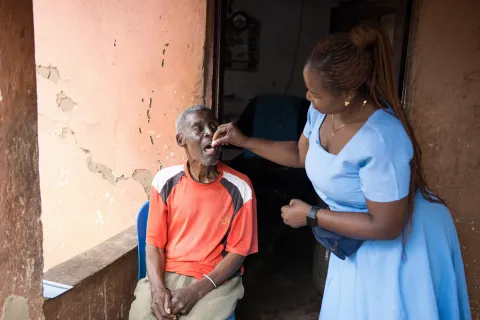
Tukomba puts up a collective front to contain Cholera
Cholera hot spot's success story

When the first cholera case was recorded in the lakeshore district of Nkhatabay in August last year, it was from Tukombo village. The outbreak spread rapidly to other parts of the district in no time. Tukombo soon became a hotspot, recording a total of 904 cases out of the district's cumulative 1,514 cases.
However, as of the end of January this year, cholera cases have reduced drastically, with no cholera case reported from Tukombo since mid-January.
District Environmental Health Officer, Matthews Kalaya, attributes this success story to the collective efforts of health workers, partners, faith, and community leaders, as well as members of the community.
"We applied several interventions in awareness, case management, stakeholder engagement, rapid response team, rehabilitation of water systems, and distribution of assorted water, hygiene and sanitation supplies to community members where cases originated from," said Kalaya adding that administration of the oral cholera vaccine was yet another success formula.
Through UNICEF, with support from the European Union's Civil Protection and Humanitarian Aid Operations (ECHO) Project, community members in Nkhatabay received lifesaving health and water, hygiene, and sanitation supplies, including chlorine and water purifiers, buckets, soaps and medical supplies including, oral rehydtaion solutions, 5 Acute Watery Diarrhoea cholera kits, essential medicines (doxycycline, erythromycin), Infection prevention and control items likes gumboots and gloves, chlorine for cholera treatment in Cholera Treatment Units (CTUs).
Unanji Banda, 18, a cholera survivor from Tukombo, recalls how she had to leave her one-year-old baby when she was admitted to the CTU in December.
"I was caught unawares. The good thing is I rushed to the hospital because I believe the early detection of cholera saved my life and that of my baby. There were also adequate supplies of cholera treatment at the health centre. I appreciate health workers for their commitment and government partners for supporting Tukombo," said Unanji.
Unanji is now a community advocate in hygiene and sanitation behavioural change practices. Her cholera experience has had an impact on changing the mindset of her community.
"I have done my part in sharing my experience to raise awareness about the cholera outbreak. I am happy to note that community members now have proper latrines. They also wash their hands regularly with soap, drink treated water and ensure their surroundings are clean. Cholera is about proper hygiene and sanitation; it is preventable," she observed.
She further said that as a mother of a young baby, she cleans her hands before and after breastfeeding the child.
According to the District Health Office, Tukombo's success in stopping cholera can also be attributed to the Case Area Targeted Intervention (CATI) approach, supported by UNICEF. CATI targets households within a high-risk radius from a suspected case, and households residing in this catchment area are supplied with essential supplies and kits to prevent cholera spread.


UNICEF also continues to train health workers in Nkhatabay in CATI and Infection, prevention and control.
"Cholera is not easy to solve, but the story of Nkhatabay, particularly Tukombo, is a game changer. Where there is cholera, communal and cultural beliefs always frustrate the response plan. We can do our part, but community members have a key role to prevent the outbreak by embracing recommended hygiene and sanitation practices. Knowing how cases came about has been an instrumental determining factor of our approach in mitigating the outbreak, and I think it has helped to prevent and eradicate the spread," explained Kalaya.
"We can do our part, but community members have a key role to prevent the outbreak by embracing recommended hygiene and sanitation practices."
He then said Nkhatabay District has not relaxed its cholera preventive measures as it continues to be on alert for any new cases from all corners of the lakeshore district.