Door‑to‑door vaccination shields the elderly and children as cholera threatens Chilomoni
Health workers scale Chilomoni slopes to vaccinate elderly residents and children

At the foot of Michiru Mountain in Chilomoni, 73‑year‑old Febbie Sam and her 82‑year‑old husband sit quietly on their veranda, watching a stream of people in blue uniforms climb and descend the steep footpaths. Each carries a blue cooler box. Each step brings hope closer.
For days, Febbie has worried about her husband’s safety. News had spread that someone in nearby Mulunguzi had died of cholera, and several others were admitted at the Chilomoni Community Hospital cholera camp.
Living high on the mountain, far from the community vaccination point, she feared they would be left behind.
Her face softens into relief when one of the uniformed women approaches.
“I am Sellina Zombazomba, Health Surveillance Assistant,” the woman says, lifting her cooler box.
“I am so glad you are here,” Febbie responds. “My husband and I are too old to descend this mountain. As you can see, he has a walking disability.”
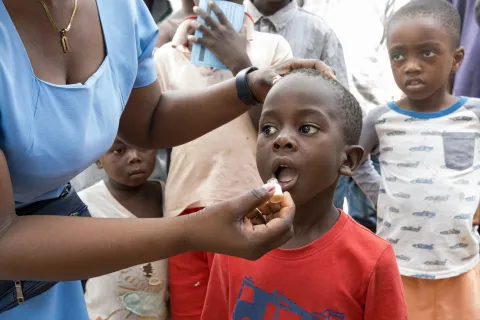
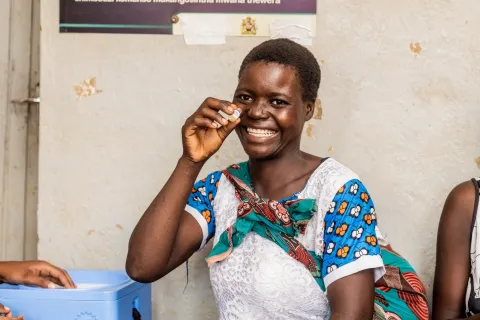
Zombazomba is part of a team deployed by the Ministry of Health and Sanitation, with support from UNICEF and WHO, to deliver oral cholera vaccines directly to households in hotspot areas of Chileka, Chilomoni and Chirimba.
The campaign targeted 94,000 people aged one year and above across four high‑risk districts of Blantyre, Mwanza, Neno and Kasungu.
Mulunguzi, where Febbie lives, is one of the most challenging zones.
“This area is a hotspot because of water scarcity,” Zombazomba explains. “Only a few households have piped water, and taps can stay dry for days. People end up using unsafe sources. There are two water kiosks, but they are far, and one is close to the mountain.”
Febbie nods. Her own tap, just steps from her veranda, often runs dry for a week at a time.
“As old as I am, I cannot walk far to find water,” she says. “I use a nearby well. How can we be safe from cholera like this?”
In another part of Chilomoni, Joyce Kamphilipiri faces a similar dilemma. She lives near a kiosk but cannot afford to buy all the water her family needs.
“In a day, we need five 20‑litre buckets. Each costs K50,” she says. “What about food? I can’t manage that. So, I use water from here for cooking, bathing and washing. I only buy one bucket for drinking.”
She admits she has had diarrhoea several times.
“But with the chlorine and the vaccine the HSAs have been giving us, I think we are safe,” she says.
Director of Health Services in Blantyre Dr. Gift Kawalazira says the campaign has surpassed expectations, reaching both children and elderly residents like Febbie and her husband.
“The uptake has been good. We had a target of 24,000 people for the district. By the end of the campaign, we exceeded it,” he says.
District statistics show 24,993 doses administered, covering 11,087 males and 13,906 females, including 3,545 children under five. Blantyre has recorded 30 cholera cases and two deaths.
For Febbie, the numbers matter less than the knock on her door.
“Now we can sleep peacefully,” she says, watching Zombazomba prepare the vaccine. “You have climbed this mountain for us.”