Emergency Support Excites Flood Survivors
Flood Recovery Support has a positive impact on affected families

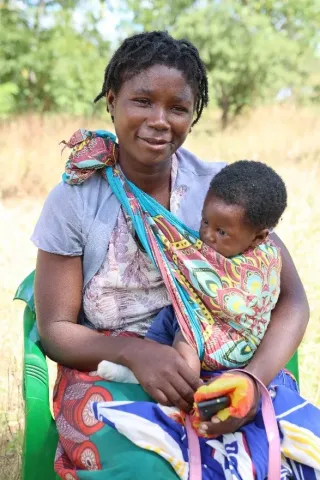
In her late 60s, Jennifer Aaron has lost track of her age.
She is worried that disasters caused by climate change have become more frequent and devastating lately.
The grandmother of five, who grows maize and millet on a field the size of a football ground, has suffered three episodes of severe flooding this year alone.
However, she felt the floods caused by Tropical Storm Ana in January as the most devastating, only rivaled by Cyclone Gombe in March.
The rainstorm that affected over 900 000 people in Southern Malawi destroyed Jennifer’s house is in Mphonde Village, Traditional Authority Ngabu in the flood-prone Chikwawa District.
“For two days, we experienced heavy rains and winds that battered the walls of my house to the ground. The western walls crumbled. The roof was blown away. My crops were washed away. All the clothes and kitchen utensils were gone with water. I had eight goats, but they were swept away,” she explains.
Jennifer took shelter in a confined kitchen until the next morning when she moved into a congested camp at Tosida Mosque, where she spent two months.
“As the torrents battered the iron sheets, soil started falling from the soaked walls. Soon, they were crumbling brick by brick. I was awakened by my 12-year-old grandson, who has mobility problems,” she narrates.
The woman and her family fled to high ground from where they saw the house and kitchen crash to the ground.
“The floods robbed me of nearly everything,” she says. “I am happy that we survived, but it won’t be easy to reconstruct the house partly built using the social cash transfer I receive every month.”
“The floods robbed me of nearly everything,” she says. “I am happy that we survived, but it won’t be easy to reconstruct the house partly built using the social cash transfer I receive every month.”

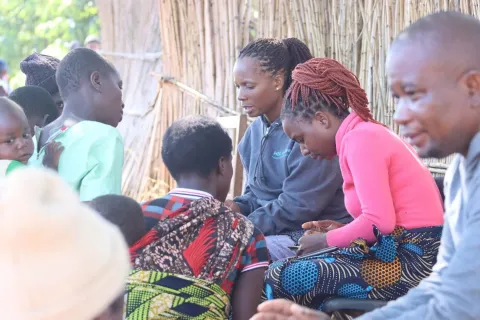
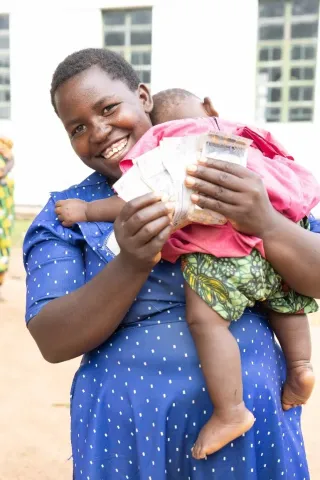
Ten months after the tragedy struck, Jennifer was among the beneficiaries of the Social Cash Transfer Programme who received Flood Recovery Support. Chikwawa District Social Welfare officials gave her family a lump sum payment of K54 000 (the equivalent of three months of support) to meet their immediate needs.
Soon after collecting the benefit, she shared her plans.
“I’m filled with joy because I will use the emergency cash support to buy food, bricks, and grass. Also, I will finally pay person who renovated the kitchen where we are staying,” she explains.
UNICEF provided technical support the Government of Malawi to provide emergency cash to the worst-hit households and social cash transfer recipients at risk of sliding into worse poverty.
“This is a huge relief,” she sighed. “Since the floods, I couldn’t rebuild because I have been struggling to feed my children and myself,” she says.
Jennifer’s husband died in 2020. She says the floods worsened the family’s poverty and suffering after spending on hospital trips and stays at Ngabu health center and Chikwawa district hospital.
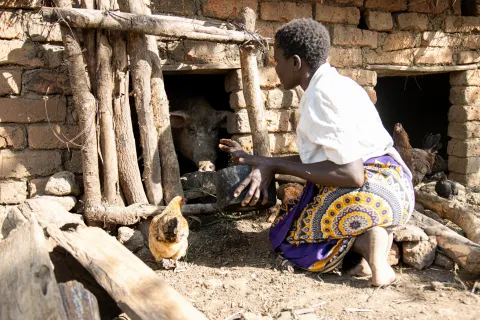
“For three years, the chronic illness had wiped out our meagre income. We were forced to sell all our two cows and goats to support the patient and the family,” she says
Raising five children by her own has made the widow strong-willed.
“If it were not for my husband`s loss, I would have found it hard to cope with the disaster that left me without food, shelter and clothes, reducing me to a beggar,” she says.
a bit too dramatic?
I don`t think this part should be so explicit in the story. Maybe one or two lines are enough. It`s even a bit contradictory: you`re saying she sold her goats but they also got washed away?

Jennifer’s husband died in 2020. She says the floods worsened the family’s poverty and suffering after spending on hospital trips and stays at Ngabu health center and Chikwawa district hospital.
“For three years, the chronic illness had wiped out our meagre income. We were forced to sell all our two cows and goats to support the patient and the family,” she says
Raising five children by her own has made the widow strong-willed.
“If it were not for my husband`s loss, I would have found it hard to cope with the disaster that left me without food, shelter and clothes, reducing me to a beggar,” she says.
I don`t think this part should be so explicit in the story. Maybe one or two lines are enough. It`s even a bit contradictory: you`re saying she sold her goats but they also got washed away?
Humphrey Magalasi, Relief and Rehabilitation Officer in Chikwawa, thanks UNICEF and its partners for attenuate the hardship faced by vulnerable households in the worst-hit district.
He states: “Chikwawa was hit the hardest by Tropical Storm Ana and Cyclone Gombe, which displaced 84 104 households scattered in 92 camps across the district.
“The loss and damage were severe and far-reaching. For the affected population, it was a big blow because they lost everything they had toiled for. This has made their recovery slow, so they needed support to rise from the rubble.”
Magalasi says the flood recovery support is timely as aid flowing to the district slumped dramatically following the closure of camps.
“After decommissioning the camps, we run short of partners to support early recovery efforts that involve the restoration of livelihoods, infrastructure, and psychosocial status. We need to provide the hardest hit with food, shelter, social cash transfers and psychosocial support,” says Magalasi.
The drop in humanitarian aid comes amid rising hunger as the lean season kicks. Besides, weather forecasts indicate that Chikwawa and the neighbouring Nsanje District at the southern tip of Malawi will receive normal to above-normal rainfall likely to trigger more floods.