Child marriage survivor gets cash transfer boost
From income growth to home ownership

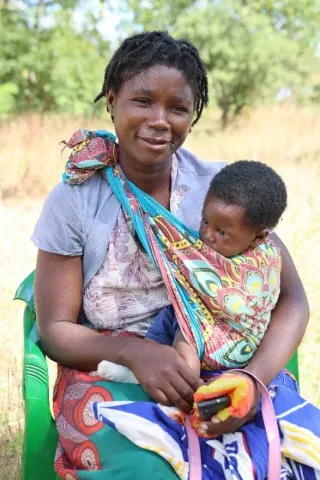
Sitting on the veranda of her newly built house with her three-year-old son, Mervis Dickson radiates pride. The green maize surrounding her home in Simon Village, Zomba, sways gently in the breeze—an everyday reminder of how far she has come.
Mervis left secondary school in Form One due to financial challenges. At 17, she married and moved in to stay with her mother-in-law. She and her husband ran a small aluminium potmaking business, but the income was barely enough to survive.
Everything changed in 2024 when she joined the Social Cash Transfer Programme (SCTP), supported by the Social Protection for Gender Empowerment and Resilience (SP‑GEAR) initiative, which is funded by the European Union and the Embassy of Ireland through UNICEF.
With her first K33,000 transfer, she bought K15,000 worth of shares in her village savings and loan association (VSLA) and steadily increased her contributions. When her savings reached K35,000, she qualified for a K70,000 loan. She added K18,000 from her savings to the loan amount and reinvested it all into their struggling pot making business.
The results were immediate. They produced two sets of pots and sold them for K75,000 each—K150,000 in total—kick‑starting their journey toward financial stability and the dream of building their own home.
Her business expanded again after she received a second transfer of K100,000. By 2025, the aluminium business was thriving, generating K600,000 in sales within just three months.
“The business is good as long as we have capital,” she explains. “We sell small pots for K15,000 and big ones for K30,000. But when we sell a full set—two pots, a frying pan, and a spoon—we make K75,000. The profit is almost 50 percent.”
Mervis has since diversified her income. She invested K250,000 in a mobile money agency, helping SCTP beneficiaries access their digital payments while earning additional income for her family.
“Before, when we got sick, we struggled to get to the hospital. We had no money for transport or medicine,” she says. “Now we can even go to small private clinics. It saves us time and gives us peace of mind.”
With savings and VSLA loans, the family invested K755,000 to construct their new home. They have already moved in and are now raising funds to install glass windows, plaster the walls, cement the floors and finish roofing the veranda.
“I already had land here in the village,” she says. “My husband and I agreed it was time to be independent and build our own house.”
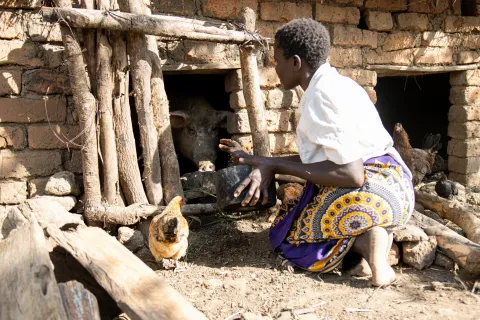
From her first VSLA payout in December, she bought four goats worth K165,000 and a solar kit for lighting and phone charging.

Financial independence, she says, has transformed her confidence and her role in the household.
“When I didn’t have money, I didn’t have a voice,” she reflects. “My husband is still the head of the house, but now he listens to my ideas and respects my decisions. That never happened when I married at 17. The support has empowered me to grow my businesses and make choices for myself.”
The SCTP is a nation-wide programme in Malawi, and SP GEAR – which focuses on social and economic empowerment of women and girls in SCTP households – is implemented in nine districts, namely Mzimba in the North; Ntcheu in the Centre; and Balaka, Chikwawa, Mulanje, Mwanza, Neno, Nsanje and Zomba in the South. The SP-GEAR programme runs from January 2024 to December 2026.
Today, Mervis is not only rebuilding her life—she is reshaping her future. What began as a small cash transfer has grown into a thriving business, a new home, and a renewed sense of dignity. Her journey shows what is possible when women and girls receive the support, they need to reclaim their independence and chart their own path.
Her story is one of thousands across Malawi, proving that with the right investment, families can break cycles of poverty, strengthen resilience and improve their wellbeing.