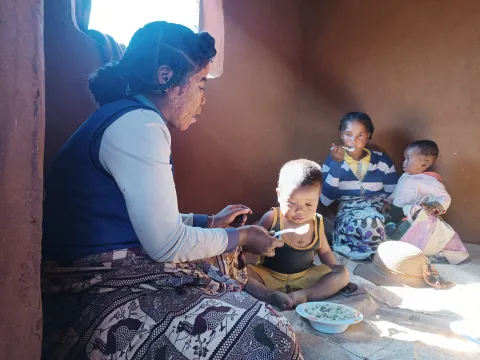
Multidimensional poverty affects two in three children in Madagascar, according to the results of an analysis carried out by the government of Madagascar, in collaboration with UNICEF

Antananarivo, 03 November, 2020: Madagascar will be able, for the first time, to prioritize the poorest people in programmatic interventions. The results of the Multidimensional Overlapping Deprivation Analysis (MODA), developed by UNICEF, which will allow monitoring of child poverty, are launched today by releasing the data related to the child deprivation in many areas.
The study has been carried out since January, while using data from the national survey on the socio-demographic situation of households (MICS-6) of Madagascar, in collaboration with the Ministry of Economy and Finance, the National Institute of Statistics and Oxford Policy Management. In this analysis, material deprivation and child well-being in general were assessed.
The MODA methodology uses the child (not the household) as the unit of analysis and focuses on the well-being of children by recognizing different needs at different stages of their lives. In addition, the analysis includes overlapping deprivations experienced by children. Indeed, the more simultaneous deprivations a child is facing, the more disadvantaged he or she will be. For example, a child who is malnourished and lives far from a health centre will be less able to cope with an illness. For this reason, it is important to know not only how many children suffer different deprivations, but also whether it is the same children who suffer different deprivations. It is therefore essential to realign strategic development priorities so as to expect more equity in children's living conditions. The dimensions of poverty considered are: health, nutrition, education, water and sanitation, housing and communication. A child is said to be multidimensionally poor if he or she suffers material deprivation in at least two dimensions.
The analysis revealed that more than two thirds (67.6%) of Malagasy children are experiencing material deprivation in at least two dimensions of well-being simultaneously and 23.7% suffer deprivation in four or more dimensions of well-being. Thus, the proportion of poor children is higher in the south and west of the country, while the central plateau and the north-eastern area have the lowest poverty rates. In the regions of Atsimo Andrefana and Ihorombe, for example, almost one child in two (49.3% and 49.1%, respectively) suffers material deprivation in at least four dimensions of well-being simultaneously, compared to Analamanga with less than 5%.
It should be noted, however, that with the health crisis caused by COVID-19, poverty is likely to have increased at both household and child level; an additional 1.3 million children are likely to fall into poverty by the end of the year according to preliminary simulations by UNICEF. "We believe that accurate and up-to-date information on development indicators is the first step in any successful strategy, and therefore the main objective of this analysis report," said Mr. Michel Saint-Lot, UNICEF Representative in Madagascar. He added that UNICEF is fully committed to this task and is eager to continue working alongside its national and international partners.
"Whenever opportunities arise, the Malagasy government will undoubtedly update the indicators developed on the basis of a multidimensional poverty analysis based on major national surveys. The aim is to have data for monitoring progress towards achieving SDG 1, relating to poverty in its various forms, especially child poverty," stated Mr Romalahy Isaora Zefania, CEO of INSTAT.
The results of the study:
· More than two out of three children (67.6%) are multidimensionally poor in Madagascar, meaning that they suffer material deprivation in at least two different dimensions of well-being. 23.7% of children are in extreme poverty (4+ dimensions of well-being).
· The extreme poverty rate in rural areas (27%) is more than twice as high as in urban areas (13%). The south-west of the country is the most seriously affected: almost one child in two lives in extreme poverty in the regions of Atsimo Andrefana (49.3%) and Ihorombe (49.1%).
· Children with multiple vulnerability factors are particularly likely to be poor. For example, the analysis indicates that the extreme poverty rate is almost seven times higher among children living in households headed by uneducated, non-Christian women in rural areas (53.4%) than among children with none of these characteristics (7.4%).
· There are pockets of severe deprivation lurking within non-poor households. For example, the analysis reveals that children in care and double orphans are particularly likely to suffer more deprivation than the other children in the same household. In particular, the former are twice as likely to suffer sexual violence as the average. Children with disabilities also tend to experience more deprivation than other household members, especially as regards nutrition, education and vaccinations.
· Boys tend to suffer significantly more deprivation than girls in terms of education. This may, in part, be explained by the fact that boys are more likely to work than girls. Boys are also more likely to be exposed to violent discipline. On the other hand, girls are more likely to be assigned the chore of fetching and carrying water.
· The education of parents, especially mothers, is strongly associated with reduced deprivation among children, even after taking into account that more educated parents tend to be wealthier, more urban, and older than the average. However, after the primary education, other social and economic pressures come into play, which may negatively affect the well-being of some children (non-breastfeeding, violence, etc.).
A few days before Madagascar celebrates the 30th anniversary of the signing of the United Nations Convention on the Rights of the Child, this study is even more important to place children – who represent 50% of the population – at the centre of development policies.
Media contacts
Additional resources

A propos d'UNICEF
L’UNICEF travaille dans les endroits les plus inhospitaliers du monde pour atteindre les enfants les plus défavorisés. Dans 190 pays et territoires, nous travaillons pour chaque enfant, partout, afin de construire un monde meilleur pour tous.
Suivez l’UNICEF sur Twitter, Facebook et Instagram