Children’s Rights Must Be Central to Liberia’s Transitional Justice Process
A New Approach to Justice: Equipping Liberian Adolescents with the Tools for Civic Engagement and Reconciliation

Children’s Rights Must Be Central to Liberia’s Transitional
UNICEF has reaffirmed its commitment to ensuring that children’s rights remain at the center of Liberia’s transitional justice efforts, recognizing that inclusive and child-sensitive justice processes are essential for accountability, reconciliation, and sustainable peace.
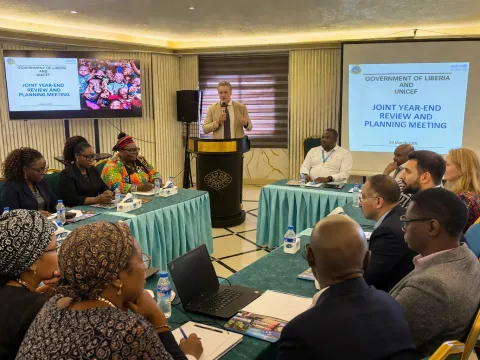
Last week in Monrovia, UNICEF Representative Andy Brooks joined Liberia’s Minister of Justice and Attorney General, Oswald N. Tweh, alongside representatives from the European Union Delegation to Liberia, the Liberia Anti-Corruption Commission, the Independent National Commission on Human Rights, and the Office of the War and Economic Crimes Court for Liberia (OWECC) at the Workshop on Transitional Justice for Parliamentary Staff. Representatives from the House of Representatives and the Senate also participated in the workshop, which was hosted by the EU Delegation and the Office of the High Commissioner for Human Rights.
The workshop brought together key stakeholders to strengthen understanding of transitional justice mechanisms and support Liberia’s ongoing efforts to address past injustices while building a more accountable and peaceful future.
Speaking during the event, Andy Brooks emphasized the importance of including children and adolescents in conversations about justice and peace.
“Children and adolescents must not be left out of conversations about justice and peace,” Brooks said. “For Liberia’s transitional justice process to be truly meaningful and sustainable, it must recognize and protect the rights of children while creating opportunities for young people to understand, engage with, and shape the future of their country.”
UNICEF has been actively supporting initiatives that empower young people to participate in discussions about justice, accountability, and civic engagement. Through its collaboration with the Office of the War and Economic Crimes Court for Liberia, UNICEF supported the Grade School Ambassadorial and Internship Program (GSAIP), which has reached 300 adolescents with mentorship on transitional justice, peacebuilding, and civic education.
The program equips young people with knowledge about Liberia’s justice processes while encouraging leadership, dialogue, and active citizenship among adolescents.
“Empowering young people with knowledge and leadership opportunities helps build a generation committed to accountability, reconciliation, and lasting peace,” Brooks added.
UNICEF continues to work with national institutions, international partners, and civil society organizations to ensure that children’s rights are embedded in the design and implementation of Liberia’s transitional justice process. Strengthening child-friendly justice mechanisms is an essential step toward creating a society where children are protected, heard, and able to thrive.
As Liberia advances its transitional justice agenda, UNICEF remains committed to supporting efforts that place children and adolescents at the heart of peacebuilding and justice, helping to build a more just and inclusive future for every child.