Advancing young children’s learning through TV series
My House is supporting young children's learning at home since the start of the COVID-19 pandemic.

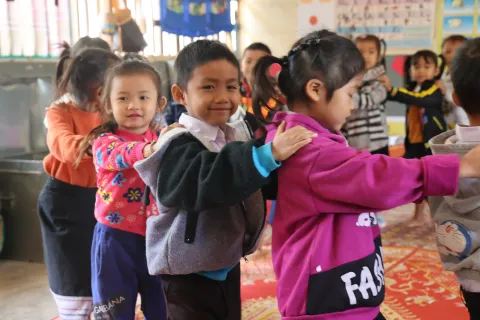
On a sunny morning in a remote village of Saravan province, Ms. Khambay Soulavong, a pre-primary teacher at Keng Kou Primary School, tries to get more than 10 pre-primary children between 3–5-year-olds seated. Children are full of energy, not interested in settling down any time soon. A burst of sound through a loudspeaker connected to the teacher’s mobile phone makes them sit down around her in a couple of seconds: the theme song of their favorite TV series; My House.
“We received the SD card with My House episodes in January 2021 and last year’s class and this year’s class both watched it.” Ms. Soulavong states. “They watch the full episode in silence. My House TV show looks like their houses, their lifestyle.”

My House is an Early Childhood Development (ECD) TV series that contributes to the physical, cognitive, social, and emotional development of children including problem-solving, coping with difficult circumstances, ability to work with others, imagination, responsibility and dealing with emotions. It contains cartoons, stories, songs and dances and promotes hygiene practices, alongside fun learning activities that provide basic knowledge for children, such as alphabets, numbers, colors, shapes and other related topics to help facilitate their school readiness.
The first season of My House was released in 2020 with 10 episodes and the second season in 2021 with 12 episodes including sign language interpretation in each season. Developed with support from partners like, the Government of Japan, USAID, the European Union and Global Partnership for Education, both seasons have been broadcasted through two national channels and the Ministry of Education and Sports (MoES) Education and Sports TV. In addition, it has been also disseminated on social media, YouTube and the MoES Khang Panya Lao Teaching and Learning Platform.

After the release of the first season, the episodes have been uploaded to SD cards and distributed across the country for children who do not have access to TV or the internet. Keng Kou Primary School is one of the schools that received the SD card, and the pre-primary teacher uploaded the episodes to her mobile phone. Now, Ms. Soulavong’s class watch My House twice a week and they love it.
“My House helped children to learn the colors, counting and calculation. However, where we have seen the biggest impact is student’s communication with each other,” Ms. Khambay Soulavong says. “Since they started to watch My House, they are more inclined to play together, show solidarity and share things.”
Entirely produced in Lao PDR, the TV series contains cartoons, animation, music, dances and stories. The animation features Lao characters, and the show is hosted by Khamhou, an 8-year-old boy who is in primary school, Khamla, a 5-year-old girl in pre-school. The main characters also include a father, mother and grandmother. The music and story context are also typically Lao.

My House is also popular at Nong Pho Primary School in the Lao Gnam district of Saravan. Ms. Chanthavin Phavong, says they received the SD card with My House episodes early this year and since then children cannot wait for watching the new episode.
When asked what they have learned from My House TV Series so far, a student replies “washing hands,” while the other one says “brushing teeth.” The list goes on for the students of Nong Pho Primary School: taking shower, washing face, counting… What they like about My House is as different as what they have learnt, some like cartoons while others are more into songs.
Ms. Phavong says children not only learn from My House, they also practice what they learn with their family members. “The way they speak has changed,” says Ms. Phavong. “They are politer. They like saying thank you and you are welcome all the time.”