One Year On
How Lao PDR is Leading ASEAN in Banning Corporal Punishment
- English
- ລາວ
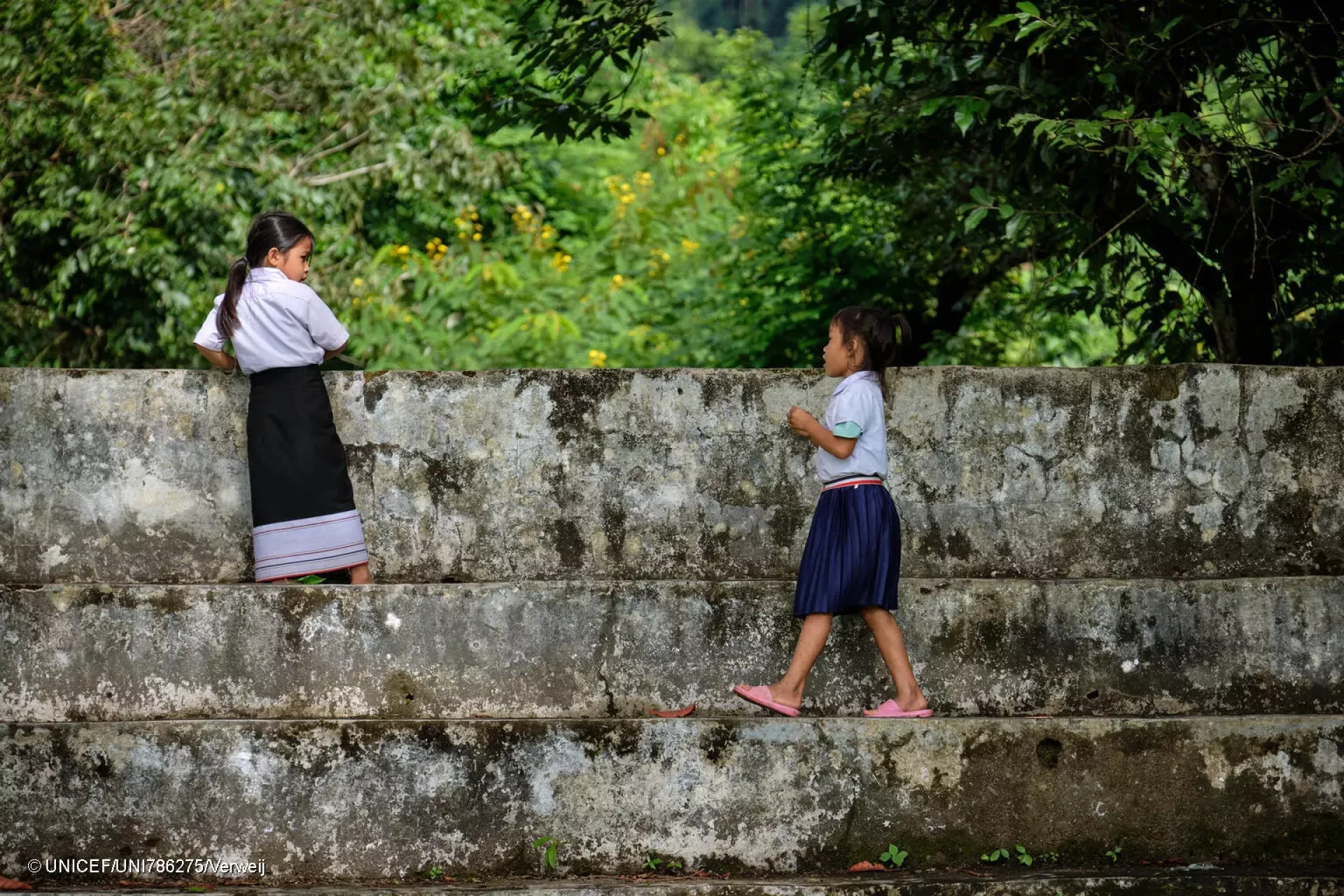
One year ago, on the International Day to End Corporal Punishment of Children, the Ministry of Justice formally declared a total ban on violent discipline in Lao PDR. By doing so, the country became the 66th worldwide—and the very first in ASEAN—to protect children from corporal punishment in every setting: at home, in schools, in alternative care and in the justice system.
This milestone followed the promulgation of the Amended Law on the Protection of the Rights and Interests of Children (December 2023). The revised law explicitly forbids any parent, guardian, civil servant or other individual from inflicting physical punishment on a child. It positions Lao PDR squarely in line with the Convention on the Rights of the Child and the Sustainable Development Goals.
Over the past 12 months, multiple ministries—supported by UNICEF—have worked to translate the law into everyday practice.
- Public awareness: A short video on the harms of corporal punishment, produced by the Ministry of Justice with UNICEF support, has aired on the “Social Justice” TV programme and circulated widely on Facebook and YouTube. This is coupled with a concise brochure summarising key legal provisions is being distributed nationwide.
- Positive parenting: Messages on non-violent child-rearing have been woven into the “Love and Care for Every Child” parenting package, now rolling out across all provinces.
- Strengthening the social service workforce: The Ministry of Labour and Social Welfare is implementing the National Strategy for Social Service Workforce Development, equipping professional and para-social workers—as well as front-line staff in health, education and justice—to identify, prevent and respond to violence against children.
- Child-friendly justice: Court staff, prosecutors and police officers have received specialised training on child rights and child-sensitive procedures to ensure that the justice system protects, rather than harms, every child who comes into contact with it.
A Call to Action
Evidence shows that corporal punishment is ineffective and can cause lasting physical and psychological harm. Yet nearly one in four Lao parents or caregivers (23 per cent) still believe it is necessary for raising a child.
Furthermore, despite overall progress violent discipline remains widespread. According to the Lao Social Indicator Survey 2023, a concerning 62 per cent of children aged 1-14 endure some form of violent discipline. While physical punishment has slightly declined to 31 per cent from 34 per cent in 2017, the situation remains alarming. Among the youngest, 30 per cent of children aged 1-2 and 43 per cent of those aged 2-3 are subjected to physical punishment.
Ensuring every child in Lao PDR grows up free from violence will require a whole-of-society effort. This is what you can do:
- Parents and caregivers can adopt positive, non-violent parenting techniques.
- Teachers and school leaders can model safe, supportive learning environments.
- Community and religious leaders can challenge harmful social norms.
- Government ministries and development partners can sustain investment in prevention, response and public education.
UNICEF stands ready to deepen its partnership with the Government, civil society and the private sector so that, together, we make corporal punishment a thing of the past—and guarantee every child the safe, nurturing childhood they deserve.