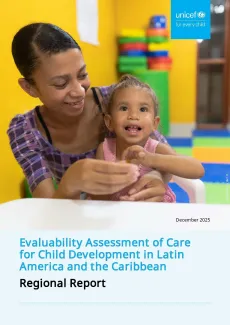
Evaluability Assessment of Care for Child Development in Latin America and the Caribbean
Regional evaluability assessment of the Care for Child Development approach in Belize, Bolivia, El Salvador, Honduras, Paraguay, Peru, and Trinidad and Tobago
- Español
- English
Highlights
The exercise sought to strengthen accountability by informing the development of a robust theory of change and results framework; facilitate learning by providing insights into CCD programme strategies, approaches, and results; and support decision-making by enabling refinements to CCD design and implementation. The exercise employed a mixed-methods approach combining quantitative, qualitative, and participatory research methods, including: 7 country case studies where CCD has been implemented; systematic desk review of 227 documents; primary data collection with 152 stakeholders; and secondary data analysis of the Multiple Indicator Cluster Survey and national information systems.
The assessment found that UNICEF offices had advanced in positioning CCD within national early childhood development agendas, but gaps remain in clearly articulated ToCs, monitoring frameworks, and disaggregated data. Scaling strategies, coordination, and institutional readiness for robust evaluation require strengthening to fully assess effectiveness, sustainability, and impact. The report makes four strategic recommendations to strengthen evaluability in principle, evaluability in practice, and overall evaluation readiness.