CAF marks one year of LAC Future Bank with nearly US$1.4 billion in projected initiatives guided by UNICEF’s Child-Lens Investing Framework
- Español
- English
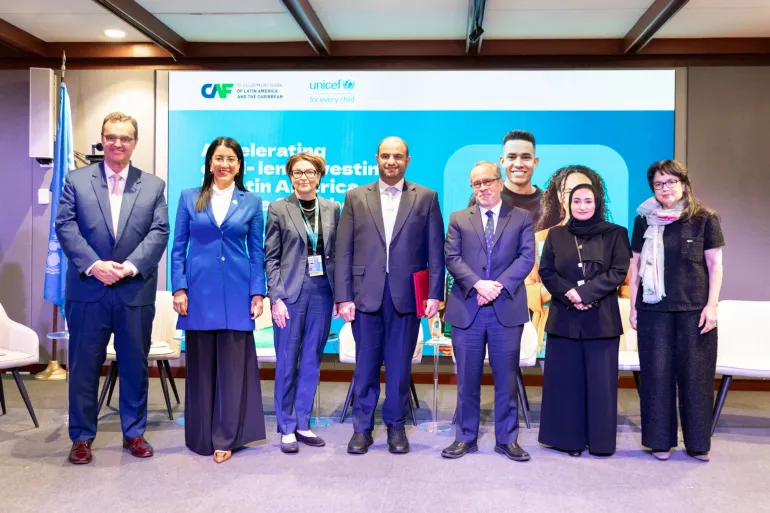
At a high-level panel at UNICEF House, CAF marked the first year of its pioneering adoption of UNICEF’s Child-Lens Investing Framework, bringing together leaders from governments, multilateral development banks and financing partners to review progress and forge new alliances to scale up child-focused investment across Latin America and the Caribbean.
NEW YORK, September 21, 2026. CAF –development bank of Latin America and the Caribbean– and UNICEF convened a high-level panel at UNICEF House, during the High-Level Week of the 81st session of the United Nations General Assembly, to mark the first anniversary of LAC Future Bank, the CAF’s regional initiative that places children, adolescents and young people at the center of development finance.
Under the title LAC Future Bank: One Year Later – From Promises to Results, the event brought together senior leaders from CAF, UNICEF and the Government of Ecuador, alongside representatives of regional and multilateral development banks, donor governments, investors and philanthropic partners to review progress, share lessons learned and identify new opportunities to increase investment in children and youth across Latin America and the Caribbean.
“Banco Futuro LAC shows that investing in children and young people is not only a social priority, but also one of the smartest long-term development investments our region can make,” said Alicia Montalvo, Vice President of Cooperation, Alliances and Resource Mobilization of CAF. “One year after launching this partnership with UNICEF, we are moving from commitments to concrete instruments, country operations and new alliances capable of mobilizing capital at scale for the future of Latin America and the Caribbean.”
In its first year, LAC Future Bank moved from vision to implementation, combining CAF’s financing capacity and regional presence with UNICEF’s technical expertise and child-lens methodology to help countries direct public and private capital toward measurable outcomes for children. By the end of 2026, approvals under the initiative are projected to reach nearly USD 1.4 billion, potentially benefiting almost 7 million children, adolescents and young people across the region.
“At a time when development resources are under pressure, every dollar must work harder for every child. One year into LAC Future Bank, we see how child-lens investing can turn priorities into results,” said Kitty van der Heijden, UNICEF’s Deputy Executive Director. “The collaboration between UNICEF and CAF highlights how innovative financing can unlock new opportunities and direct resources where they are needed most to improve the lives of children, adolescents and young people. The next step is scale impact and mobilize more partners,” added.
LAC Future Bank was presented by CAF and UNICEF in September 2025, during the 80th session of the UN General Assembly, with CAF committing to mobilizing USD 5 billion by 2031 to reach 50 million children, adolescents and young people. With that launch, CAF became the first multilateral development bank to adopt UNICEF’s Child-Lens Investing Framework (CLIF). The initiative responds to an urgent regional challenge: of the approximately 255 million children, adolescents and young people living in Latin America and the Caribbean, nearly 45% are at risk due to poverty, and many face inequality and violence.
In January 2026, CAF launched a USD 1 billion Children and Youth Bond Program, becoming the first multilateral development bank to apply CLIF to a bond programme in international capital markets. To date, CAF has issued more than USD 315 million under a common impact, governance and reporting framework aligned with CLIF, which strengthens project selection, impact measurement and accountability, and shows that child-focused financing instruments can be delivered with rigor, credibility and scale.
The event also highlighted the transition from partnership design to country-level implementation. The Minister of Labor and Human Development of Ecuador, H.E. Cynthia Gellibert, presented the country´s experience integrating child-focused evidence into development financing through the Nueva Infancia CAF program.
LAC Future Bank is also supporting financial incentive mechanisms linked to Sustainable Development Goals (SDG) results for children and young people, a concrete example of how results-based approaches can strengthen accountability and accelerate progress in early childhood development, health and education. Operations in Argentina, Barbados, the Dominican Republic, El Salvador, Honduras, Panama, Trinidad and Tobago, and Uruguay are also helping to consolidate the model and pilot the methodology.
At a time of declining traditional support for multilateral agendas, and with persistent poverty, inequality, violence and gaps in child-related SDGs across the region, the event underscored the need for a broader coalition to mobilize new resources for children. In a panel featuring representatives from organizations such as Qatar Fund for Development, Education Above All, the World Bank and the Governments of Ecuador and Finland discussed how donor governments, development finance institutions, multilateral and regional development banks, investors and philanthropic organizations can contribute through co-financing, guarantees, concessional resources, grants, technical assistance and other forms of catalytic support.
The event also featured remarks by Richard Martínez, who reflected on the role of young people in addressing some of the region's most pressing challenges. Richard serves as a representative on the UNICEF Latin America and Caribbean Regional Office Adolescent and Young People Action Board, a platform for dialogue and collaboration between UNICEF and young leaders across the region.
The dialogue also served as a peer-learning platform for financial institutions interested in adapting child-focused financing approaches to their own regions and markets. CAF highlighted its participation in the Child-Lens Investing Framework Community of Practice alongside other financial institutions, contributing to shared learning on how to integrate child-focused criteria into investment processes, project selection and impact measurement. In doing so, CAF and UNICEF positioned LAC Future Bank as a practical global reference for the Innovative Finance for Children (IF4C) agenda.
Media contacts
About CAF
We are a development bank committed to supporting the countries of Latin America and the Caribbean and improving the quality of life in the region. Our actions promote sustainable development and regional integration. We serve the public and private sectors, providing multiple products and services to a broad client base of 24 member countries, private companies, and financial institutions.
About UNICEF
UNICEF, the United Nations agency for children, works to protect the rights of every child, everywhere, especially the most disadvantaged children and in the toughest places to reach. Across more than 190 countries and territories, we do whatever it takes to help children survive, thrive, and fulfil their potential.
For more information about UNICEF and its work, please visit: www.unicef.org/lac
Follow UNICEF on X (Twitter), Facebook, Instagram, and YouTube
About LAC Future Bank
LAC Future Bank is a CAF initiative developed in collaboration with UNICEF to mobilize financing for projects that improve outcomes for children, adolescents and young people in Latin America and the Caribbean. The initiative combines development finance, capital markets innovation and child-lens investment criteria to support countries in prioritizing investments with long-term social and economic returns.
Note for editors:
UNICEF’s collaboration with CAF is solely with respect to the implementation of the CLIF criteria in Partner’s internal investment process, and is neither acting as an investment adviser nor has had or will have any role in the design, structuring, development, management or operation of any fund or investments managed by CAF or its affiliates. CAF has sole responsibility for making investment decision for any investments it makes or funds that it manages. UNICEF has not endorsed CAF or its affiliates, its investment strategy or any funds managed by CAF or its affiliates, or any investments of these funds. UNICEF may withdraw at its discretion and at any time from any association with CAF or its affiliates and will have no liability in relation to investments made or funds managed by CAF or its affiliates.