Latin America: adolescent girls spend on average seven more hours per week than their male peers on unpaid domestic and care work
A UNICEF study, which includes data from five countries in the region, revealed that the gender gap in care work can double for girls living in the poorest households
- Español
- English
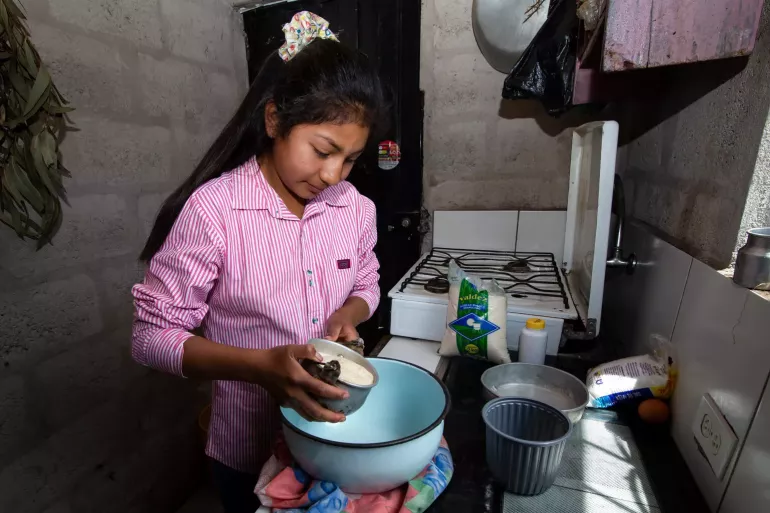
PANAMA CITY, 11 August 2025.– On average, adolescent girls spend at least one more hour per day—adding up to seven more hours per week—on domestic and caregiving tasks than their male peers, according to a UNICEF study on time use among adolescents in Latin America, which includes data from five countries in the region: Argentina, Chile, Colombia, Mexico, and Uruguay.
The involvement of girls in caregiving activities begins at a very early age and increases during adolescence, becoming more pronounced in the poorest households, where the gender gap in caregiving work can double. In these cases, girls may dedicate at least 14 more hours per week than boys to these tasks. Meanwhile, boys tend to spend a greater portion of their time on recreational and leisure activities.
Among the factors associated with the time adolescents dedicate to care work are the presence of children under five years old in the household, limited access to early childhood care services, and the level of involvement of parents in unpaid domestic work, which perpetuates gender inequality across generations.
“From a very young age, many girls in the most vulnerable households disproportionately take on domestic and caregiving responsibilities at home, which limits their right to study, play, and develop their full potential,” said Roberto Benes, UNICEF Regional Director for Latin America and the Caribbean.
“These inequalities take away their time to simply be children and affect their opportunities both now and in the future. It is essential that these families have access to quality care services for their young children, elderly family members, or relatives with disabilities, to ensure caregiving responsibilities are distributed fairly and do not fall disproportionately on adolescent girls”.
-Roberto Benes, UNICEF Regional Director for Latin America and the Caribbean
The evidence gathered by UNICEF also reveals a clear link between schooling and unpaid domestic and care work, with participation in caregviging higher among children and adolescents who do not attend school compared to those who do. At the XVI Regional Conference on Women in Latin America and the Caribbean, to be held in Mexico, UNICEF and UN Women will present a policy brief recommending the review and strengthening of care policies to:
- Expand the coverage of care services (for young children, older adults, and people with disabilities) and education as a necessary condition for redistributing care work and preventing it from falling disproportionately on girls and adolescents. This includes making services more accessible and sensitive to the time availability of adolescents.
- Provide social protection that supports transitions and promotes shared responsibility, including cash transfer programmes and other economic assistance that can reduce the caregiving burdens placed on adolescent girls.
- Promote cultural transformation from and for adolescence through campaigns targeted at adolescents, using their own language, media, and codes; raise awareness of caregiving as work equally valuable for both men and women (and boys and girls); promote masculinities grounded in shared responsibilities; and create spaces for collective participation and reflection through the education system, media, and communities.
- Generate robust evidence and strengthen information systems with specific, up-to-date, and disaggregated data by sex and age to understand the caregiving burden taken on by adolescents, its causes, and its consequences.
- Promote education for equality and the comprehensive guarantee of rights. To achieve this, it is necessary to transform the education system to be inclusive of those facing caregiving responsibilities through curricular adaptations, flexible learning modalities, personalized tutoring, and psychosocial support.
“Unpaid care work is one of the main barriers to gender equality. The unequal distribution of care work, which even affects girls, reflects social structures that continue to assign these tasks based on gender. To change this reality, we need public policies that redistribute care through the State, guarantee personal time for girls and adolescents, and promote cultural transformation. Ensuring fair caregiving conditions from early childhood lays the foundation for girls and adolescents to build a future with more freedom, equality, and opportunity,” said María Noel Vaeza, UN Women Regional Director for the Americas and the Caribbean.
Note for editors:
- About the study Time use among adolescents in Latin America, available here. This research is based on recent official time-use surveys conducted in Latin America. For this study, recent data from Argentina, Chile, Colombia, Mexico, and Uruguay were considered.
- Definition of care work: Care work refers to activities that regenerate the physical and emotional well-being of people on a daily and generational basis. It includes everyday tasks related to managing and sustaining life, such as maintaining domestic spaces and belongings, caring for bodies, educating/training people, maintaining social relationships, and providing psychological support to family members.
Media contacts
Additional resources
About UNICEF
UNICEF works in some of the world's toughest places, to reach the world's most disadvantaged children. Across more than 190 countries and territories, we work for every child, everywhere, to build a better world for everyone.
For more information about UNICEF and its work for children, visit www.unicef.org/lac/en.
Follow UNICEF on LinkedIn, Twitter and Facebook.
About UN Women
UN Women exists to promote women’s rights, gender equality, and the empowerment of all women and girls. As the UN’s leading entity on gender equality, we drive changes in laws, institutions, social behaviors, and services to close the gender gap and build an equal world by and for ALL women and girls. UN Women keeps the rights of women and girls at the heart of global progress—always and everywhere. Because gender equality is not just what we do; it’s who we are.
For more information about UN Women and its work, visit: https://lac.unwomen.org/es
Follow UN Women on X, Facebook, Instagram, LinkedIn, TikTok, and YouTube.