

COVID-19: Social Protection responses in Latin America and the Caribbean
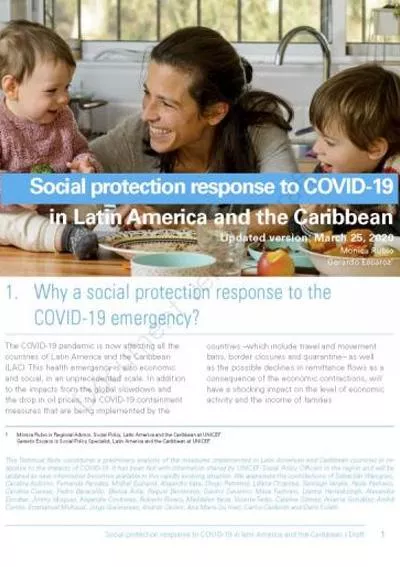
Social protection systems as the main mechanism of governments to provide timely and sufficient assistance to children and their families.

COVID-19 has impacted all countries in Latin America and the Caribbean socioeconomically, further deepening the pre-existing structural problems in the region. Many families have lost their livelihoods and income, and children nowadays face greater barriers to access health, education, nutrition, and protection services.
If countries do nothing to strengthen and build social protection systems based on a systemic approach, one out of every two children in Latin America and the Caribbean might live in households without the necessary income to cover their essential needs. This would imply almost 20 million additional children in poverty, mainly distributed in South America (over 13 million), then in Central America and Mexico (almost 5 million), and the rest in the Caribbean countries (1.2 million).[1]
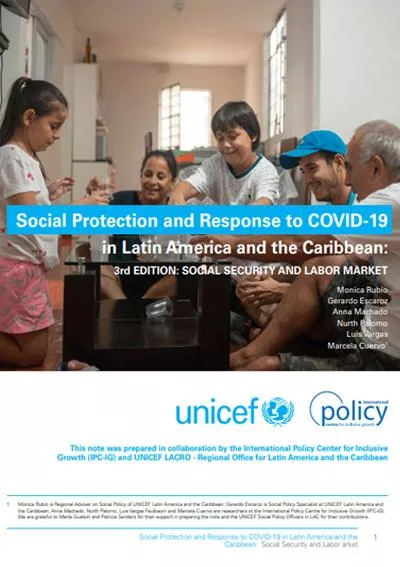
The crisis has exposed deep inequalities regarding access to social protection in all countries in the region. Before COVID-19, social protection systems had heterogeneous levels of development, which under normal conditions remained fragmented and even with visible deficiencies in coverage for some cases. In the region, 40% of the population lacked access to effective coverage of at least one social protection benefit in 2018. Similarly, a third of children, pregnant women, mothers with new-borns, and older adults did not have the right to monetary social protection benefits[2].
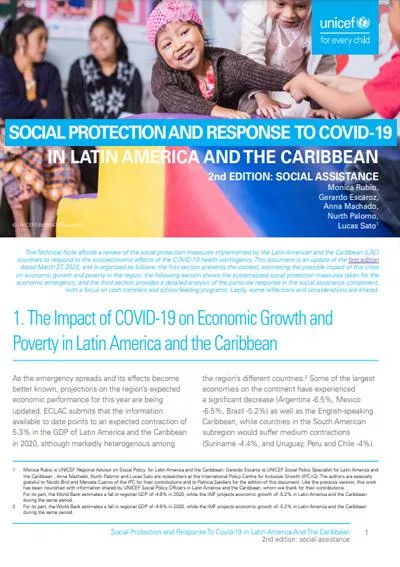
However, on the positive side, social protection programs became the main mechanism for governments to provide timely and sufficient assistance to children and their families during the pandemic and to mitigate the effects it is causing. In LAC, all countries applied some social protection measures in response to the crisis: at least 15 have adapted their existing social assistance programs, at least 18 creating new emergency transfers, and many countries even resorted to both strategies. Besides, the social security and labor market components were also adapted to protect employment during confinement.
In a short time, the region has experienced greater changes and innovations that seemed still distant a few years ago, such as the processes of identification, registration, and payment of beneficiaries of transfer programs, or the teleworking regulation as a flexible work modality that contributes to childcare. Social protection has become the main instrument for countries to respond to the socio-economic effects of COVID-19. The pandemic reshaped the regional and global scenario, placing the opportunity to invest in and strengthen social protection systems for all children on the development agenda.
This section provides an overview of social protection responses to face COVID-19 and the purpose of UNICEF to contribute to the construction of universal and child-sensitive social protection systems in Latin America and the Caribbean.
_____________
[1] United Nations Children's Fund, Technical note 3: Social Protection and Response to COVID-19 in Latin America and the Caribbean. Social security and labor market, UNICEF, s. l., s.f., pág 8.
[2] Banco Mundial, Organización Mundial de la Salud, Hacia la cobertura universal en salud y la equidad en América Latina y el Caribe, Banco Mundial, OMS, Washington, DC, 2017.
UNICEF offices in the region work to:

Provide technical and financial assistance for the adaptation or expansion of social protection programs during the crisis.

Design, finance, and implement cash transfer programs for populations excluded during the emergency.

Develop a solid and ambitious research agenda to understand the socioeconomic effects of COVID-19 on households with children and adolescents.
Resources
Regional research agenda in social protection
as a response to COVID-19

Online events
Results-Based Budgeting for Early Childhood Development: The Case of Peru (18 March 2021)
Evaluating the impact of the pandemic on early childhood development in LAC (9 December 2020)
Use of data and microsimulations to inform the response and recovery (6 October 2020)
Private sector and early childhood investment
(13 August 2020)
Early childhood care services packages in Latin America
(18 June 2020)
Early childhood and COVID-19: Responses to the emergency
(29 April 2020)
The impact of COVID-19 on poverty and inequality of children and adolescents in Peru: a comprehensive view (15 October 2020)

ENCOVID19: survey to monitor the effects of COVID-19 on the well-being of Mexican households, 4th round (8 December 2020)