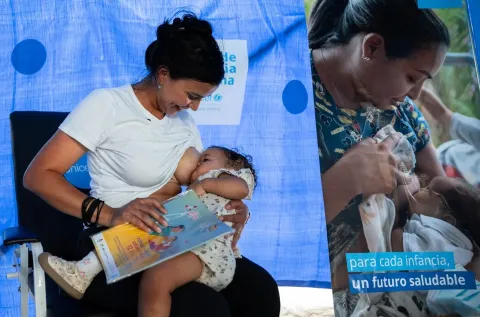
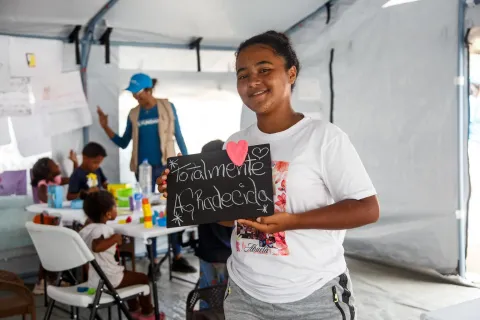
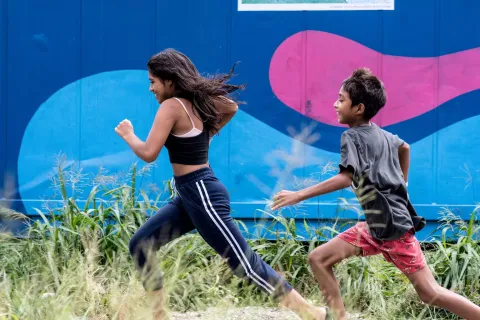
Under the shade provided by a huge white tent that stands at the José María Vargas Sports Center, in La Guaira, where hundreds of families affected by the earthquakes that devastated this state on June 24 find shelter, the sound of children's voices and laughter marks the entrance to the child-friendly space. Here, children find an oasis to emotional recovery from the difficult moments they experienced because of the earthquakes.
The space, managed by UNICEF in conjunction with the Foundation for Comprehensive Youth Care, Fundainil, offers psychosocial support to children, without neglecting the recreational and recreational component that allows them to feel heard and express their emotions with their own language at such a difficult time.
Yonaiker Del Rosario, Fundainil’s coordinator of Protection, highlights the importance of emotional management for children.
"In emergency contexts it is necessary to pay attention to aspects such as health and housing, but we can never forget the emotions."
Friendly spaces seek to create a safe space and the professionals who provide their support at this time come to strengthen the role of containment and support that families, teachers and communities also offer, but that in times of emergency they find it difficult to cover because they are also affected. "The important thing about the friendly space is that it is that small refuge where children and adolescents can clear their minds to feel happy and begin to recover from what happened."


The challenge for frontline workers
In the middle of the grass of the sports field there are hundreds of small white and blue tents that serve as a temporary roof for the families staying there. Yonaiker highlights the emotional challenge that humanitarian workers also face in managing such a high-profile crisis. The two consecutive earthquakes that occurred in Venezuela, of magnitude 7.2 and 7.5, have left thousands of dead, tens of thousands injured and thousands of families homeless.
"This is a new experience for each of us. We are trained to provide a response in terms of protection under any circumstance but experiencing it in practice is very different and it is an impact for each professional who is on site."
He adds that they are always attentive to look for emotional self-regulation strategies to be able to continue providing support with the highest quality to those affected. "A mother brought her daughter to this friendly space, she broke down when she told us that she lost her entire family and the only refuge she has left is the girl," he recalls. He recounts another difficult moment when a teenager told him that he lost his two sisters. "We must have the emotional management to handle that situation, because it also affects us."

He finds in the reactions of the children and adolescents in these difficult circumstances a great inspiration for his work. "I can count as good practice that they organized a protection brigade to support other children in this space."
He points out that this is a great example of how safe spaces help children in fundamental aspects such as emotional management and crisis management, but also to promote good treatment among peers and contribute to the enjoyment of their rights.
All this also drives him daily to put an extra effort into his routine, which begins very early each day in the transitional camp in La Guaira, where children are looking forward to him. Their journey will then continue at home, where they will plan new activities to help them express themselves creatively.
"You have to reinvent yourself every day so that each activity is different, and the children can feel safe within this space."
UNICEF remains on the ground, implementing protection measures as part of the response to the earthquakes to ensure that children and adolescents affected by the emergency have access to child-friendly spaces and specialized services that support their path towards recovery.