The Cedrón family is comprised of 15 members, ten children and five adults. Among the adults, Lincon (43) is disabled and communicates exclusively using sign language. Together the Cedrón grandparents, mothers, fathers, uncles, aunts, cousins, infants, children, and adolescents, range in age from just 10 months old to 56 years of age. Their main objective is to stay together. Having crossed the frontier with Panama, they have reached the Temporary Migrant Care Center (CATEM, by its Spanish acronym) in Ciudad Neily, in southern Costa Rica.
Exhausted, and suffering from the symptoms of malaria contracted during their journey through what they call “the green hell' – the Darién jungle that separates Colombia from Panama, the Cedrón family has remained united.

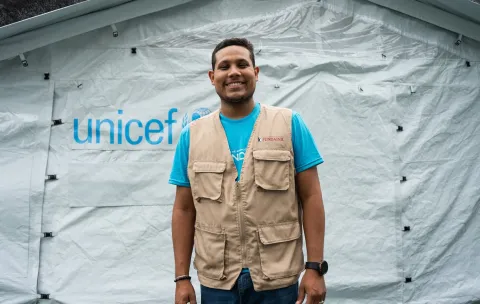
The CATEM is a temporary care center for migrants and refugee-seekers established by the Government of Costa Rica Immigration Authorities in October 2023 to address the unprecedented increased number of people, mostly families, arriving in the country through irregular routes involving the crossing of the Darién jungle.
The physical risks along irregular migration routes are innumerable, especially for infants, children, and adolescents, pregnant women and lactating mothers. In addition to the dangerous terrain they traverse, (from the dense jungle with its thick almost impenetrable foliage, dangerous animals such as snakes, mud, insects, and parasites, its rivers with strong and unpredictable currents, through railways and highways). On these routes children and adolescents can also suffer violence, exploitation, and abuse.
Some of these families leave immediately for their next destination, while others remain at CATEM to receive care to address their health requirements. Here at the CATEM, these families have access to safe drinking water, to hygiene and sanitation, and to protection services and referrals to meet their humanitarian life-saving needs.
The Cedrón family members are part of the more than 206.471 migrants who have entered Costa Rica during the first semester of 2024. According to statistics from the General Directorate of Migration and Immigration of Costa Rica (DGME), 529.348 people arrived from Panama during 2023. UNICEF estimates that 1 in 5 are children.

“The migration issue has been a constant since 2021, however, in 2023 we noticed a significant increase in the migratory flow with the particularity of the arrival of families with children, including small children, and adolescents.”
- Mónica Paniagua Zelada, Costa Rica’s UNICEF emergency officer
Yorkelis (13) and Alex (11) are two of the ten children and adolescents who are part of the Cedrón family. Along with them are their brothers (2 years and 10 months respectively) and their 6 cousins (ranging in age from 10 months to 18 years). The remaining family members are the five adults: two women (19 and 30 years old) and three men (24, 43 (Lincoln who is disabled) and 56 years old).
Yorkelis, Alex and their family arrived at CATEM suffering from malaria contracted in the jungle. Both of these children were also in very poor health conditions. It was here in the CATEM centre where the UNICEF frontline team was able to determine the family's needs and provide referrals to other institutions including to Costa Rica’s Child Welfare Agency (PANI) and to the Costa Rican Social Security Services (CCSS) to guarantee medical treatment, health monitoring, and support.
A space to return to childhood

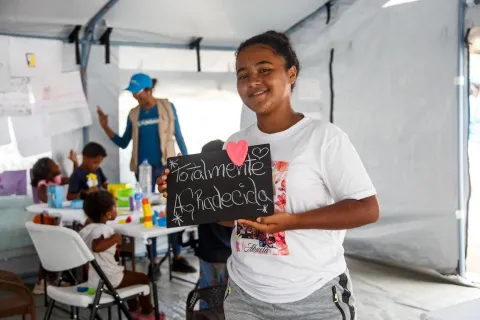
Yorkelis and Alex are part of the 35 children who have fun singing in chorus in one of the two Child-Friendly Spaces, supported by UNICEF. After their recovery they were able to join the activities.
The Child-Friendly Safe Space in the CATEM serves the migrant and refugee-seeking population located in the Center's accommodation areas, where people, mostly families, whose need is determined by the Center’s authorities and humanitarian respondents can stay from three to eight days. The second, in the EMISUR facility, opened in March 2024, serves the needs of the children in transit, those whom in some cases, are only transiting through EMISUR with their families during stays that range from a couple of hours, to never more than three days or so.
According to data from UNICEF Costa Rica, every month about 3,000 children and adolescents benefit from the Child-Friendly Safe Spaces, located in both the northern and southern zones, by participating in their guided psycho-social learning and ludic activities which, are specially designed to stimulate learning and support families in gaining increased awareness and knowledge of their children’s comprehensive development and mental health needs and rights. This is the purpose of UNICEF’s Child-Friendly Safe Spaces that in the CATEM and EMISUR facilities that are specially designed and adapted to meet the needs of migrant children, adolescents, and their families.
“We were able to see the number of children and adolescents who made use of the Child-Friendly Safe Spaces and we saw that it was effective. They could reach this point and say, 'here we found a place for play and learning.' That is something that perhaps already felt far removed for children like Yorkelis and Alex,” explained Dinia Vallejos, coordinator of the local PANI office.
She added: "Here there are two phases: children who travel alone, unaccompanied, but also children who travel with their parents. There are fathers and mothers who come with their children and what they want is to give them a better quality of life, but to move on to that main objective they must go through a whole journey where one could say that their children are rather at high risk. The challenge we have faced is that many children drop out of schools, their learning, and rights, including their rights to learn through play components are completely violated.
Mónica Paniagua Zelada, UNICEF’s emergency officer, added that “the main needs of these children and their families are lifesaving including food, safe drinking water, emergency and basic health interventions and access to child protection services.

In both, the CATEM and the EMISUR Child-Friendly Safe Spaces, girls, boys, and adolescents find ludic-learning activities. They learn and exercise their child rights through singing and dancing, and other form of learning and play especially designed for them. In these Child-Friendly Safe Spaces, these children take part in educational and ludic workshops to support their ability to cope with the stresses of what they have lived through. The Child-Friendly Safe Spaces’ specialized, guided activities promote an understanding in the children and their families of child rights, including the importance of addressing the psychological, physical, nutritional, and social developmental needs of children through a life-cycle approach. At the core of this work, is a strong foundation for the prevention of all types of violence, including gender violence.
“That is one of the most beautiful things we do here: that boys, girls and adolescents return to that childhood. They arrive after going through very difficult situations and that is why we want them to feel listened to and cared for. That they can be boys and girls again and that no one reproaches them for that,” said Juan Arias, at Fundación Acción Joven, UNICEF implementing partner.
For Yorkelis and Alex's family, it was a relief to know that there was a safe space for their children and nephews where they could play and learn through play every day. “The passage was very hard; I don't recommend anyone do it. But being here feels like a pause for all of us,” explained Carlos Cedrón, the grandfather.
“When I go to the Child-Friendly Safe Space, I feel happy, joyful and excited because I meet many classmates and I play with them,” said Yorkelis. “I've played with everything that's here,” added Alex.

Child-Friendly Safe Spaces are also an effective means and venue for the provision of psychological support. Here psycho-social services are provided and situations of children at risk and vulnerability are detected and prevented. “In this Space they recognize and realise their rights and that prevents the risk that they may suffer violence, abuse or neglect in the future,” added Diana Gutiérrez, psychologist at Fundación Acción Joven, UNICEF implementing partner in CATEM.
The Child-Friendly Safe Spaces are an initiative led by Costa Rica’s lead Child Welfare Agency (PANI), in alliance with the National Directorate of Community Development (DINADECO) and the General Directorate of Migration and Immigration (DGME), with UNICEF’s support.
Additionally, the actions promoted by UNICEF Costa Rica works in alliance with the Presidency of the Republic and local governments with the support of the Office of Population, Refugees and Migration of the United States Department of State; the United States Embassy in Costa Rica, France Embassy in Costa Rica, UNICEF Spain, UNICEF USA and the United Nations Costa Rica.
In addition to Child-Friendly Safe Spaces, UNICEF works to promote the water, sanitation and hygiene (WASH) humanitarian services through the construction and refurbishment of infrastructure for access to safe drinking water, safe sanitation services, showers, laundry, etc. On average 36,000 people use these WASH facilities per month. Additionally, UNICEF delivered over 5,315 hygiene kits and supplies in the first six months of 2024.
A path that continues

Yorkelis and Alex don't give up on their dreams. She wants to become a veterinarian or a doctor, he wants to become a firefighter. “As long as we stay together, I am sure we will do well. We take great care of each other. It has always been like this,” concluded with hope grandfather Carlos Cedrón.