Saving Sight
When Every Minute Counts

The children of Myrzaim and Umutaim have just undergone a check-up at the Osh Children's Hospital. The babies were born prematurely, and their eyesight is fine. The doctors assured that the children show no signs of vision impairment (retinopathy), which was joyful news for the young mothers.
"When I was told that my child is fine, I breathed a sigh of relief," says Umutaim. Myrzaim adds, "I am very grateful to the doctors; they pay great attention to every baby, especially those born prematurely."
However, not all stories end so easily. Gulnaz (name changed), who gave birth at 29 weeks of pregnancy, still does not know what awaits her son. We met her half an hour before the examination.
"I am not worried because the doctors here are very attentive. I was told that they underwent special training in Kazakhstan," shares Gulnaz, waiting for the next examination. The family doctor insisted on checking the baby's eyesight, and now the doctors are preparing for an examination that could change everything.
Gulnaz preferred not to be photographed herself but agreed to take a photo of her child and the examination so that other mothers would also consider checking the health of their babies, especially if they were born prematurely.
During the examination, the doctor suspected her son had vision impairment (retinopathy—a condition where the blood vessels in the retina do not develop properly) and the risk of developing blindness. It was recommended to urgently fly to Bishkek for surgery.
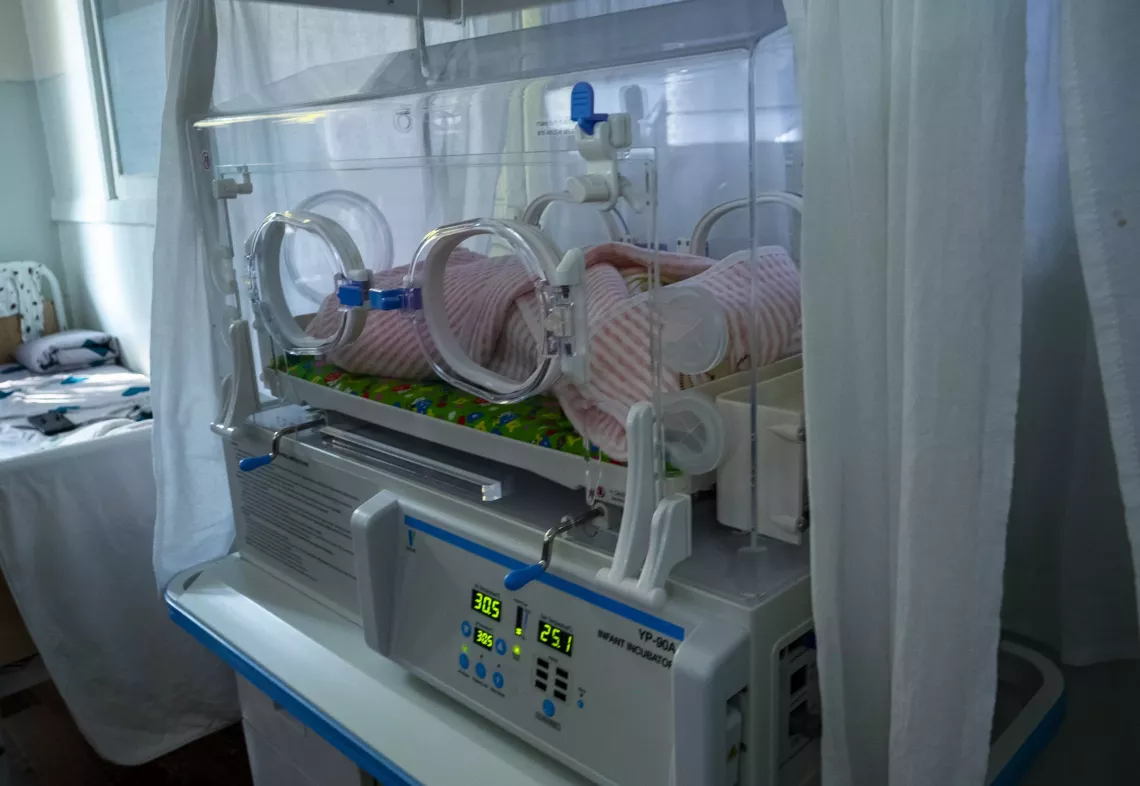
Retinopathy of Prematurity: A Threat Requiring Early Diagnosis
Premature babies often develop retinopathy, which, without urgent surgery, can lead to blindness. Since October 2019, screening and early detection of retinopathy have been conducted in medical institutions in Kyrgyzstan with the highest concentration of premature newborns. If the diagnosis is confirmed, the child's vision can be saved through surgery, but time plays a crucial role.
By 2030, the Ministry of Health plans to create a system of accessible and comprehensive medical care for newborns with retinopathy. This includes early diagnosis in maternity hospitals and modern methods of surgical correction.

Training That Gives a Chance to See
Previously, only doctors in Bishkek could diagnose retinopathy in newborns by examining their retinas. However, since January 2024, active work on early detection of retinopathy has begun at the Osh Regional Hospital. Premature newborns are sent here from all southern regions of Kyrgyzstan, which accounts for more than half of all newborns in the country.
Aigul Azizova, an ophthalmologist, underwent two weeks of training in Almaty with the support of UNICEF, where she mastered modern methods for timely detection of retinopathy. "In Kazakhstan, such examinations have been conducted for 12 years," shares Aigul. "We were at the perinatal center, where there is an operating room right in the maternity hospital for immediate treatment of children with detected retinopathy. This is an invaluable element of the medical system; we wish we had something like this here."
Now, in the southern regions of Kyrgyzstan, there are doctors who can timely save the vision of newborns by promptly identifying pathologies and referring patients to Bishkek.
The story of Gulnaz and her newborn son is one of many where doctors manage to timely detect retinopathy and save the child's vision. Thanks to the support of UNICEF and the dedicated work of the doctors at Osh Hospital, premature babies are given a chance for a full life.

A Chance to See: Combating Retinopathy of Prematurity in Kyrgyzstan
In Kyrgyzstan, timely detection of the risk of vision loss (retinopathy) began only in 2019, and surgeries started in 2024. Dinara Suerkul kyzy, an ophthalmologist at the NCOD Ophthalmology Department, shared that over the past few years, about 120-130 premature babies with various forms of retinopathy were sent abroad for treatment. Since 2024, doctors have started treating children with retinopathy on-site.
Timely consultation, diagnosis, and treatment of retinopathy of prematurity, along with collaborative teamwork with neonatologists and anesthesiologists, prevent blindness in 50 out of 100 newborns at risk of blindness each year. Currently, this screening for early detection is available in only 10% of medical institutions.
The widespread implementation of early detection of retinopathy and timely high-tech medical care will reduce state budget expenditures and improve the quality of life for children with retinopathy. Most importantly, a newborn child has the chance to preserve their vision and see the world around them in all its beauty.
On March 5, 2025, the Ministry of Health issued an order to develop neonatal screening services, creating a map and plans to expand neonatal screening to ensure that every newborn has a chance to see, regardless of where the mother gave birth.