New horizons for girls
The UNICEF project helps girls in Kyrgyzstan overcome stereotypes and explore STEM fields

"We are told that girls can only become cooks, taylors, or nurses," says Nilyufar, a student at Akmatov School in the village of Borbash, Nookat District.
According to her, for many girls, their careers are chosen by their parents based on gender stereotypes. Many are not able to choose their profession and are forced to follow traditions or social expectations.
For example, Nilyufar's parents told her she would become a doctor, and she lived with that belief. However, everything changed when she attended a lecture for students organized by UNICEF.
Overcoming Stereotypes and Family Expectations
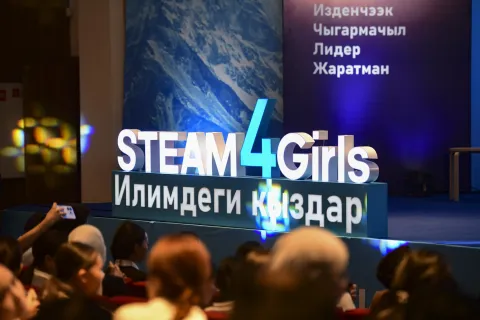
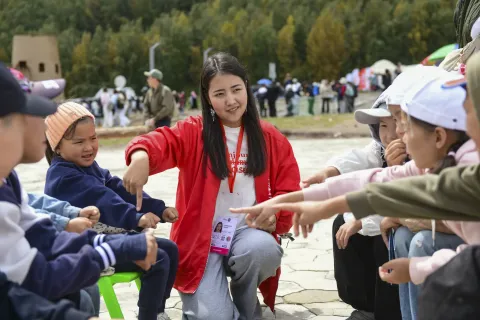
The lectures were organized as part of the UNICEF project "Girls in Science," which aims to empower girls. The project not only teaches the basics of STEM (Science, Technology, Engineering, and Mathematics), but also helps girls become leaders in their communities, develop public speaking skills, and build self-confidence.

Inspired by her classmates and the project leaders, she gained the courage and determination to choose her own path. Nilyufar became interested in tourism and decided to become a tour guide.
First Steps Toward a Profession
After taking part in the project, Nilyufar started to actively grow in her chosen field: learning English and studying eco-friendly technologies. Together with her classmates, she organized talks about waste recycling for the people in her village, encouraging them to care more about cleanliness and the environment.

Nilyufar believes that the state of the environment is closely linked to the development of tourism: "People should come and visit clean and beautiful places."
Although she had support from her school and was part of the project, Nilyufar initially faced criticism and teasing from her peers.
But later, those same girls expressed an interest in her success and asked to join the "Girls in Science" project and submitted the application. As a result, 30 girls from Borbash village followed Nilyufar and joined a similar UNICEF project.
Promoting STEM
The UNICEF project not only teaches girls the basics of science and technology, but also inspires them to create their own initiatives. For example, Nilyufar plans to open an eco-center in her village in the future.
One of the biggest successes of the program is the change in the way teachers support and teach girls. The project collaborates with teachers, parents, and school staff to create a supportive environment. This helps girls not only learn STEM but also use it in school, at home, and in their community. Nilyufar's teacher, Mahabat Nurzhinova, says she didn’t know about the STEM before the project, but now she sees how important it is and fully supports her students.
"Now I understand that this is very useful for everyone. STEM is a part of life, it's what we use every day," she says.
UNICEF also gave the girls a book with teaching methods, which is now actively used in the school.

"I always thought that Jazgul should become a teacher, just like me, but after the STEM courses my student attended, I changed my views," says Nurzhinova.
The Role of Mentors and Role Models
Nilyufar was inspired by successful women in science she met through UNICEF. Her role mentor is a psychologist who teaches in Osh.
"She’s strong and amazing. I want to be like her," says Nilyufar.
Nilyufar adds that she has learned to speak in front of an audience and is now ready to share her knowledge with others.

Why "Girls in Science"?
There are still only few women in science. According to UNESCO, only about one-third of researchers are women. Since the times of Marie Curie in 1903, only 17 women have won Nobel Prizes in Physics, Chemistry, or Medicine, compared to 572 men.
It’s hard for girls to dream about careers they don’t see around them. Without support at home, school, or university, it’s even harder to plan their education and future.
The "Girls in Science" program helps girls who want to succeed in science and shows them that they can overcome stereotypes and choose their own path.
Nilyufar Abibilaeva’s story is one example of how education and support can change lives and create new opportunities.