Finding “another half of the heart”
The story of a 13-Year-Old adolescent raised in “Kovcheg” private children’s family home

Nine years ago, a four-year-old boy arrived in Almaty by train from Petropavlovsk. Here, in Talgar, a town in southern Kazakhstan, “Kovcheg” (Russian for “ark” — translator’s note) was expecting him. The kids who live here would not call this place a children’s home. “We’re a family,” says a serious girl standing at the entrance to the courtyard.
“Kovcheg” is an inclusive private children’s home, one of the few in Kazakhstan that aim at finding foster families for each and every one of their children and to eventually “go out of business.” “Kovcheg” helps families in difficult situations and works with professional foster families.
According to Marina Sugakova, head of “Kovcheg,” 65 children have found a foster family and 148 children have been returned to their natural families.
Today there are over thirty children living in the family and Maxim Utyuganov from the far-away northern city has become part of this friendly community.
“Kovcheg” staff has been working on the problems of children without parental care since the early 2000s. It started with a group of enthusiasts doing volunteer work and paying weekly visits to children’s homes, and then they created their own children’s home on the large and picturesque territory of the former pioneer camp “Leninets.” For many years, the home has been funded privately by concerned people and companies, without any budgetary funding.

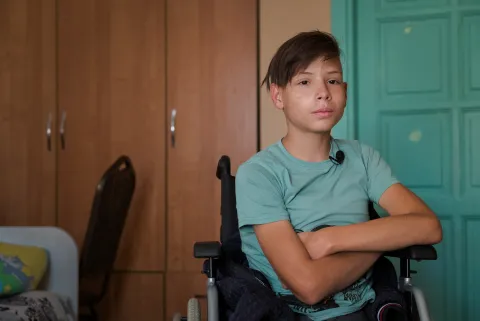
Maxim is the only one in “Kovcheg” who has to move around in a wheelchair. According to Maksim, this does not affect his ability to get to where he needs to be and enjoy physical activities.
“I skateboard. My skateboard can speed up to 40 km/h. It’s electric! My remote control has broken down, though,” he says. And while the board is waiting in the corner of his room, Maxim plans to take up a new amateur sport: “I think when school starts, I’ll try workout.
The home allows its inhabitants to choose and attend the classes to their liking, which is probably why Maxim is so confident and relaxed about his options. “Maybe I’ll take up speedcubing — assembling Rubik’s cube. I like puzzles, too, by the way,” he shares. On the shelf in his room there is a colorful triangular Rubik’s cube, and to the right of the bed there is a guitar. Maxim refuses to demonstrate his humble skills and play the instrument that “Papa Guido” gave him.
“Papa Guido” is one of the founders of “Kovcheg.” He never planned to open a children’s home in Kazakhstan, but found himself in that role by a twist of fate. Mama Marina is his companion. The leader of the “Kovcheg,” Marina Sugakova does everything in her power to make the life of the children in the home closer to the life of their peers who live with their families — here she meets a girl who has returned from kindergarten, and here for the tenth time she sincerely admires the ability of one of the children to masterfully operate a tolocar (a toy car).

Maxim, 13, also wants his share of attention: by September 1 he has a fancy haircut, and recently he had his hair tinted purple and pink. The school administration and teachers do not interfere with bold experiments like that. When asked about school, the teenager answers evasively: “When I am in a good (mood — editor’s note), I can get A’s all day long. Maxim’s preferred subject is computer science, and he considers IT to be the most promising for him so far.
“I may be studying to become an IT specialist,” says Maxim. But he immediately makes it clear that this choice is more likely due to rational reasons than a sincere and deep desire to master programming. In fact, the teenager dreams of becoming a cynologist because he loves dogs and prefers to spend his free time to reading specialized books about the habits and character of these animals. “I already have experience. Some professional cynologists came and trained us. They brought their dogs with them — a Labrador and a Husky,” explains Maxim.
For his birthday, the teenager likes to treat his large family to some sushi he orders from a restaurant. Commenting on what he would like to get as a present, Maxim suddenly says — “a quiet day.”
In the sewing shop, Angelina comes up to Maxim and shows her hand, saying, “Max, look, I have half a heart. “Draw me another half,” the teenager responds swiftly.

The atmosphere at “Kovcheg” in the summer resembles a children’s camp: after spending a couple of hours in the workshop, the kids noisily storm into the canteen for an afternoon snack, take bananas, and go off to take care of their own business. Some of them roll down the main alley on a skateboard. Maxim catches the last summer day’s sun rays sitting by the building; the girls fill their watering cans and methodically water the flowerbeds for a while until Marina’s mother gives her permission to go jump on the trampolines.

Maxim sits in his coffee-colored room and shares his plans: “I dream of flying to Italy, maybe. And Israel. Find something, see the people there.” Almaty is the only city he is considering at the moment as his place of residence in the future. He will have his own house in the city, the teenager said, because it is easier to adapt it for one’s needs than an apartment.
UNICEF does not support “Kovcheg” children’s home family home directly, but works closely with government agencies and partners to ensure that children in Kazakhstan can live with their own or adoptive families rather than in institutions.
For more than two decades, UNICEF in Kazakhstan has been solving the various problems of children without parental care, and has worked tirelessly to ensure that every child has a family.
Maxim doesn’t want to start a family in the future: “Maybe a couple of dogs, and that’s a maybe. And a parrot to make it more fun.”
Help children find a loving family.
Make a donation of any amount, your support will help children return to their biological families or find foster parents.