Sanaa’s Journey to a Happy Home
A mother’s transformation through the Happy Home programme at Makani Centre.

- English
- العربية
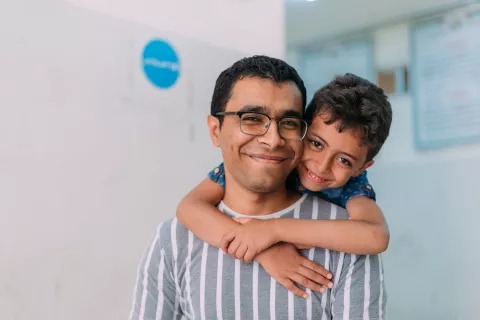
Sanaa, a dedicated 45-year-old mother, experienced a transformative journey thanks to a UNICEF-supported programme called our happy home at the Makani Centre. Her story is one of resilience, learning, and the unwavering love of a mother for her child.
Sanaa's only child, Ammar, is a lively five-year-old who, like many children his age, is full of energy and curiosity. However, Sanaa often found herself struggling to manage his behavior. Ammar would frequently shout, break things, and even hit others. Sanaa, feeling overwhelmed and unsure of how to handle these challenges, resorted to punishment, which left her heartbroken.
One day, while scrolling through social media, Sanaa came across an advertisement at the UNICEF supported Makani Centre, which offered a kindergarten and various other services. Intrigued, she decided to visit the centre to enroll Ammar in the kindergarten. Little did she know, this decision would change their lives.
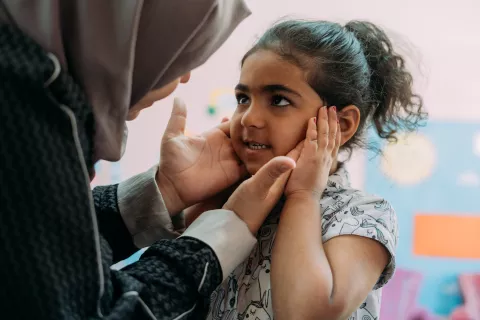
At the Makani Centre, Sanaa learned about the Happy Home course for parents, a UNICEF-supported initiative designed to equip parents with the skills and knowledge to raise their children in a healthy and nurturing environment. "I was intrigued because I learned that this course would teach me the best ways to raise my child and how to deal with him," Sanaa recalls. Eager to provide the best for Ammar, Sanaa enrolled in the course.

For three months, Sanaa attended the Happy Home course while Ammar was in the kindergarten. The convenience of having her child nearby allowed her to focus on learning without worry. "It was very convenient and put my mind at ease knowing that my child was nearby," she says.
The course was a revelation. Sanaa discovered that children learn by imitating their parents and that positive engagement is key to their development. "One of the most impactful lessons I learned was the importance of modeling the behavior I wanted to see in Ammar," Sanaa explains. Instead of ordering him to clean up his messes, she began to clean alongside him, asking politely for his help. This simple change had a profound effect. "It worked like a charm. Now that my son sees me speaking politely to him, he has become polite himself and has learned how to clean up the mess he makes because I do it in front of him."
The transformation didn't stop there. Sanaa realized that her own anger was mirrored in Ammar's behavior. By managing her emotions and creating a calm environment, she saw a significant reduction in Ammar's outbursts. "He was no longer the angry child I once struggled with; he was becoming a reflection of the calm and patient mother I was striving to be," she says.
The Happy Home course also emphasized the importance of self-care for parents. Sanaa learned that to be the best parent she could be, she needed to take time for herself. "In the past, I gave all my time to others and never took time for myself. That made me burned out and short-tempered all the time. But now, I take time out, away from everything, and just sit and relax," she shares. This has had amazing results because she no longer feels burned out and has more energy to give to her family.
Today, Sanaa and Ammar's relationship is stronger than ever. The skills and knowledge she gained from the UNICEF-supported Happy Home course have empowered her to create a loving and supportive environment for her son. Sanaa's journey is a testament to the transformative power of education and support, and it highlights the vital role that UNICEF-supported programs like those at the Makani Centre play in building stronger families and communities.
The Parenting Programme is one of the Early Childhood Development which takes place in UNICEF supported Makani Centers. It aims to empower parents to be able to provide a stimulating, loving and protective environment at home. Through this programme, parents acquire knowledge and skills that promote the psychosocial, cognitive and physical development of their children.
This programme is implemented thanks to the generous support of The Government of Germany (BMZ) through (KfW).