A Strong Start in Basra: Expanding Early Childhood Education in Al-Faw
New early childhood education centres are giving children in Al-Faw the chance to learn, grow and thrive.

- English
- العربية
Breaking Barriers to Early Learning
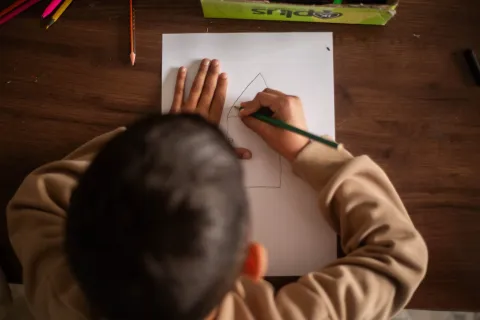
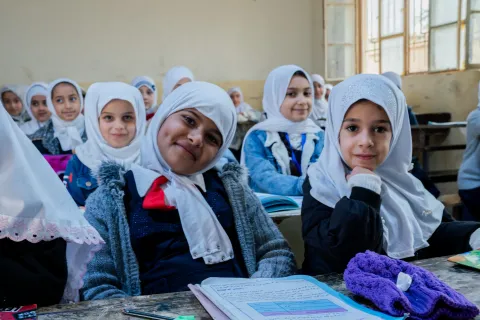
In the southern district of Al-Faw, Basra, young children are finally getting the chance to begin their education in safe, child-friendly classrooms. Until recently, families in the district relied on a single overcrowded kindergarten, where more than 75 children packed into each classroom. Teachers struggled to provide individual attention, and many children entered primary school without the basic skills they needed to succeed.
Across Iraq, this story is all too common. Only 11 per cent of children aged 4–5 are enrolled in early childhood education, and in Basra the figure is even lower, at just 9 per cent. Limited infrastructure and a shortage of dedicated early learning spaces mean that thousands of children miss out on this crucial foundation for lifelong learning.

New Spaces, Brighter Futures
To close these gaps, UNICEF partnered with the Ministry of Education and the Basra Directorate of Education, with generous support from Daewoo Engineering & Construction and the Korean Committee for UNICEF. Together, they launched a three-year initiative to expand access to early learning in some of the most disadvantaged areas of Al-Faw.
“When my daughter comes home from class, she sings the new songs she learned. I can see how excited she is every morning to go back,” said the parent of an ECE student.
Between 2023 and 2025, five new school-based ECE centres were constructed, each with spacious classrooms, safe outdoor play areas and child-friendly facilities. Four centres opened for the 2024/2025 academic year, while the fifth will open in 2025/2026. Once fully operational, the centres will host 450 children each year, compared to just a fraction of that number before the project began.
Strong community advocacy played a decisive role: the Basra Directorate of Education exceptionally approved to increase the number of children per class from the national limit of 25 children to 45 children per class, allowing more children to benefit from early learning opportunities.
“At first, we thought our children would have no place to learn. Now, with these new centres, we feel the future is brighter,” said Ahmed, whose daughter is now enrolled in one of the centres.

Strengthening Teachers and Schools
The project also trained 24 female teachers in Iraq’s national pre-primary curriculum and new ECE quality standards, while 24 school management committee members, most of them women, received training in school-based management (SBM). These efforts strengthened both teaching and governance, ensuring that the new centres not only expanded access but also improved quality.

Communities Leading Change
By the end of this project, more than 450 children will be enrolled each year in the new centres, leaving a lasting legacy for early learning in Basra. With continued support, UNICEF aims to build on this success and expand early learning opportunities so that every child in Iraq gets the strong start they deserve.
Communities Leading Change
Parents and caregivers also played a vital role. Through awareness campaigns and local civil society organizations, communities engaged around the importance of early childhood education. Their engagement not only increased enrolment but also built strong ownership that will sustain the centres for years to come.
“Before, I was shy and didn’t like to talk in class. Now, I answer questions and have many friends,” said Asal, 6 years old, a student at Wadi Al-Salam School
A Lasting Impact
By the end of the project, more than 800 children will have gained access to safe, stimulating early learning environments in Al-Faw. The initiative has reduced overcrowding, built teacher and community capacity, and demonstrated the power of partnership in giving children the best possible start in life.
With continued investment, these gains can be scaled up across Basra and Iraq—helping ensure that every child has the chance to learn, grow and thrive from the very beginning.