World Children’s Day 2024
Statement by UNICEF Regional Director for the Middle East and North Africa Adele Khodr
- English
- العربية
AMMAN, 20 November 2024 - “On World Children’s Day, we honor the promise we made to every child — to protect and uphold their rights, safeguard their future and nurture their potential.
“35 years ago, these promises were adopted in the United Nations Convention on the Rights of the Child (CRC). Children’s unique and inherent rights were recognized by world leaders who committed to uphold them.
“34 years ago, I joined UNICEF. From Sudan, Nepal, Cote d’Ivoire and Afghanistan to Sierra Leone, India, and Ethiopia, and now as UNICEF’s regional director for the Middle East and North Africa, I have had the absolute privilege of spending my life working for children’s rights.
“Ahead of my retirement tomorrow, I have been reflecting on these past decades. I worked as the CRC became the most widely ratified human rights treaty in history, with 196 countries behind it. And then I witnessed firsthand that many of those countries blatantly disregard this vital international agreement.
“I retire proud of the progress we made across those countries and many others, but I also leave in fear of the worsening situation for children, especially in the Middle East and North Africa.
“The data are sobering, highlighting the continued need for extensive efforts to uphold children's rights and improve the prospects for a better future for all children in the region. For example:
- There are 198 million children in this region. UNICEF estimates that about one quarter of them require urgent humanitarian assistance.
- Nine out of ten children in the region live in areas of high or extremely high-water stress, exacerbated by climate change.
- Every year, 700,000 girls are forced into child marriage.
- Almost 17 million children are out of school and a staggering 63 per cent of 10-year-olds in the region are unable to read and understand a simple text, highlighting a severe learning crisis.
- 1 in 3 children suffer from at least one form of malnutrition.
- Millions of children are refugees or internally displaced.
“This does not reflect a collective respect for children’s rights.
“Further, this year has brought devastating violence across the Middle East – including in Sudan, Lebanon and the State of Palestine – while protracted conflicts continue in Syria and Yemen. Children are the main victims in these conflicts, subjected to killing, maiming, unimaginable suffering, displacement, and trauma.
“Many of the schools, hospitals, and essential infrastructure they rely on have been destroyed, leaving them without the spaces and support systems they need to grow and thrive. Others are forced into labor, recruited by armed groups, or married far too young, all to survive circumstances beyond their control.
“Each child robbed of safety and support is a lost opportunity for the region to move toward a peaceful and stable future. Every destroyed classroom, every missed vaccination, and every moment of violence or abuse brings us further from the vision of a world where every child grows in a safe environment and has a fair chance to reach their potential.
“This generation faces enough challenges as it is. But UNICEF’s State of the World’s Children report released today reveals how three global megatrends - demographic change, the climate and environmental crisis and breakthrough technologies – will impact children’s lives in 2050 depending on the choices world leaders make, or fail to, today.
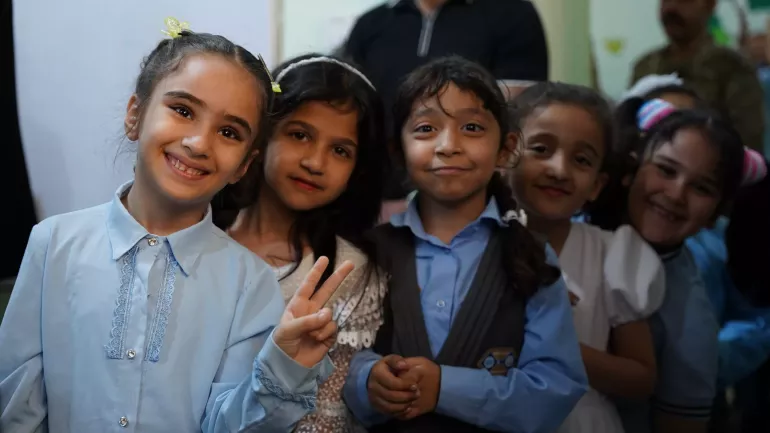
“In the face of these myriad challenges, UNICEF and our partners are doubling down on efforts to reach the most vulnerable children with life-saving assistance. And it is here that I find hope. In the kindness, laughter and smiles of children who are surviving unimaginable hardship. They have vision and hope for the future; we must do our utmost to listen to it and honor it. I also find hope in the commitment of my UNICEF colleagues in the Middle East and North Africa who continue to work on the realization of children’s rights as enshrined in the CRC without fear and with determination.
“At no time since the CRC was adopted 35 years ago have children’s rights been in greater jeopardy. We urge all leaders in the Middle East and North Africa, and those elsewhere with influence in the region, to act now to protect children and their rights. All parties in conflict zones must respect international humanitarian and human rights laws, including by protecting children, ensuring the flow of lifesaving aid and ending attacks on schools, hospitals and other civilian infrastructure.
“On this World Children’s Day, let us strengthen our resolve to advocate for children’s rights and ensure that the commitments made by countries over the past 35 years are put into practice, that there is true accountability for violations of children’s rights and every child in this region, and the world, knows we are keeping our promise to them.”
#####
Notes to editors:
Download multimedia content.
Access the SOWC Statistical Compendium.
Media contacts:
Ammar Ammar, +962 7 9183 7388, [email protected]
Salim Oweis, +962 7 9936 5212, [email protected]
Tess Ingram, +962 7 9385 7212, [email protected]
Media contacts
Additional resources

About UNICEF
UNICEF promotes the rights and wellbeing of every child, in everything we do. Together with our partners, we work in 190 countries and territories to translate that commitment into practical action, focusing special effort on reaching the most vulnerable and excluded children, to the benefit of all children, everywhere.
For more information about UNICEF and its work for children, visit www.unicef.org.