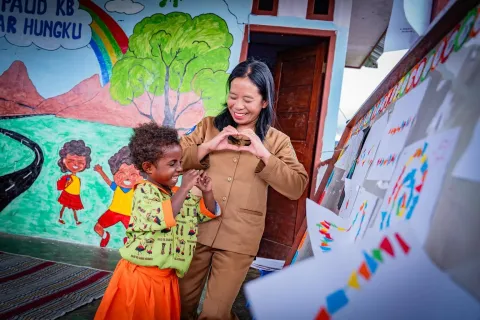
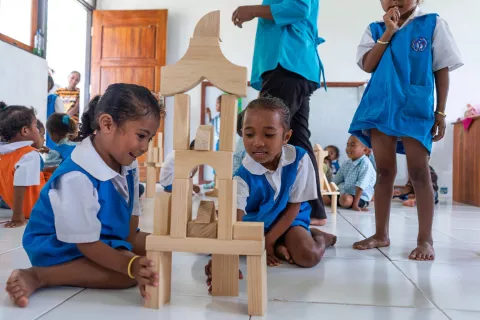
When teachers are supported, children thrive
At a primary school in Asmat, South Papua, teachers, school leaders and community representatives are working together to address teacher absence and keep children learning.
- English
- Bahasa Indonesia
Meylani’s hand shoots up when the teacher asks who would like to read aloud. Around her, other hands rise too. For the second-grade student, moments like this are part of what makes school worth the journey. But these moments depend on something children should be able to count on every day: a teacher in the classroom.
Meylani’s school day begins at 5 a.m. After breakfast, she packs her books and leaves home at 6 a.m. The distance to school is about 10 kilometres away. She usually walks, meets friends along the way, and enjoys the fresh morning breeze. On some days, her father, Emanuel Metaweyau, takes her to school before heading to work in the fields.
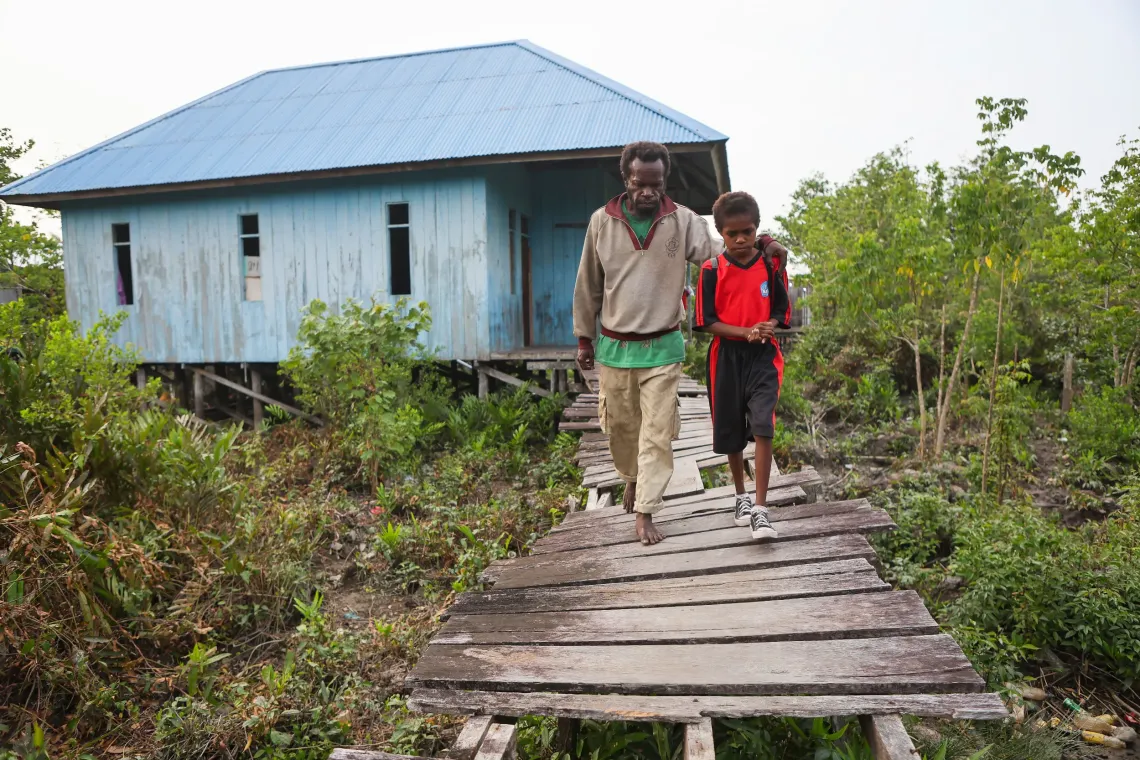
By the time Meylani reaches the wooden-clad schoolyard on Monday morning, it is already filled with students. Established in 1987, SD Negeri Inpres Syuru is one of the oldest public primary schools in Asmat District, South Papua, and has long been part of the rhythm of community life.
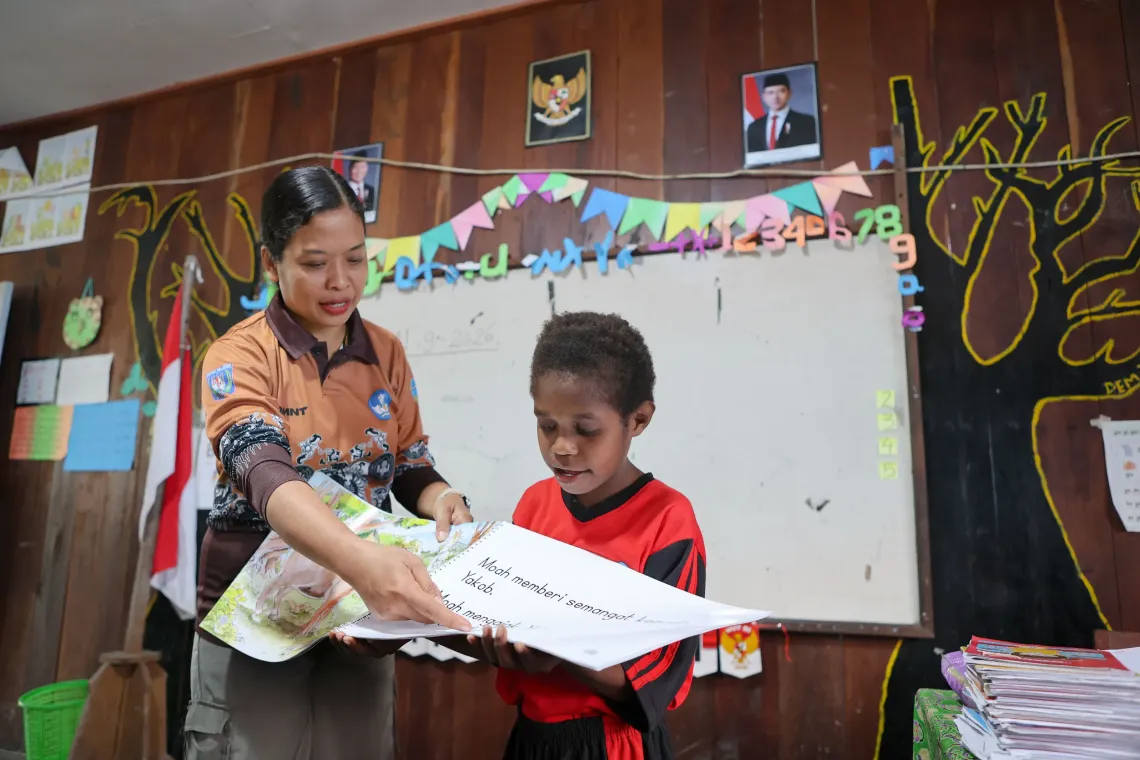
For Meylani - Mey to her friends - school is more than a place to learn and spend time with friends. She loves dancing and playing football and often stays after school to play in the schoolyard before walking home. But it is learning—especially her Indonesian language classesthat draws her most strongly to school. It is where her dream of becoming a nurse begins to feel possible—a dream nurtured each day by teachers who guide, encourage and support her and her classmates. Their presence gives her not only lessons, but also the confidence to imagine a future beyond the classroom.






Not every child in Papua can count on that. Across many remote areas of the Papua Provinces, schools continue to struggle with teacher absenteeism. At SD Negeri Inpres Syuru, the responsibility for confronting this challenge falls in large part to Susilo, the principal who has led the school for two decades.
Over those years, Susilo has seen both how deeply children depend on their teachers and how rapidly the school has grown. “When I arrived here in 2006, we had six classrooms or as we say in Papua, six Rombongan Belajar (rombel). We now have 21 rombel and more than 500 students,” he says.
For him, every new class underscores the same reality: when a teacher is absent, more children risk losing the guidance and continuity they need to learn.
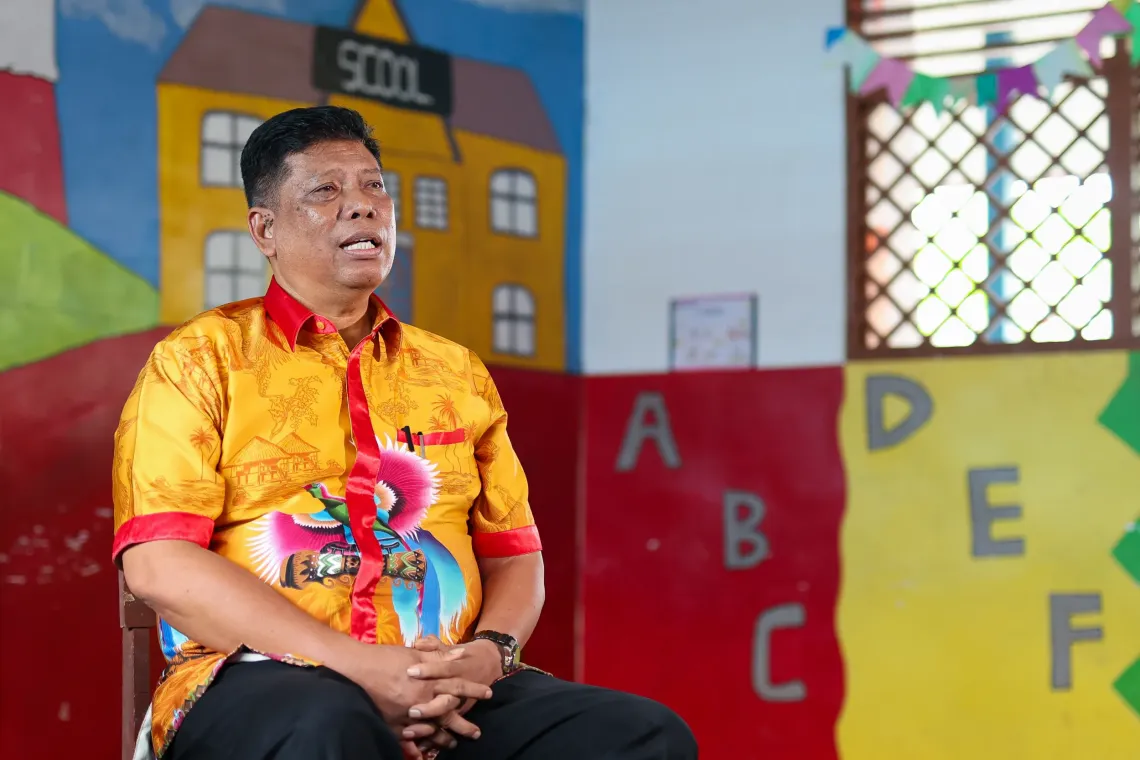
“When teachers are absent, children’s learning outcomes decline because they lose the guidance and support they need.”
Susilo explains. “Student attendance and discipline can also be affected, as children often follow the examples they see around them.”
For children, the presence of a teacher is more than a routine. It provides structure, reassurance, and continuity. In a classroom, a teacher’s presence helps children stay engaged and feel supported as they learn. When that presence is uncertain, the effects can be felt in the overall learning environment.
In Susilo’s experience, the reasons teachers stay away are rarely simple. “At our school, teachers may be absent for several reasons, particularly unresolved personal or family matters,” he explains. “Other factors include heavy teaching and administrative workloads, and the challenge of adapting to life in Asmat for teachers who have moved here from elsewhere. When I look more closely, however, a lack of motivation is often the main trigger.”
Susilo’s observations echo a UNICEF study titled “Teacher absenteeism in Papua and West Papua” published in 2024, based on qualitative research conducted in ten primary schools in Papua and West Papua provinces. Teacher absence was reported in every school visited. Some teachers were reported to have been away for extended periods; while others came to school but did not remain in the classroom to teach.
The study found that pressures on teachers often pile up: difficult transport and severe weather can make schools hard to reach; poor housing, and family or cultural responsibilities can make it difficult to stay; and training obligations or the need for extra income can draw teachers away.
The study also highlights the central role of school principals in responding to teacher absenteeism – not as isolated problem solvers, but as the people who connect teachers, education authorities and communities. This shared responsibility is especially important in Asmat, where one school supervisor (Pengawas Sekolah) is responsible for dozens of schools. In practice, it falls to principals to respond first, with the backing of communities and local education authorities.
Understanding these realities, Susilo believes that the school needs to open collaboration with communities and invite multiple stakeholders to school meetings to discuss several agendas, including teacher absenteeism.
For him, the solution does not stop at policy and regulation. It needs follow-through from the school itself, which must act as a support system and safety net for every teacher. “The first step is to approach the teacher directly, or through a colleague, and offer support,” he says. “Furthermore, every Saturday, with the teachers’ agreement, we also hold an informal session called SADIS, or Saturday Discussion.
We use it to talk about issues such as teacher absenteeism, enjoyable learning methods, and activities that can bring greater energy to the school. If the issue remains unresolved, we take a more holistic approach by involving village or religious leaders,” he adds. “I keep communication open with them and invite them to the school to discuss how we can support the teachers. These figures often have considerable influence within the community, including among teachers.”

Those leaders share his view that education is everyone’s business. Agats village leader Antonius Dendew shares this perspective. “My role is not only to lead the village but also to be actively involved in education,” he says. “I want every child in Syuru to have the opportunity to learn, read and build a better future.”
The aim of all this support is simple: to help teachers feel ready and motivated to teach.
Among the 30 teachers at SD Negeri Inpres Syuru are Zery and Thobias. Both have spent years helping children learn and thrive, and each have their own reasons for staying.
For Zery, the challenge and the reward lie in reaching every child.
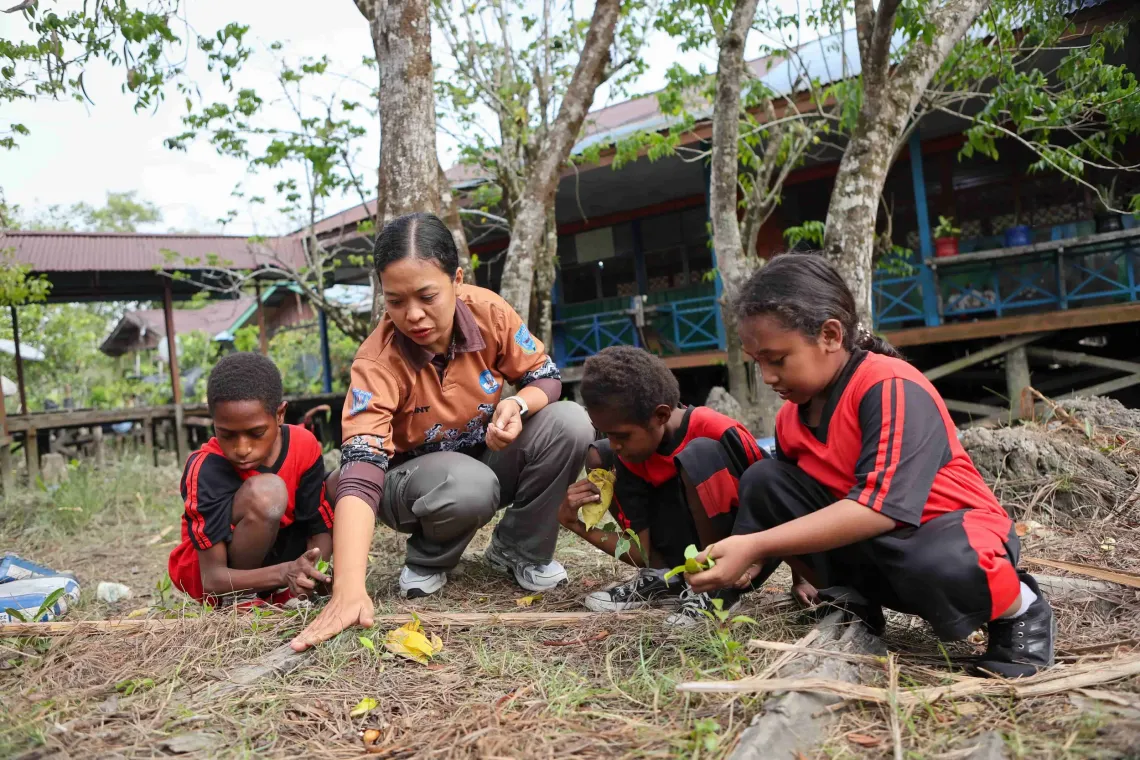
“I have been teaching for more than 20 years,” she says. "Seeing students smile as they learn something new is one of the most rewarding parts of this work. This is what makes me want to stay as a teacher.” She smiles with relief.
“Every child learns differently. Finding ways to make lessons enjoyable and meaningful is never easy, but that is also what makes teaching exciting."


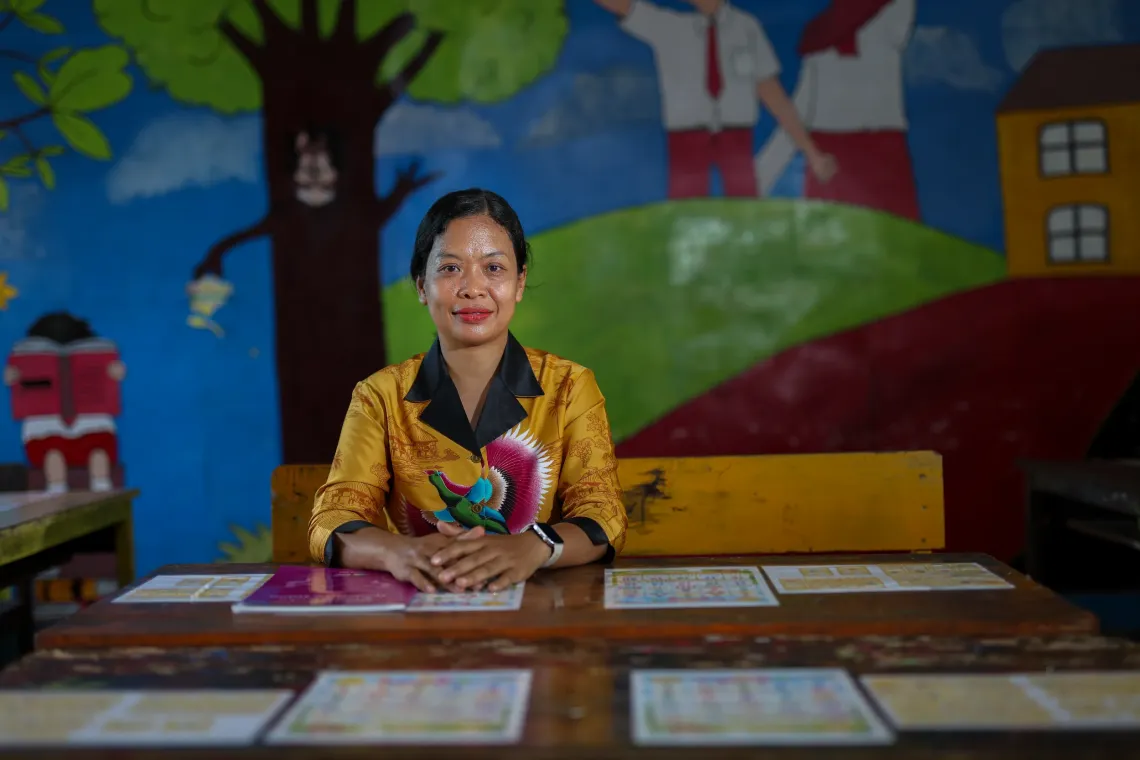


Thobias finds motivation in a passion that extends beyond classroom teaching. A traditional dancer, he shares his skills with students and helps them connect learning with culture and creative expression.
“Teaching is more than a job. It is calling,” he says. “When you truly feel that calling, responsibility comes naturally. That is why I want to stay with the children and continue supporting them.”
Their reasons for staying are their own, but neither of them does this work alone. Both say support from colleagues matters. In a remote setting such as Asmat, encouragement from fellow teachers often makes the difference between feeling isolated and feeling part of a community.






Zery and Tobias have also played a part in tackling the problem more formally, joining Susilo and community leaders in discussions that led to a school regulation on teacher absenteeism. Signed by Susilo in July 2026, it sets out clear steps for recording, responding to and following up on teacher absence, from reminders and warnings to reporting persistent absences to district officials.
The regulation grew out of a series of workshops and consultations that brought together the Asmat Regent, local government representatives, village and religious leaders, and representatives from other schools in Asmat to examine the causes of teacher absenteeism and identify practical responses. UNICEF facilitated this locally led process, with the co-facilitation support from two implementing partners: Yayasan Berkat Lestari (YBL) and Universitas Pendidikan Muhammadiyah (UNIMUDA) Sorong.
The school’s regulation is now serving as a reference and advocacy tool for a district-level regulation on teacher absenteeism, which is still being developed. Lessons from one school are then helping to shape a more consistent response to teacher absence across Asmat. This is how UNICEF works through the new phase of its Early Grade Learning programme, delivered in partnership with the Australian Government. UNICEF brings education authorities, schools and community leaders together, helps them understand why teachers are absent, and supports them to agree on solutions that work locally.

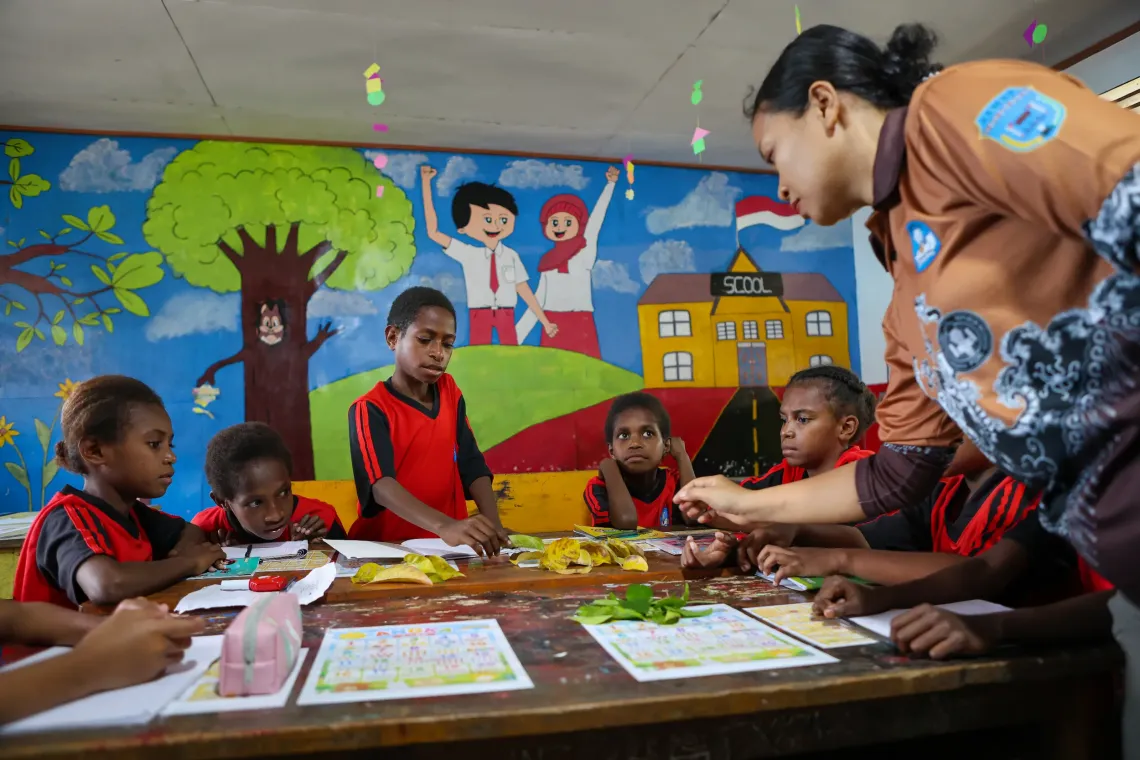
Back in the classroom, Meylani listens quietly as her teachers lead lessons and activities. Asked what she hopes for her teachers, she pauses before answering. "I hope Ibu Zery, Pak Thobias and all my teachers stay healthy, so they can always be with us."
It is a simple wish, but it captures the heart of the issue. For children like Meylani, teacher attendance is not merely a policy matter or a performance indicator. It means having trusted adults present each day to teach, encourage, and support them.
There is no single solution to teacher absenteeism. Addressing absenteeism requires an understanding of the realities teachers face, stronger systems of support around schools, and a meaningful role for communities in education.
Moving forward, UNICEF plans to continue to bring stakeholders together and advocate for government action on the structural barriers that keep teachers from teaching regularly, including a better access to schools, safety and healthcare for teachers, and basic services such as clean water and electricity.
When teachers are supported, classrooms become stronger. And when classrooms become stronger, children like Mey have a better chance to learn, grow and realise their potential.