Healthcare Workers in West Papua Give Malaria No Second Chances
Wulan’s Mission to End Malaria in the Arfak Mountains
- English
- Bahasa Indonesia
Every morning, Wulan asks herself: “Who can I help today?” As a Malaria Officer at the Hingk District Community Health Centre in Arfak Mountains, West Papua, her mission is clear – to treat those suffering from the disease and to help eliminate malaria once and for all.
Wulan has been on the frontlines of this work for a decade. When she first arrived in the Arfak Mountains in 2015, she knew the challenge ahead was immense. Papua is Indonesia’s most malaria-endemic province, accounting for 93 per cent of the country’s cases.
The fight against malaria has been long and difficult, but 2024 brought a remarkable breakthrough – the Ministry of Health officially declared Arfak Mountains malaria-free. Yet, flanked by malaria-endemic regions, the area remains vulnerable to imported cases of malaria.
Thanks to dedicated health workers like Wulan, along with robust surveillance, early diagnostics and prompt treatment, there have been only five imported malaria cases in the Arfak Mountains since the 2024 declaration.

Treating malaria patients in this remote area is no easy feat. The landscape is breathtaking, but unforgiving. Towering mountain ranges, dense forests and long winding roads make it challenging for healthcare workers to make home visits.
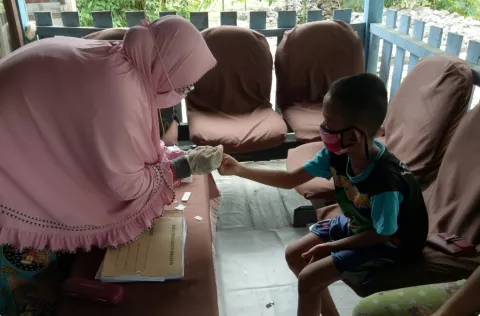
Wulan remains undaunted. Armed with a backpack full of medicine and rapid diagnostic tests, she treks on foot through rugged terrain and scorching heat, determined to reach even the most isolated villages. “The people need medical support, and I have the drive,” she says.

Afrida, a mother in the Hingk District, was recently struck by malaria, leaving her weak and immobile. Her husband was away and she struggled to take care of her two-year-old son Nino. “I could not work,” she recalls. “I was thinking who will feed my child if I am this weak?”
Afrida thought about what she had learned from Wulan about the dangers of malaria. Gathering her strength, and with young Nino by her side, Afrida walked several miles to the nearest community health centre (Puskesmas), where she was diagnosed and treated.

This is not a common choice in Afrida’s village, where “suanggi” (witchcraft) is often blamed for illness, a deep-rooted belief that prevents people from seeking medical treatment. “Many villagers think that malaria is a simple illness, despite our efforts to educate them about its dangers if left untreated,” Wulan explains.

Beyond cultural beliefs, other challenges make efforts to eliminate malaria even harder. “There have been many difficulties along the way, including insufficient capacity [of health workers], a lack of understanding on how to eliminate malaria, and the logistics to ensure the movement of health supplies from provinces to regencies,” says Edi Sunandar, Head of the Disease Prevention and Control (P2P) Section at the Health Office of West Papua Province


To support Wulan and other health workers in tackling malaria, UNICEF has partnered with the Ministry of Health and provincial governments to implement tailored interventions. These include community engagement and education led by health care workers and local leaders, distribution of bed nets, provision of immediate treatment for malaria symptoms and setting up surveillance systems for early detection and tracking of cases.
The training of health care workers in prevention strategies is another essential intervention. Through UNICEF-supported workshops, Wulan learned how to educate villagers more effectively. “When we treat patients in the villages, we also teach them [about malaria],” she explains. “We persuade them to go to the health centre as soon as they feel symptoms.”

Religious leaders have also played an important role. “Church cadres and missionaries have been very helpful,” explains Dominggus Saeba, the Regent of Arfak Mountains. “They are always ready to support whenever there are no health workers available.”
Progress is unfolding across the country, bringing Indonesia closer to its goal of eliminating malaria nationwide by 2030. With UNICEF’s support, 15 of 75 malaria-endemic districts achieved elimination status by mid-2025, including two in Tanah Papua—South Sorong and Maybrat Districts in Southwest Papua Province.
Nationally, 407 out of 514 endemic districts have now achieved malaria elimination status – a testament to the dedication of health workers, government-led initiatives, and community-driven efforts.

Wulan knows the journey isn’t over in the villages she serves. “If people do not go to the Puskesmas immediately, death is imminent,” she says. Her message to households remains simple yet urgent: malaria is preventable, curable, and must never be taken lightly.