A Nutritious Turn for the Better for Expectant Mothers in East Java
Local-Based Food Supplementation Programme Provides Meals and Nutrition Services for Malnourished Pregnant Women
- English
- Bahasa Indonesia
As the first light of dawn creeps into her home, Titis, nine months pregnant with her second child, is already busy with her sewing. A native of Kediri district in East Java, Titis fills her days with activities, despite being less mobile.
Early in the pregnancy, during a visit to the puskesmas (primary health centre), Titis discovered that her Mid-Upper Arm Circumference (MUAC) – an important indicator of nutritional status – was lower than it should be. She was diagnosed as malnourished.
Titis was fraught with worry. During her pregnancy, Titis did not have accurate information about what to include in her diet. “I was told that I should not eat fish and other nutritious foods,” she recalls.

In a neighboring village, Novi faced a different challenge. At three months pregnant, she was consuming very little. “It was difficult for her to eat,” says her husband Aji, who was deeply concerned. “I had to persuade her constantly, but often she would vomit everything.”
Novi was diagnosed with chronic energy deficiency, a condition caused by insufficient consumption of a nutritious diet that can lead to serious health problems for both pregnant women and their unborn children.

“Ensuring that mothers attend their compulsory visits has been challenging. This affects their understanding about pregnancy and nutrition.”
Across East Java, many expectant mothers have similar struggles with maternal nutrition, relying largely on inherited local knowledge – which often includes unhelpful myths – rather than routine visits for professional health care.
“Ensuring that mothers attend their compulsory visits has been challenging,” explains Farida, Midwife Coordinator at Puskesmas Pranggang in Kediri. “This affects their understanding about pregnancy and nutrition.”
During pregnancy, a woman's energy and nutrient needs increase significantly. In 2023, nearly 20 per cent of pregnant women in East Java were diagnosed with chronic energy deficiency, surpassing the national average of 16.9 per cent (Indonesia Health Survey, 2023).
Poor maternal nutrition can lead to severe complications like anemia, pre-eclampsia and even maternal and infant death. It can also result in low birth weight, developmental delays and other health issues. A balanced diet rich in essential nutrients like iodine, iron, folate, calcium and zinc is essential for pregnant women.
To address these nutritional needs and improve health outcomes for both mothers and their babies, the Ministry of Health launched the Local-Based Food Supplementation Programme in 2022. With support from UNICEF, the programme has been implemented in three districts in East Java, including Kediri, since 2024.

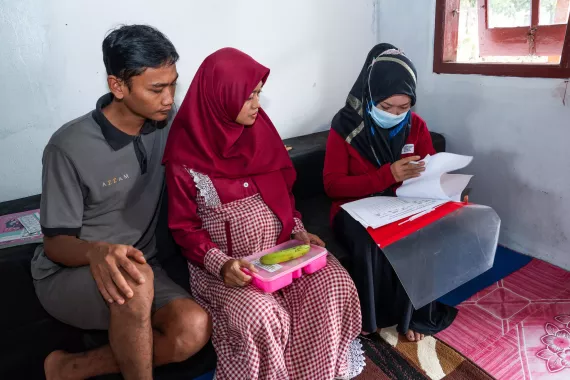


Local health workers enrolled both Titis and Novi in the programme, which delivers daily nutritious meals to the homes of malnourished pregnant women for 120 days.
The food supplementation programme ensures that all meals provided to malnourished pregnant women are prepared with mandatory fortified foods such as iodized salt, fortified edible oil and wheat flour. Some areas also use fortified rice.


The women also benefit from essential nutrition services, including iron folic acid/multiple micronutrient supplementation, Mother Support Groups and regular nutrition counselling.

“I gained new knowledge about what I should eat, and how to prepare the food I need. What’s great is that I also have new friends from the Mother Support Group,” says Titis cheerfully. “We talk about our pregnancies and support each other.”

Novi, who used to feel constant exhaustion, has improved significantly. “Now I am more nourished from what I eat, which is a balanced diet with plenty of options, combined with daily iron folic acid,” she says with a confident smile.

“The mothers are very welcoming of the programme,” says Romi, a nutritionist for Puskesmas Pranggang in Kediri. “They eagerly await our visits to deliver the food supplementation and to monitor their pregnancies. It’s heartening to see.”
The programme also provides training for healthcare workers to improve the quality of nutrition services and effectively manage the maternal food supplementation programme.
To date, the food supplementation programme has benefited more than 56,000 pregnant women across Kediri, Lumajang and Bondowoso districts. Nationally, this government-led initiative which combines food supplementation and maternal nutrition services aims to reach 4.8 million pregnant women every year, contributing to the reduction of pregnancy complications and the risk of malnutrition in newborns.

Titis and Novi are now enjoying healthier pregnancies, along with thousands of other pregnant women enrolled in the programme in East Java. “Without help from the puskesmas, we would not understand as much as we do now,” says Titis. “My advice to other pregnant women is not to be hesitant or afraid to ask the health workers questions. It is better to know than to remain in the dark – for the sake of your baby.”