Community Based Monitoring gathers voices of marginalized families in India to assess the impact of Covid-19 Pandemic
• UNICEF and Institute for Human Development (IHD), partner to analyze the data • During the first wave of the pandemic, marginalized families in rural India show better resilience to withstand impact of pandemic than those in urban India
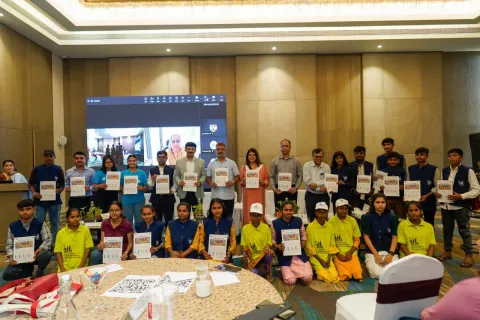
NEW DELHI, 18 October, 2021 - UNICEF India in partnership with the Indian Institute of Human Development (IHD) today launched a study titled: ‘Assessing Impact of the COVID-19 Pandemic on the Socioeconomic Situation of Vulnerable Populations – through Community Based Monitoring.’
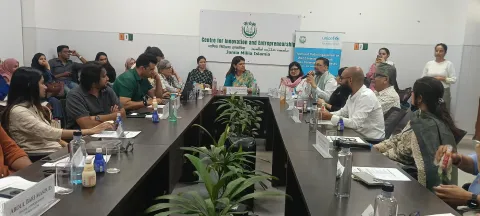
The study was launched in the presence of the UN Resident Coordinator a.i. in India, Ms. Deirdre Boyd, UNICEF India Representative Dr. Yasmin Ali Haque, Director, IHD, Professor Alakh N. Sharma and senior representatives from the government, UNICEF and IHD. It was followed by a panel discussion participated by senior representatives from the Government, academia, policy advisors, UNICEF and IHD.
The study was designed and rolled out in partnership with 13 Civil Society Organizations and its network of 300 community volunteers living in the 300 locations, where the study was conducted. The data was collected in four rounds between May and December 2020, covering 12 districts in seven states.
The study assessed the immediate social and economic costs of the pandemic, lockdown and post-lockdown challenges faced by vulnerable communities such as urban slum dwellers, rural communities and children in the country.
It brought to attention the impact on livelihoods, food availability, health, nutrition, education, and access to basic public services such as health, nutrition, and social protection schemes by vulnerable groups in 2020. Though this report is being released now, yet the lessons learnt from the study would be useful for future in handling humanitarian emergencies, especially around access to social services by the marginalized families.
Speaking at the launch of the study, Ms. Deirdre Boyd, the UN Resident Coordinator a.i., in India said, “Using Community Based Monitoring, this study provides an excellent overview on how the pandemic affected the lives and livelihoods of the most vulnerable populations, including rural communities and urban slum dwellers. We know that data driven governance based on the lived experiences of those most affected can drive real progress on national priorities and the Sustainable Development Goals.”
“The pandemic exposed the precarious situation that many marginalized groups, including the urban poor, face during humanitarian crises such as the COVID-19 pandemic,” said Dr Yasmin Ali Haque, Representative, UNICEF India.
“The CBM has proved to be an essential tool to provide rapid assessment during the acute phase, for agile programmatic response as well as to support policy decisions to reduce the current and future shocks due to widened inequalities. It also highlights the opportunity for strengthening data-ecosystems to capture humanitarian situations in the country.”
Professor Alakh N Sharma, Director, IHD said, “The pandemic containment measures exposed the livelihood-centric vulnerabilities of the urban poor in particular. The enormous scale of job losses in the urban sector coupled with social security handicaps that ensued as an immediate aftermath of the lockdown, rendered severe blows to the economically marginalized populace. The economic recovery has been rather slow for the deprived communities and call for even stronger measures to spring back to pre-lockdown levels."
Key findings from the report:
- Due to poorer quality of jobs available post pandemic, that not only pay less but are not in commensuration with the skill possessed by the worker, most families experienced a decline in wages and persistence of lower incomes, especially in rural India.
- In June-July, joblessness among the families in the cohort was 26 per cent in urban and 20 per cent in rural areas. However, it declined to pre-pandemic levels of 8-9 per cent by December 2020.
- In December, 62 per cent of those working under MGNREGS got timely wage payment, an improvement from 41 per cent in October-November 2020.
- Access to treatment for COVID-19 in August-September improved in urban areas vis-à-vis that in rural areas.
- Access to government facilities for pregnancy-related services post pandemic related lockdown, improved positively in August-September and December. In December, access to MCP/Jachcha Bachcha/ Mamta Card (December) was higher in rural areas (94 per cent) than urban (82 per cent).
- While the availability of health services for pregnant women improved yet, just around a third of the women who were aware, received maternity benefits as given under the Government scheme.
- Child immunization was adversely impacted more in urban than in rural areas. In August-September 2020, the child immunization situation improves. In December 2020, 81 per cent of rural mothers and 71 per cent urban mothers of less than one-year old child reported that they have immunized their children.
- During first wave of the pandemic, the impact of the lockdown was more severe in urban than in rural areas. Urban infrastructure for delivery of social services needs strengthening
- During the last phase of CBM data collection in December 2020, 33 per cent of the mothers of 6 to19 year old children informed they have heard or seen cases of violence against women/children in their habitation.
- 35 per cent of the main earning members reported that the hours of engagement in domestic chores by the children has increased as compared to pre-pandemic.
- In December 2020, around 68 per cent of the main earning members confirmed that their children who are engaged in domestic chores usually spend more than an hour daily on these chores.
- Community volunteers in the CBM mechanism reported about low awareness level and low access to some major social protection schemes among respondents, particularly in the urban locations.
The CBM mechanism covered seven states - Andhra Pradesh, Gujarat, Maharashtra, Rajasthan, Tamil Nadu, Telangana and Uttar Pradesh.
On an average, each round of data collection covered around 6,000 families. Rural districts were selected based on the presence of a large number of home returnees (families who migrated back home after the lockdown) and vulnerable population. Selection of urban districts were based on the existence of large slum habitations and COVID infection level.
The data were analyzed by the Institute for Human Development, in collaboration with UNICEF, and the findings were presented in the mentioned report.
About UNICEF
UNICEF works in some of the world’s toughest places, to reach the world’s most disadvantaged children. In more than 190 countries and territories, we work for every child, everywhere, to build a better world for everyone. For more information about UNICEF India and its work for children, visit www.unicef.org/india
UNICEF India relies on the support and donations from businesses and individuals to sustain and expand health, nutrition, water and sanitation, education and child protection programmes for all girls and boys in India. Support us today to help every child survive and thrive.
Visit UNICEF India on http://unicef.in
Follow us on Twitter, Facebook, Instagram and LinkedIn.
About IHD
The Institute for Human Development (IHD) is an Indian Council of Social Science Research (ICSSR) recognized category institution which is well known for its research in the areas relating to employment, livelihoods, gender, education and human development issues. The institute closely works with governments – both central and states – and has brought out several policy documents in collaboration with them. The institute has published more than 60 books and a large number of working papers. The institute has a dedicated faculty, including visiting faculty, who are well known for their research contributions. The institute publishes two peer reviewed journals – the Indian Journal of Labour Economics and Indian Journal of Human Development – which are globally circulated. The institute is a knowledge partner of NITI Aayog and a Centre of Excellence on Tribal issues declared by the Ministry of Tribal Affairs of Government of India. For more information - www.ihdindia.org
For further information, please contact:
IHD:
Prof. Tanuka Endow/[email protected]/9899468968
UNICEF:
Alka Gupta/ UNICEF India /[email protected]/7303259183
Sonia Sarkar/UNICEF India / [email protected]/ 98910170289
Media contacts
About UNICEF
UNICEF promotes the rights and wellbeing of every child, in everything we do. Together with our partners, we work in 190 countries and territories to translate that commitment into practical action, focusing special effort on reaching the most vulnerable and excluded children, to the benefit of all children, everywhere.
UNICEF India relies on the support and donations from businesses and individuals to sustain and expand health, nutrition, water and sanitation, education and child protection programmes for all girls and boys in India. Support us today to help every child survive and thrive!
For more information on UNICEF India and its work visit https://www.unicef.org/india/. Follow us on Twitter, Facebook, Instagram, Google+ and LinkedIn