What Violence Reaches First
Ali’s journey back to safety and hope
- Français
- English
“It was a Saturday,” recalls Ali* “I was walking around with my friends when a black car stopped near us. Men got out and offered us a lot of money.”
By then, Ali* had already lost almost everything.
Earlier that year, in Léogâne, violence had reached Ali’s neighborhood. During a wave of shootings, a stray bullet killed his mother. leaving him without a caregiver and acutely vulnerable to the armed groups that routinely prey on unprotected children in Haiti. “There was a lot of shooting,” Ali says. “I lost my mother to this violence. I became alone.”
A woman in the area briefly took him in, but after repeated mistreatment, he ran away and ended up on the streets.
Separated from everyone he had known, Ali found himself sleeping in the streets, trying to survive day by day. There, he met five other boys like him, all trying to survive. One day, while they were sitting near a supermarket, a vehicle stopped abruptly beside them. Men stepped out and handed out bundles of cash.
“The others rushed to get it,” Ali says. “They were very happy.”
What at first seemed like an act of generosity quickly took on a more troubling meaning. After giving them money, the same men placed weapons in the boys’ hands. Ali refused. For some children in Haiti, this is how violence enters their lives: not all at once, but through fear, exploitation and the absence of protection.

Each time they tried to lead him down that path, Ali refused.
It was not the only time. On another occasion, men showed him shoes, new clothes and money, telling him that all of it could be his if he followed the same path. Once again, they tried to draw him in, but Ali refused.
At one point, Ali fell seriously ill. With no money and in severe pain, he managed to reach a hospital, where he was treated. He later arrived at the OFAVA centre, where he found care and safety.
Children in Haiti are often forced to join armed groups to support their families, after receiving direct threats, or after being separated from those who care for them. Recruitment and use of children by armed groups is a grave violation of children’s rights and a breach of international law.
“Children’s rights are non-negotiable,” said UNICEF Executive Director Catherine Russell.
“Every child must be protected. And every child recruited or used by armed groups must be released and supported so they can heal, return to learning, and rebuild their future.”

Children associated with armed groups must not be treated as perpetrators. They are children first, children who need protection, care and a real chance to recover.
UNICEF works with the Ministry of Social Affairs and Labour (MAST), through the Haitian Institute of Social Welfare and Research (IBESR), the Ministry of National Education and Vocational Training (MENFP), the Ministry of Justice and Public Security (MJSP), civil society, UN agencies and other partners to support children affected by violence. Together, they provide psychosocial support, case management, education support, referrals to essential services, and family tracing and reunification where possible.
This work builds on the Handover Protocol signed by the Government of Haiti and the United Nations system, including UNICEF, to ensure that children associated with armed groups are quickly referred to child protection services and supported towards recovery and reintegration.
PREJEUNES, a government-led and UNICEF-supported child protection and reintegration programme, carries this commitment forward by helping children leave armed groups and protecting those at risk of recruitment through prevention, care and social reintegration.
Since this framework was put in place, UNICEF and child protection actors have verified and supported more than 500 children associated with armed groups across Haiti.
Today, Ali speaks not only of fear, but also of recovery.
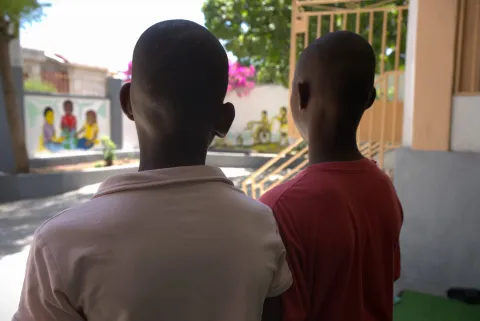
“I really like this space,” he says. “Here, I found friends to play with, and the social workers take good care of us.” “One day, I dream of becoming a pilot,” he says his eyes filled with hope for a better future.
That dream matters. It is a reminder that even after profound loss, children can heal when they are protected, supported and given the opportunity to rebuild their lives.
UNICEF continues to work alongside national authorities and communities, with the support of partners including the European Union, the United Nations Peacebuilding Fund, Canada, AECID and France, to prevent recruitment, support children affected by armed violence, and help them heal, return to learning and rebuild their future with dignity and hope.
*Name changed for protection reasons.