“When I play football, I forget everything”: Peter finds his smile again
Fleeing insecurity in Port-au-Prince, Peter found refuge in the South-East. Thanks to support from the United States, with the backing of IBESR and the assistance provided by UNICEF through Child-Friendly Spaces.
- Français
- English
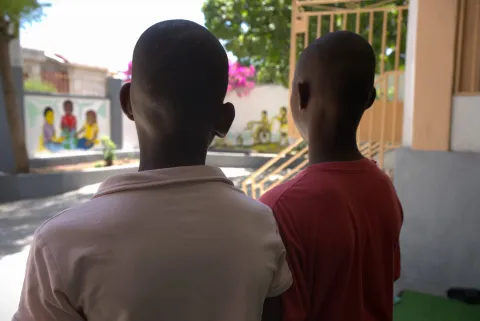
South-East, Peredo – Peter grew up in Port-au-Prince, but when armed groups moved into his neighborhood, his everyday life became unbearable. “Over there, I couldn’t go outside. We stayed locked in, always worried,” he says.
One day, he took the road to Martissan to join his aunt in the South-East. The journey was risky, but he managed to make it through. “Here in Peredo, I can walk around without any problem because here, I feel safe,” he shares with a shy smile.
A space to rebuild
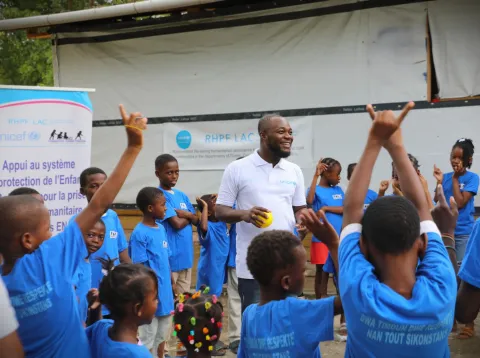
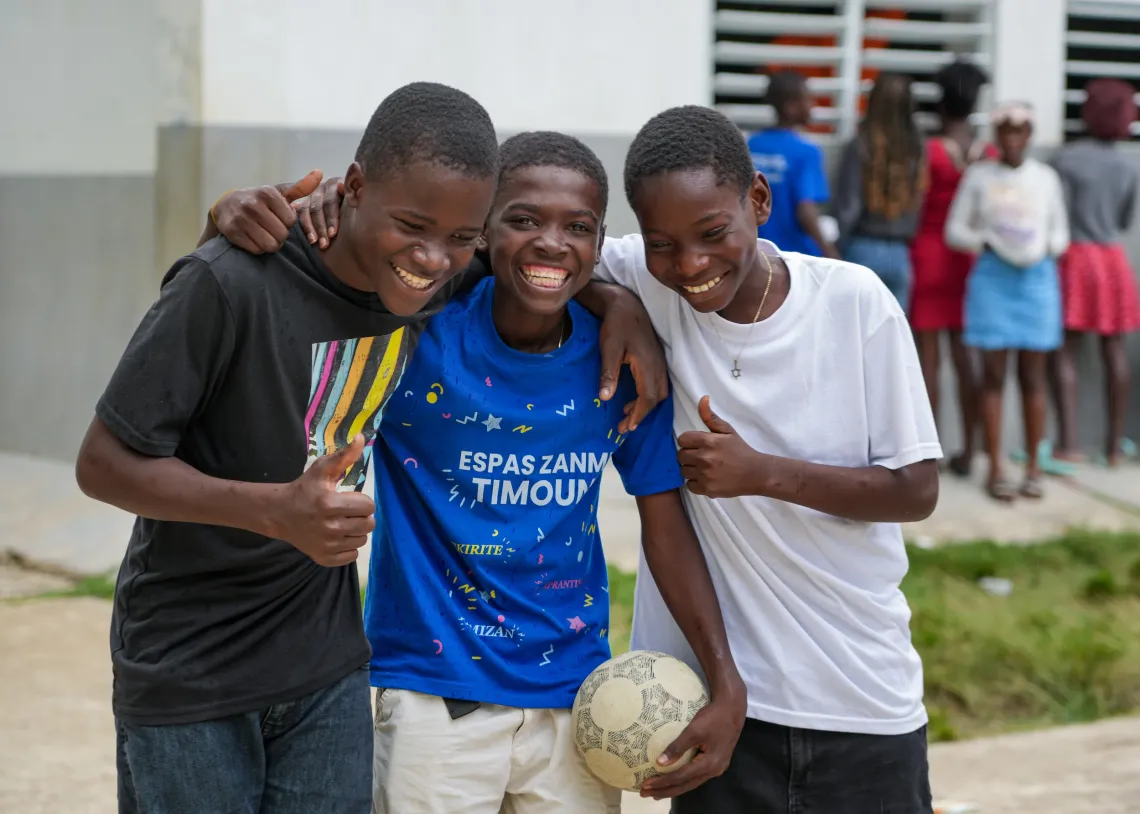
It was in Peredo that Peter discovered the Child-Friendly Space, a safe place set up by UNICEF with the support of the Government of the United States of America.
“Football is my pride. Even when I got injured, I never wanted to give up. When I play, I forget everything and I dream of representing Haiti,” he says.
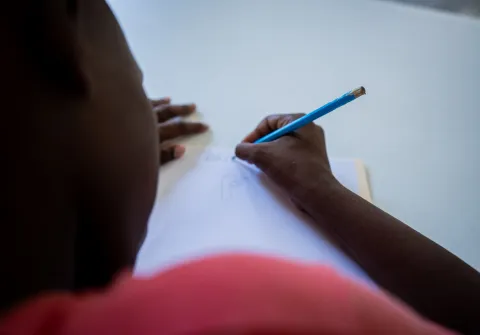
In this space, Peter does more than just kick the ball. He takes part in group activities, learns to make simple crafts, explores drawing, and shares playtime with other displaced children. But for him, nothing compares to football:
“My dream is to become a great player to help my family. When I score a goal, I can already see myself among the top players,” he explains.

Safe spaces for thousands of children
Like Peter, many displaced children find an essential refuge in the South-East. In 2025, six Child-Friendly Spaces welcomed over 3,640 children. More than half were displaced, some coming from Port-au-Prince, the South, or from families deported from the Dominican Republic.
These spaces offer much more than a place to play. They provide psychosocial support and organize awareness activities to protect children from abuse, neglect, and exploitation. More than 11,380 people, both children and adults, benefited from these services across the three communes.
At the same time, 512 vulnerable children received personalized support, including psychosocial assistance, referrals to health services, school reintegration, and cash assistance for 450 children to support their families and reduce risks.
Thanks to the partnership with the Institute of Social Welfare and Research (IBESR) and Plan International, 450 children (214 girls and 236 boys) were able to obtain a birth certificate free of charge. For many, this represents not just an official document, but also a source of confidence and the pride of feeling fully recognized as Haitian children.

Today, Peter is regaining confidence and nurturing big dreams. On the field, every match reminds him that a future is possible, despite the challenges. Like him, thousands of other displaced children find safety, support, and hope in the Child-Friendly Spaces. With the support of the Government of the United States of America, and in collaboration with IBESR, UNICEF and its partners continue to provide these safe spaces where children can rebuild their lives.