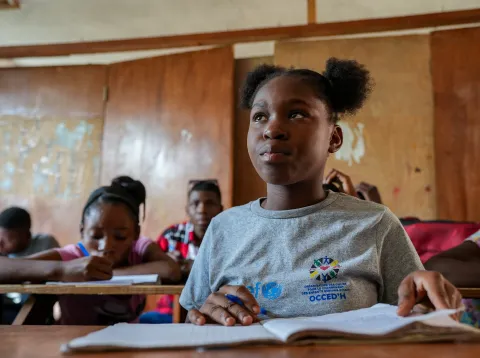
Seeking safety and education at Camp-Perrin.
Fleeing the violence in the Port-au-Prince metropolitan area, families are seeking refuge with their relatives in various parts of the country.

- Français
- English
Camp-Perrin, Haiti, 17 September 2023 – In a calm voice tinged with fear at the idea of sharing his story again, 15-year-old Mérélus P. takes the floor. "Criminals have invaded our neighborhood in Carrefour-Feuilles. They terrorized us and took the lives of many people. I witnessed these horrors with my own eyes. These crime scenes deeply disturbed me. For my health and safety, we were forced to leave the area."
The resurgence of violence in the Port-au-Prince metropolitan area has led to a new wave of displacement in recent weeks. Families have been separated, and children have been left without their parents. Some of them, having families in other departments, are considering returning to join them.
Judith Remarais, a 33-year-old nurse working at Immaculate Conception Hospital in Les Cayes, has opened her home to four children and soon a fifth. Although she does not yet have biological children, Judith feels a deep connection with these children. Together with her mother, who is a shopkeeper, they work hard to give them as normal a life as possible.
"These children are from my family. To get them to Camp-Perrin, we borrowed money to cover their transportation costs. We do not know how we will pay off this debt, but we had to save their lives," Judith said.
The new school year officially launched on 11 September in Doudoune, Grand'Anse, is proving to be difficult in the metropolitan region and within the families who welcome displaced children. These families do not have sufficient financial resources to send children to school. "Of the four children from Carrefour-Feuilles, only two are already in school. We do not yet have the means to buy the necessary school materials for the other two. Often, they accompany my mother when she sells items on the street. It is not easy for them," Judith says sadly.

This situation is equally desperate for children whose hope of achieving their dreams is dwindling by the day.
"I was enrolled at St. John's Mixed School in Camp-Perrin. Due to a lack of financial resources and school materials, I have not yet had the chance to attend. It hurts. For now, my only wish is to go back to school," says Emmanuela timidly.
UNICEF, with Canada's support, has launched a cash transfer project in the southern of Haiti to enable vulnerable parents to have the means to send their children to school.
"Despite our financial problems, I am determined to send all children to school because this is where they learn the skills they need to succeed in life," concludes Judith.
The massive movement of families leaving Port-au-Prince to seek refuge in other departments is aggravating the pre-existing humanitarian situation in the country. Haiti now has more than 200,000 internally displaced people, 130,000 of whom are concentrated in Port-au-Prince. It is imperative not to abandon these children and their families, who also need help to cope with life's challenges.

UNICEF needs to mobilize nearly 246 million US dollars to provide assistance to children and families affected by humanitarian emergencies. To date, less than 20 per cent of these resources have been mobilized.