One in five children suffers from acute malnutrition in Cité Soleil
8,000 children under five are at risk of due to combined threat of severe wasting and cholera

- Français
- English
PORT-AU-PRINCE, 14 OCTOBER 2022 – The 27-year-old mother Vatilde Lynda is a relieved. Lately, she has noticed that her little Colas Darlens is gaining weight.
“Thanks to these foods, my baby no longer suffers from acute malnutrition. I started giving him Plumpy'Nut and his weight started increasing. I am very happy and satisfied with the results of my child,” she said.
Plumpy'Nut is a ready-to-use therapeutic food (RUTF) used to treat severe acute malnutrition in young children. Before the burden was lifted from her, the mother of three suffered in silence.
“My husband has been ill for a few months and he is in the provinces. I am all alone with the children, which has caused my baby Colas Darlens to lose a lot of weight”.
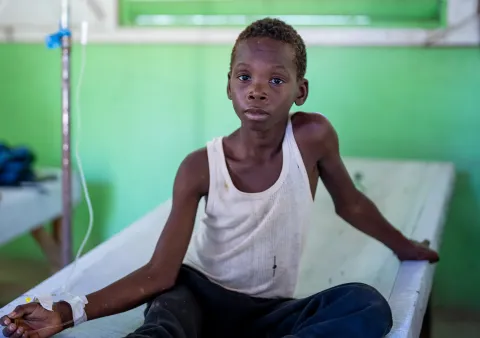
Nearly 100,000 children under the age of five who are already suffering from severe acute malnutrition -also known as severe wasting - are especially vulnerable to the ongoing cholera outbreak affecting Haiti.
At a time when much of the country is facing growing food insecurity, acutely malnourished children have weakened immune systems and they are at least three times more likely to die if they contract cholera, further reinforcing the need for urgent action to contain the disease. Since cholera was first reported on 2 October 2022, there have been 357 suspected cases with more than half of these in children under the age of 14. Children aged between one and four years are at the greatest risk.

Vatilde's baby suffers from malnutrition, which affects one in five children in Cité Soleil, a municipality of a quarter million inhabitants. A nutrition assessment conducted in April in Cité Soleil revealed critical levels of malnutrition, with one in five children under 5 years of age suffering from wasting. Chronic malnutrition, or stunting, is also a major problem in Haiti, affecting nearly one in four children. From July to October 2022, the support provided by UNICEF and partners in Cité Soleil has enabled to screen 3,155 children under five and provide quality care to 1,180 children with wasting.

With gang violence and insecurity that has plagued Cité Soleil for several years, families do not have access to quality food, good infant and young child feeding practices, basic health, hygiene and sanitation services. Food becomes scarce as households have got increasingly poor.
“One of the major problems in the neighborhood is when there are shootings, we can't go out and the children can't eat properly. Almost all the children in the area fall into malnutrition,” explained Vatilde.
Despite her own will, Vatilde has lived in Cité Soleil for the past 18 years. “I was 9 years old when I moved to this neighborhood. I turned 27 last January. This neighborhood used to be a garbage dump, but we have nowhere else to go. This is where we have found shelter, so we decided to stay there,” she resigned herself. Hygiene and sanitation are not optimal, vaccination coverage is low and children are not immune to infectious diseases.

Haiti is the country in the northern hemisphere with the lowest vaccination rate. Only four of the country's 10 departments have reached the protective coverage rate of at least 80% per antigen. The lowest rates are observed in the Center and South-East where only one child in three is fully vaccinated and in the West where one child in two is.
In the Metropolitan Area of Port-au-Prince, 15% of health institutions are closed or dysfunctional, and with the prevailing insecurity, the attendance of those still functional would have dropped by 71.2%. In Cité Soleil, humanitarian organizations such as Médecins sans frontières (MSF) provide 62% of the population with the health services they need. Only 4% of the population go to public health intuitions.
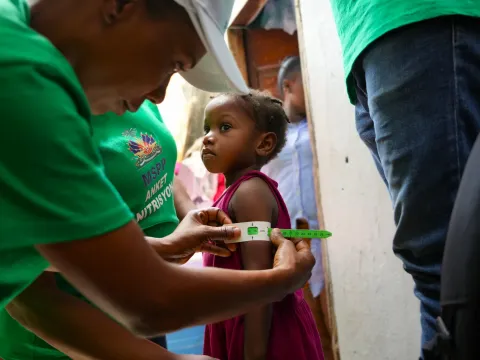
To contain malnutrition during this cholera upsurge, UNICEF, the Ministry of health and partners have launched active screening to identify wasting among 40,000 children under five, timely referral of wasting cases to UNICEF-supported mobile clinics or to nearest health facilities as well as provision of quality care to 8,000 children under five with wasting.
“Today, we wage a fierce war against malnutrition and cholera, two deadly threats that put children’s lives at risks,” added Maes. “Time is against us, as cholera spreads rapidly and there is a risk of the outbreak growing out of control.”

UNICEF has also made available to partners ready-to-use therapeutic food, therapeutic milk (F-75, F-100) and other supplies for treatment of wasting and strengthened treatment capacity and adequate hospitalization capacity. UNICEF also works with community health workers (ASCP) to promote infant and young child feeding practices as well teach households how to stop the transmission of cholera in the community.
“A big thank you for this program which helps me with my baby although his father is not present with us. I give him what I have, and I accompany him with Plumpy'Nut, which makes his weight increase,” said Vatilde.
UNICEF has made a preliminary appeal for cholera-specific response of US$ 22 million. So far, this appeal is un-funded.