"Violence against children: Social Workers in Health Break the Silence"
Social workers in health services in Guinea- Bissau identify and help report cases of violence against children and woman.

- English
- Portuguese
That morning, the young mother was visibly distraught as she sat beside the bed of her son in the Regional Hospital of Bafata, Guinea Bissau. Her newborn, just two days old, was battling neonatal sepsis, a lifethreatening infection in the bloodstream, and she had no means to afford the necessary medical care. Just as despair sank in, Sana Fati, a 45-year-old social work assistant, started his rounds in the busy hospital wards to speak to new patients. He was able to relieve part of her suffering.
“Health services need to have a social assistant because of the general population's economic difficulties,” explains Sana. In Guinea-Bissau, 69% of the population lives below the poverty line, and 33% of them in extreme poverty. As a social worker in the largest hospital in Bafata, on the eastern side of Guinea Bissau, he provides patients with information about which services they can access for free and how to do so when justified. He also acts as an advocate for patients. “In other words, social work assistants help patients understand their health rights,” he summarizes.
The project, “Strengthening social cohesion through promoting inclusive and effective public health sector governance, management, and administration”, implemented by UNICEF World Health Organization (WHO), and Interpeace/voz di Paz, with funding from the United Nations Peacebuilding Fund, recognizes that social workers in health services are essential to promote access to impartial and inclusive quality health services. As so, it has invested in capacity-building activities, including in mental health and psychosocial support to children’s victims of violence and abuse and GBV, and system strengthening of the health sector.
“I like being a social worker and I do it with love. I chose this profession because I'm a natural helper”, says Madi Gassi, 38, a social worker at the Regional Hospital of Gabu, in the eastern part of the country. Unfortunately, in this line of service, it is common for him to come across children in suffering. “We receive several cases of violence against children, and the most frequent are cases of sexual abuse”, he comments. “It's quite frequent here, and the victims are always girls”, he adds.
When spotting a case of violence, health social workers can provide “support to cover the cost of medical services and even assistance to cover food costs”, if the family can't afford the costs, Sana explains. The essential aspect is the “psychosocial support for the victim and the advice for the family on how to support the victim”, he continues.
Even after leaving the hospital, “we try to make home visits to monitor the child's situation”, says Madi, explaining that “a child who suffers violence is emotionally affected and the family is also in shock”. This year, the project delivered one car and three motorbikes to the Ministry of Health to support social services in responding effectively to psychosocial and mental health care for women and children who are victims of violence.
In this small West African undeveloped country health is constantly underfunded and quality health services are rarely available. To support the vulnerable population, Guinea Bissau has 52 social work assistants serving the regional and local hospitals and smaller health facilities, but 16 of them are in the capital, Bissau. The project also delivered tablets and computer equipment to support the good functioning of these services, including strengthening the information management on child rights violations and GBV.
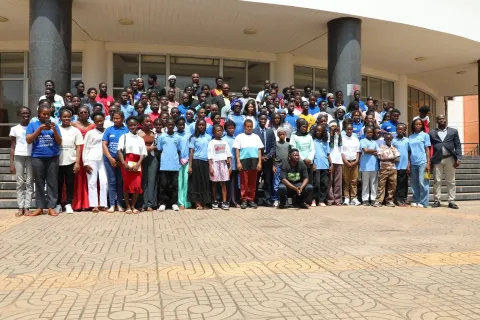
“Now, I have a different perspective on violence”, says Inacia Ventura, 37, who recently started working at the Regional Hospital of Tombali, the southern area of the country. She is participating in a training for social workers in health services on how to identify and refer violence against children and how to report it on Kobo Collect, a digital platform managed by the Ministry of Woman Family and Social Solidarity (Woman and Child Institute). The trainings were held all over the country for social work assistants in health, with positive feedback from these professionals. “I'm going to change the way I work and practice what I've learned’”, continues Inacia.


At the training, Ussumane Embalo, 39, trainer and coordinator of the information management system on violence against children in the Woman and Child Institute, starts by emphasizing the importance of always respecting the dignity of victims. He moves on to explain in detail the types of violence against children and what is expected from social assistants. Child marriage, Female Genital Mutilation, human trafficking, neglect, psychological violence, and sexual abuse and exploitation are some of the practices discussed. At this point, Inacia admits that she did not know that some of these practices were a crime.

In the last part of the training, social assistants learn how to use the Kobo Collect, a tool created to improve the collection of data on violence, abuse, exploitation, and neglect against children in Guinea-Bissau. The digital platform “has helped us understand the dynamics of violations of children's rights through statistical data,” says Ussumane, from the Woman and Child Institute.
The Institute for Women and Children aims to produce quality, reliable data on violence trends to influence national policies, inform decision-makers, and stimulate public debate. For that, the input of social workers in the health system is invaluable, as they often become aware of cases of violence against children that might otherwise go unreported. With the support of the project and thanks to the training, the number of social workers reporting and referring cases of violence against children increased from 6 to 28. The objective is to reach a higher number of incident reporting and case management by the end of 2024.

For Inacia, the sensitization of doctors, nurses, and all health workers is crucial to tackle the violence against children and increase reporting. “We need to explain to adults how children should be treated because people don't realize that children have rights”, she says.
Still in the pediatric ward, Sana is currently asking mothers if they need any assistance. He takes this opportunity to ask them about their children's birth registration status. After discussing with the doctor, he promises to find a way to help the young mother and her newborn boy.