Rescued: Collaborating to save trafficked and abused children
Authorities and institutions in Guinea-Bissau are engaged to respond and collect data on violence against children with United Nations agencies' support through the Peacebuilding Fund

- English
- Portuguese
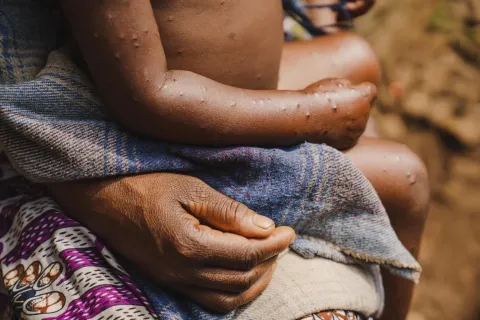
“He was not like this when he left,” says Bubacar Balde, his voice trembling with anger as he points to the scars on his son's face, arms, and hands. "He came back with nothing but torn clothes and worn-out sneakers," the father adds, his frustration evident. At eight years old, Abulai Balde left his home in Pitche, in Guinea-Bissau’s Gabu region, to study at a Koranic school in Dakar, Senegal. Instead, unbeknownst to his parents, the child was subjected to abuse and forced to beg on the streets for three years. This talibé child, as koranic students are usually named in the region, became a victim of human trafficking justified by religious purposes.
It was only when Abulai escaped from his koranic master who was exploiting him that his parents realized something was terribly wrong. On that fateful day, he ran away after being brutally punished for not making enough money begging on the streets. “They tied him up in a sack and beat him,” his father recounts, with anger. Fortunately, a neighbor helped Abulai escape and brought him to a children’s shelter in Dakar.
Returning the boy from the shelter to his parents required a coordinated effort from various agents on both sides of the border. The process began with the Associação Amigos da Criança (AMIC, Friends of Children Association), which located the boy’s family in a remote, hard-to-reach village in rural Gabu. Right after this, the Women and Child Institute, overseen by the Ministry of Women, Family, and Social Solidarity, stepped in.

“Our intervention was to receive him at the border, as we work in collaboration with Senegal's National Direction for Child Protection,” explains Ussumane Embalo, the Coordinator of the Committee on the Prevention of Human Trafficking at the Women and Child Institute. “Once AMIC identified the families, we sent the information to Senegal and proposed a return date for the child. Our partners ensured the logistics,” he adds.
The partners include UNICEF, the Office of the High Commissioner for Human Rights (OHCHR), and the United Nations Development Programme (UNDP). They have been supporting the Government under the project “Enhancing the Human Rights Protection System in Guinea-Bissau,” funded by the United Nations Peacebuilding Fund. One of the project's goals is to enhance coordination among various actors and create a multidisciplinary response to better protect children from all forms of violence.
Upon returning to Guinea-Bissau, Abulai spent a few days at AMIC’s shelter in Gabu. There, children receive medical attention and psychological support before returning home for good. During this period, AMIC workers gather data on the children and their trafficking cases, entering it into Kobo Collect—a digital platform designed to enhance data collection on violence, abuse, exploitation, and neglect against children. “The platform has made it easier for different institutions managing cases of violence against children to collaborate by creating a space for exchange between different stakeholders,” explains Ussumane. Managed by the Woman and Child Institute, Kobo Collect “has helped us understand the dynamics of violations of children's rights through statistical data,” he adds.
At AMIC’s shelter, Abulai Balde met Amadu Djamanca, another 11-year-old boy from the Gabu region, who had also been rescued from a human trafficking situation in Dakar. Amadu was sent to Senegal by his family when he was six years old, to proceed with religious studies. For five years, he also endured the hardships imposed by his koranic masters until he managed to escape. During his time in Senegal, Amadu was forced to work and beg on the streets and never had the opportunity to attend school. Now, at 11 years old, he cannot read or write, not even his own name, just like Abulai.

As Ussumane explains, it is common for Bissau-Guinean families in the eastern region to send children to Senegal to study in Koranic schools. Unfortunately, they often do so clandestinely, crossing the border illegally, leaving no traceable records, and exposing the children to vulnerability and abuse. Raw data from the Woman and Child Institute, collected during the last 18 months, shows that about half of the reports of violence against children are cases of human trafficking of young boys.
For Abulai Djamanca, Amadu's father, it was a dream to have a son study the Quran in Senegal, as he had started to do so himself but couldn't finish due to health reasons. He couldn't imagine the suffering his son was going through. “When we called to talk to him, his koranic master forced him to say that everything was fine,” says the father.
Since child protection information management system (IMS) became available in the country in 2022, with the technical support of UNICEF, UNDP, and OHCHR through the Peacebuilding Fund, the Woman and Child Institute can now generate quality and reliable data and information about violence trends, to influence national policies and decision-makers, and spark public debates.
Just like AMIC, other key players have access to the platform, including health and police authorities, NGOs, and the Center for Access to Justice (CAJ). Amadu Uri, head of the Gender and Human Rights office of the Public Order Police (POP) in the Gabu region, uses the platform to register all cases involving minors. “The most frequent cases are sexual abuse, physical domestic violence, and child marriage,” he states.
Thanks to the project, the police authorities now have a strong relationship with the health authorities to support the victims. “If a child appears to be the victim of physical aggression or sexual abuse, we issue a medical request to the hospital for treatment. Once they return with the medical report, we investigate and pursue the suspect, sending them to the public prosecutor's office,” explains Officer Amadu Uri.
This was a crucial step in Aissatu's case. After the family filed a rape complaint, the medical report confirmed that the 12-year-old girl was seven months pregnant. Faced with the evidence, the perpetrator, a 36-year-old relative and neighbor, was compelled to confess to the crime in front of the family and the police. Officer Amadu presented the abuser to the public prosecutor.
According to Ussumane from the Woman and Child Institute, “cases of violence against children have increased due to awareness-raising campaigns”. He believes these campaigns help people feel involved in the mission to protect children. “Actors from different institutions are now aware that when they encounter a case of violence against children, they must report it,” he adds.
Amadu barely speaks and often hides his face, except when he's playing football or talking about his football idol: Kylian Mbappé. Abulai, on the other side, has told his parents all the abuse he suffered in Dakar and has no difficulty expressing himself. Both boys were reunited with their families back home in March 2024 and look forward to start going to school, in a few months.